
OPSCOM Parking & Security Operations Platform
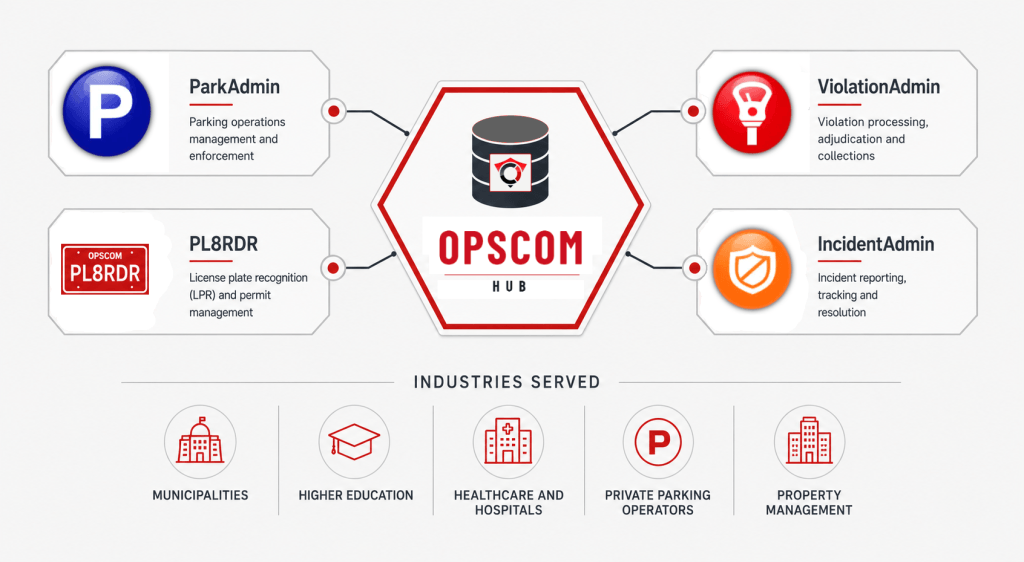
One Platform. One Database. Total Control.
OperationsCommander (OPSCOM) is a unified parking and security operations platform. It connects permit management, parking enforcement, license plate recognition, incident management, dispatch workflows, payments, appeals, analytics, and operational reporting in one cloud-based system — on one shared database.
That last part matters more than any feature list. When permits, enforcement, LPR, and security all share the same database, the operational gaps that disconnected systems create simply don’t exist. A permit purchased at 8:45am is visible to an enforcement officer at 9:00am. A vehicle scanned during a routine parking patrol triggers a security watchlist alert in real time. An incident investigation has immediate access to the vehicle’s full parking history without a data request to another department.
OPSCOM is built for municipalities, universities, healthcare campuses, airports, private parking operators, mixed-use developments, and security-focused organizations that need parking and security to work as one operation — not as two departments using separate tools.
Proven outcomes from connected operations
The value of a connected platform shows up in measurable ways across OPSCOM’s client library.
- 91% ticket collection rate in Year 1 — Town of Perth, Ontario, after connecting enforcement, permit validation, and online payment in one system. Read the Town of Perth case study.
- 37% annual budget savings — Cambrian College, after replacing manual permit and enforcement processes with OPSCOM’s connected self-service platform. Read the Cambrian College case study.
- “Met 100% of our needs” — Chris Jones, CIO, Taylor University, after replacing a legacy system with OPSCOM integrated with Banner and SSO. Read the Taylor University case study.
- Capital infrastructure decision informed by data — a large US healthcare organization used OPSCOM utilization data to justify and design a parking garage expansion with confidence.
The four modules that make up the OPSCOM platform
OPSCOM is built around four connected modules. Each delivers standalone value. Together they create a unified operational environment where data flows automatically across every workflow.

ParkAdmin — Parking Management
ParkAdmin manages the complete permit lifecycle for every user type your operation serves — students, staff, residents, visitors, contractors, and more. Virtual permits tied to license plates replace physical hangtags. Self-service workflows give parkers online access to permits, payments, and account management without office visits. Waitlist automation, temporary parking tools, the Validator for tenant and departmental access, and third-party parking app integration all connect through one permit database.
Cambrian College achieved 37% annual budget savings with ParkAdmin. Taylor University’s CIO described it as meeting “100% of our needs.” Brandon University used ParkAdmin’s analytics to identify and address an unexplained revenue decline their previous system couldn’t even make visible.

ViolationAdmin — Parking Enforcement
ViolationAdmin connects every stage of the enforcement lifecycle in one workflow. Officers use any device — iOS or Android — to validate permits in real time, issue citations with automatic evidence capture, and share digital chalking records across shifts. Online violation payment and appeals mean parkers resolve citations without office visits. For Ontario municipalities, ViolationAdmin supports the complete Provincial Offences Act workflow including automated NIC generation, MTO vehicle owner lookup, and court-ready documentation.
The Town of Perth achieved a 91% ticket collection rate in Year 1. Anderson University unified enforcement across 30+ lots with real-time field data. The Village at Valley Forge made towing decisions defensible by building evidence capture into every citation.

PL8RDR — License Plate Recognition
PL8RDR supports three deployment modes — handheld, vehicle-mounted, and fixed cameras — all validating against the same live database as permits, enforcement, and security. Every plate read is checked instantly against permit status, violation history, digital chalking records, and security watchlists. Vehicle-mounted LPR enables drive-by validation across entire parking areas at driving speed. Fixed cameras support gateless parking workflows, continuous entry/exit monitoring, and 24/7 security coverage without patrol staffing.
Forks North Portage uses vehicle-mounted PL8RDR across 20+ downtown lots. Fleming College’s Systems Administrator described the read accuracy improvement as “a major improvement — significantly improved range of read angles and distance.”

IncidentAdmin — Incident and Security Management
IncidentAdmin connects security incident reporting, dispatch coordination, investigations, watchlists, evidence tracking, and Clery Act compliance workflows to the same database as parking permits, enforcement, and LPR. When a vehicle is added to a watchlist, every subsequent plate scan during parking patrol triggers an automatic alert to the officer’s device. When an investigation involves a vehicle, its full parking and enforcement history is immediately accessible within the case file.
Brian Billings, Director of Campus Safety Services at Carleton University: “As the Director of University Safety, I needed a solution I could access from anywhere. OperationsCommander delivered.” Saint Mary’s University replaced four separate systems — parking, enforcement, incidents, and locker management — with one connected OPSCOM platform.
Start with one module. Scale with all four.
OPSCOM’s modular architecture means organizations don’t need to implement everything at once. A municipality might start with ViolationAdmin for enforcement. A university might start with ParkAdmin for permit management. A property manager might start with just the Validator for tenant parking validation.
Each module delivers immediate operational value on its own. When additional modules are added, they connect automatically through the shared database — no re-implementation, no data migration, no rebuilding of existing workflows. The operational value compounds as the platform expands.
Organizations in OPSCOM’s client library range from Canadian Mennonite University with two parking lots and approximately 100 spaces, to Carleton University with 9,000+ active permits and 12,000+ annual violations — running the same platform configured differently for each scale and context.
Self-service that reduces workload at every level
Every OPSCOM module includes self-service tools that shift routine transactions from staff to the people they serve — reducing counter visits, phone calls, and manual processing without reducing service quality.
- Parkers purchase permits, register vehicles, pay violations, and submit appeals online at any time from any device
- Commercial tenants and departments validate visitor parking directly through the Validator without involving the parking office
- Third-party parking app payments are ingested into OPSCOM so all activity flows into one system of record regardless of payment method
- Automated renewal reminders reduce the administrative effort of annual permit cycles
- Student financial account holds for unpaid violations processed automatically through Banner and PeopleSoft integration
Integrations that connect OPSCOM to your existing systems
OPSCOM connects with the systems your organization already uses — reducing manual data entry, improving accuracy, and eliminating the reconciliation work that fragmented systems create.
- Student and staff information systems — Banner, PeopleSoft, and similar platforms
- Single Sign-On (SSO) — campus credentials used for parking services access
- Payment gateways — TouchNet, Moneris, and other PCI-compliant payment processors
- Financial systems — custom export formats for Asyst and other municipal and institutional accounting platforms
- LPR hardware — camera systems and enforcement devices connected to permit validation workflows
- Third-party parking apps — payment data ingested into OPSCOM as the system of record
- Access control systems — gate and barrier integration for controlled parking environments
Explore by industry
OPSCOM is configured differently depending on the operational environment. Each industry page explains how the platform is deployed for that specific context — including relevant client case studies, module configurations, and integration requirements.
- Higher Education — virtual permits, SSO integration, Banner and PeopleSoft connectivity, campus zone management, Clery compliance, and connected security workflows
- Municipal — POA-compliant enforcement, NIC automation, MTO integration, ARIS court support, resident permit programs, and downtown parking management
- Healthcare — staff, patient, and visitor permit programs, multi-facility management, gateless entry monitoring, and security-connected vehicle tracking
- Property Management — resident and tenant permits, the Validator for commercial tenant validation, towing-defensible evidence capture, and multi-property portfolio management
- Smaller Operations — professional parking management at a price and scale that works for private operators, smaller campuses, and towing and security companies
Frequently Asked Questions
What is OperationsCommander (OPSCOM)?
OperationsCommander (OPSCOM) is a unified cloud-based platform for parking and security operations. It connects permit management, parking enforcement, license plate recognition, incident management, dispatch workflows, payments, appeals, analytics, and operational reporting in one system. All modules share a single database — so data flows automatically across every workflow without manual exports or reconciliation between systems.
What makes OPSCOM different from other parking management systems?
The primary difference is architecture. Most parking software consists of separate tools — a permit system, an enforcement app, a payment portal — that are loosely integrated through scheduled exports or API connections. OPSCOM is built on a single shared database. Permit data, enforcement activity, LPR reads, payment records, and security incidents all exist in the same system and update in real time. That architectural difference produces outcomes that separate tools can’t match — including the Town of Perth’s 91% ticket collection rate and Cambrian College’s 37% budget savings.
Can organizations implement one module at a time?
Yes. OPSCOM’s modular architecture supports starting with one module and adding others as operational needs evolve. Each module delivers standalone value and connects automatically to others through the shared database when added — no re-implementation or data migration required.
What types of organizations use OPSCOM?
OPSCOM is used by universities and colleges, municipalities, healthcare campuses, airports, mixed-use developments, commercial properties, private parking operators, towing companies, and security-focused organizations across North America. The platform scales from smaller operations managing a few hundred permits to large campuses managing thousands of permits and violations annually.
Does OPSCOM support Ontario’s Provincial Offences Act?
Yes. ViolationAdmin supports the complete POA enforcement lifecycle — court-ready documentation, automated NIC generation, Ministry of Transportation vehicle owner lookup, and ARIS court process support. This is built into the platform rather than requiring custom configuration.
Does OPSCOM work on iOS and Android?
Yes. OPSCOM’s enforcement and field tools work on any device — iOS or Android — including handheld smartphones, tablets, and dedicated enforcement devices. There is no requirement to standardize on a specific hardware platform.
What integrations does OPSCOM support?
OPSCOM integrates with student and staff information systems including Banner and PeopleSoft, Single Sign-On providers, payment gateways including TouchNet and Moneris, financial systems including Asyst, LPR hardware and camera systems, third-party parking payment apps, and access control systems. Custom export formats are available for organizations with specific financial or compliance reporting requirements.
Is OPSCOM a cloud-based platform?
Yes. OPSCOM is a hosted cloud platform. Organizations access the system through a web browser without managing on-premise infrastructure. The platform receives continuous updates and improvements without requiring IT involvement or upgrade projects.
What security and compliance certifications does OPSCOM hold?
OPSCOM is currently pursuing SOC 2 Type 2 certification. Our security posture, controls, and compliance documentation are available through our Trust Center, powered by Drata. For organizations with specific compliance requirements, contact us to discuss your needs directly.
Ready to see the platform in action?
Every organization in OPSCOM’s client library started with the same question: is there a better way to manage this? The answer was consistently yes — and the impact shows up in collection rates, budget savings, reduced staff workload, and security operations that finally have the visibility they need.
Or explore the client library to see what connected operations look like in practice:
