License Plate Recognition (LPR): How It Works in Modern Parking Enforcement
License plate recognition has been a part of parking enforcement long enough that most operations have at least considered it. But “LPR” covers a wide range of implementations — from a smartphone app that reads plates manually to a vehicle-mounted multi-camera system that validates hundreds of vehicles per hour — and the difference between a useful LPR deployment and a frustrating one usually comes down to understanding what the technology actually does, and what determines whether it performs well in the field.
This post covers the fundamentals: how LPR works technically, what affects performance in real enforcement conditions, the three deployment types and how to choose between them, and what the plate read actually needs to connect to in order to be operationally useful.
What LPR actually does — the technical process
At its core, LPR is an image recognition and database matching problem. A camera captures an image of a vehicle. Software identifies the license plate in that image, reads the characters, converts them to a text string, and compares that string against one or more databases. The system returns a result — valid permit, violation, watchlist alert, or unregistered — in fractions of a second.
The process involves four distinct stages, and each one has its own failure modes.
Image capture
A camera — handheld, vehicle-mounted, or fixed — photographs the vehicle or a stream of vehicles. Image quality is determined by camera resolution, the distance between camera and plate, the angle of capture, ambient lighting, and whether the vehicle is stationary or moving. These factors interact: a high-resolution camera at a poor angle in direct sunlight may produce a worse read than a mid-resolution camera at the optimal angle in diffused light.
Modern LPR cameras designed for parking enforcement — including the cameras supported by OPSCOM’s PL8RDR system — include adaptive exposure control, infrared illumination for low-light conditions, and wide-angle lenses optimized for the capture distances typical in parking lots and on-street environments.
Plate detection
Once an image is captured, software locates the license plate within the frame. This sounds straightforward but isn’t — plates appear at different sizes depending on distance, at different angles depending on camera position, against backgrounds that vary from bare asphalt to complex urban streetscapes. Plate detection needs to work reliably across this range of conditions before character recognition can begin.
Character recognition (OCR)
The recognized plate region is processed by optical character recognition software that reads individual characters and assembles them into a plate string. This is where font variations, regional formats, plate damage, dirt, and ambiguous characters (0 vs O, 1 vs I, 8 vs B) create errors. Quality LPR systems handle regional plate formats explicitly — North America has hundreds of plate designs across US states and Canadian provinces — and flag low-confidence reads for manual review rather than silently passing uncertain results as accurate.
That last point matters operationally. A system that passes uncertain reads as accurate generates enforcement errors that create disputes and administrative work. A system that flags uncertain reads for officer review creates a manageable exception workflow instead.
Database matching
The plate string is compared against configured databases — permit records, violation history, payment sessions, watchlists, access control registries. In a connected system like OPSCOM, this comparison happens against live data. A permit purchased twenty minutes ago is visible. A financial hold applied this morning is surfaced. A watchlist entry added by the security team yesterday triggers an alert.
The database matching step is where standalone LPR hardware and connected LPR systems diverge most significantly. Hardware that captures plates accurately but matches against a permit database exported yesterday morning isn’t operating in real time — it’s operating on a snapshot. For the full argument on why integration determines LPR performance, see LPR Parking Enforcement Software: Why Integration Defines Performance.
What affects read accuracy in real conditions
Vendors quote read accuracy figures that were measured in controlled conditions. Real parking enforcement is not a controlled condition. Understanding what degrades accuracy in practice helps set realistic expectations and evaluate vendor claims honestly.
Plate condition. Dirty, damaged, faded, bent, or partially obscured plates reduce read accuracy. A plate covered in road salt or mud may not be readable at all. This is an environmental fact of enforcement, not a technology limitation — but it affects real-world accuracy figures significantly.
Capture angle. LPR cameras have optimal angle ranges. Plates at steep horizontal or vertical angles produce distorted character images that are harder to read accurately. Vehicle-mounted systems are designed to capture plates within the camera’s optimal angle range as the patrol vehicle moves through a lot — but irregular parking, vehicles pulled far forward or back in spaces, and unusual vehicle heights all create edge cases.
Lighting. Parking enforcement happens at dawn, dusk, night, in covered garages, and in direct sunlight. Each lighting condition creates different image quality challenges. Systems with infrared illumination handle low-light conditions significantly better than those without. Glare from direct sunlight or reflective plate coatings creates a different class of challenge.
Regional plate format coverage. A system trained on a limited set of plate formats will misread or miss plates from jurisdictions outside its training data. For operations serving diverse vehicle populations — urban environments, university campuses near state or provincial borders, tourist destinations — broad regional format coverage matters.
Fleming College’s Systems Administrator described the read accuracy improvement after switching to PL8RDR: improved read accuracy, better handling of varied capture angles and distances, and significantly simpler camera mounting compared to their previous system. The practical result was faster patrol coverage and fewer manual read corrections.
The three deployment types
LPR is deployed in three primary configurations. Each has different operational characteristics, cost profiles, and use cases. Most mature LPR deployments use a combination.
Handheld / mobile app
An officer uses a smartphone, tablet, or dedicated device to photograph plates. The image is processed by the connected app and the system returns a status immediately. OPSCOM’s mobile enforcement app runs on both iOS and Android, giving operations flexibility in device choice without being locked to a single hardware manufacturer.
Handheld LPR is the most accessible entry point — lower cost, no vehicle modification, works in any environment an officer can walk through. The coverage tradeoff is real: an officer can only scan vehicles they physically approach. For operations where officers are already on foot — gated communities, urban on-street enforcement, indoor garages — handheld LPR is often the right primary deployment. For large open lots where coverage efficiency matters, it’s a useful secondary capability alongside vehicle-mounted systems.
Vehicle-mounted LPR
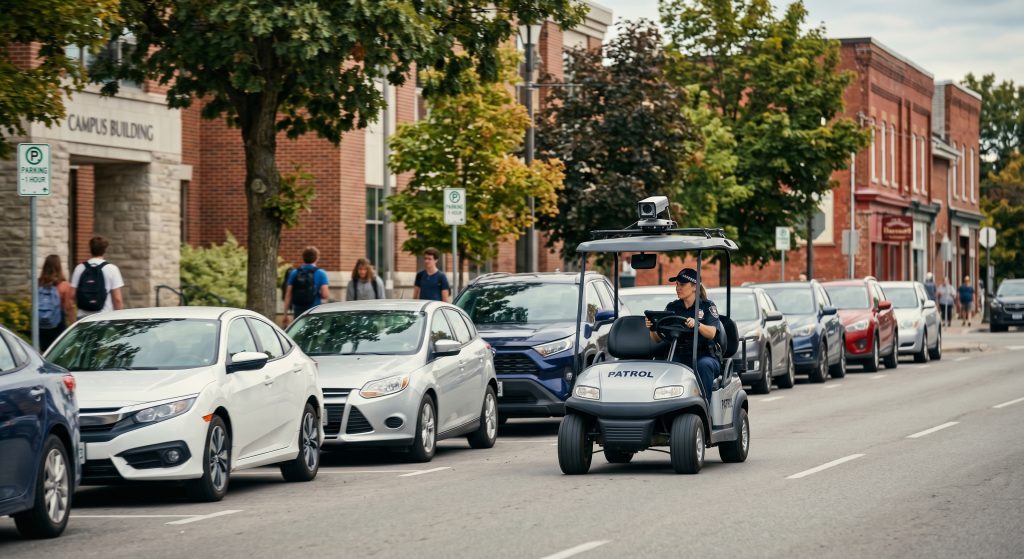
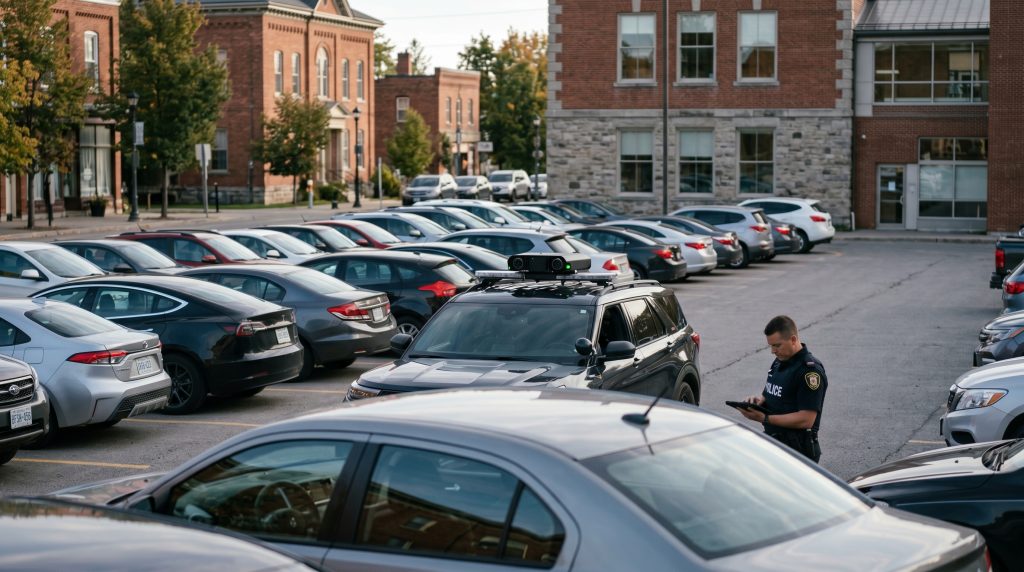
One or more cameras mount to a patrol vehicle and continuously capture and process plates as the vehicle drives through the patrol area. The officer receives alerts for violations and watchlist matches without stopping to scan individual vehicles manually.
The coverage efficiency gain is the primary argument for vehicle-mounted LPR. A patrol vehicle covering a 500-space lot validates every vehicle in a single pass. The same coverage on foot takes significantly longer and requires the officer to approach every vehicle. For large campuses, multi-lot municipal operations, or any environment where thorough coverage with limited staff is a constraint, vehicle-mounted LPR changes what’s achievable.
Victor Valley College integrated LPR into their campus police patrol so that permit validation happens as part of every routine security patrol — not as a separate dedicated enforcement effort. LPR coverage is a byproduct of security coverage rather than an additional operational commitment. See how higher education operations deploy LPR on OPSCOM.
Fixed LPR
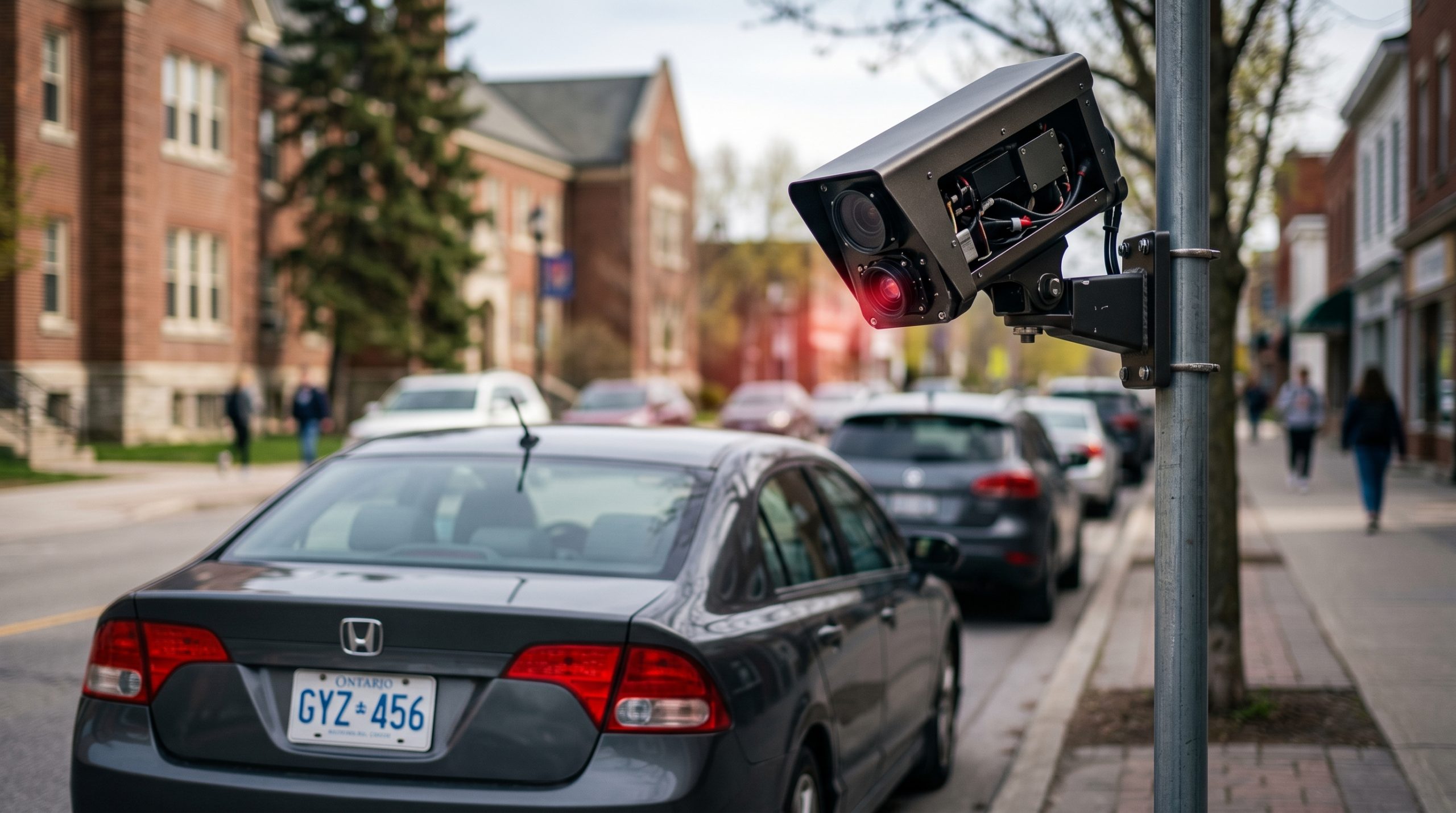
Cameras are permanently installed at entry/exit points, lot perimeters, or specific zones. Fixed LPR captures every vehicle that passes a monitored point, creating a complete record of lot entries, exits, and dwell times without requiring any patrol activity.
Fixed LPR is the foundation of virtual permit environments — lots where access is controlled entirely by plate-based permit validation rather than physical hangtags or access control hardware. Every vehicle entering a monitored zone is validated against the permit database automatically. Violations are flagged without officer presence.
Carleton University’s transition to fully virtual permits relies on fixed LPR coverage at key access points across their urban campus — validating permit holders automatically and flagging non-permit vehicles for enforcement follow-up. Read the Carleton University case study.
LPR terminology: LPR, ALPR, ANPR
These terms refer to the same core technology with different naming conventions by region and application.
LPR (License Plate Recognition) is the general term used most commonly in North America for parking enforcement applications.
ALPR (Automated License Plate Recognition) emphasizes the automated, continuous nature of the capture process — typically used in the context of vehicle-mounted or fixed systems operating without manual officer intervention.
ANPR (Automatic Number Plate Recognition) is the predominant term in the United Kingdom and Commonwealth countries, reflecting the “number plate” terminology used in those regions.
For practical purposes they describe the same technology. OPSCOM’s PL8RDR platform handles all three contexts — manual handheld reads, automated vehicle-mounted patrol, and fixed camera deployments — within the same connected system.
What the plate read needs to connect to
A plate read that returns a status in real time is operationally useful. A plate read that returns a status based on yesterday’s data isn’t — it just produces errors faster. The value of LPR in parking enforcement is inseparable from the quality of the data it’s matching against and the actions the system can take based on the match result.
In OPSCOM, a plate read connects to:
- Live permit records in ParkAdmin — current permit status, zone validity, expiry
- Active payment sessions — pay-by-phone, Text2ParkMe, meter transactions
- Violation history in ViolationAdmin — outstanding citations, financial holds, escalation status
- Security watchlists in IncidentAdmin — BOLO plates, security alerts, access restrictions
- Digital chalking records — first observation time for time-limit enforcement
Each of these connections updates in real time. The plate read isn’t just checking a static list — it’s querying a live operational database that reflects everything that has happened in the parking operation up to that moment.
Explore LPR in depth
- LPR in Parking Enforcement Operations: How Patrols Actually Work
- LPR ROI: What License Plate Recognition Delivers in Parking Enforcement
- Using LPR for Compliance Monitoring in Parking Enforcement
- LPR Parking Enforcement Software: Why Integration Defines Performance
- PL8RDR: OPSCOM’s LPR platform
- License Plate Recognition Knowledge Center