
Beyond the Citation: How Modern Enforcement Drives ROI and Community Growth

For too long, parking enforcement has been viewed as a necessary evil—a source of friction between operations teams and the public. But forward-thinking municipalities, universities, and private operators are flipping that script.
By adopting modern digital enforcement tools, industry leaders are transforming their curbside management from a frustrating cost center into a highly efficient, revenue-generating asset. Here is how modernizing your enforcement strategy delivers massive Return on Investment (ROI) while surprisingly improving customer service and shaping future development.
OperationsCommander (OPSCOM) brings permits, enforcement, payments, and incident data into a single system, allowing every enforcement action to be validated, processed, and resolved in real time without switching tools.
In most environments, enforcement relies on multiple disconnected systems and manual handoffs. OPSCOM replaces this with a coordinated, real-time process.
1. Exponential Efficiency: Doing More Without Adding Headcount
The most immediate ROI from digital parking enforcement comes from operational efficiency. Traditional enforcement relies on manual labor: walking lots, chalking tires, and writing paper citations. It is slow, prone to human error, and mathematically limits how much revenue you can capture.
Modern parking platforms change the equation. When enforcement, permits, and payments operate in one system, efficiency scales immediately.
- Doing More With Less: By outfitting officers with License Plate Recognition (LPR) and mobile handheld devices, your team can cover exponentially more ground in a fraction of the time.
- Zero Administrative Bottlenecks: Digital citations are synced to the cloud instantly. This eliminates the need for front-office staff to spend hours manually entering handwritten tickets into a database, freeing them up for higher-level tasks.
- Higher Collection Rates: Digital enforcement creates an undeniable chain of evidence (including timestamped photos). When violators cannot exploit loopholes or complain about illegible handwriting, appeal rates drop, and fine collection rates skyrocket.
With OPSCOM, LPR validation, citation issuance, and permit checks all occur within a single workflow, allowing officers to process more vehicles without switching systems.
2. The Counterintuitive Truth: How Strict Enforcement Improves Customer Service
It sounds completely contradictory, but highly efficient enforcement—even measures like vehicle immobilization (booting)—can actually improve the customer experience when handled through structured workflows.
In OPSCOM, self-release booting is integrated directly into the enforcement workflow, allowing violations, payments, and resolution to occur within a single system.
Consider the traditional penalty for a severe parking violation: towing. When a vehicle is towed, the driver faces a nightmare scenario of finding a ride to a remote impound lot and paying exorbitant fees to a third-party towing company. Your organization loses out on that revenue, and the driver is furious.
A modern immobilization strategy keeps the process flexible and localized:
- Frictionless Resolution: When a vehicle is booted instead of towed, the driver remains on-site. Using a mobile device, they can scan a QR code on the notice, pay their outstanding fines via your 24/7 self-serve portal, and receive an unlock code instantly.
- Kept Revenue: The fines go directly into your organization’s operating budget, rather than a third-party towing company’s pocket.
- Preserved Goodwill: While getting a ticket is never fun, saving a driver from the cost and hassle of an impound lot is a surprisingly delightful alternative that de-escalates tension.
3. Data-Driven Development: Funding the Future
The benefits of digital enforcement extend far beyond the curbside. Every digital citation, LPR scan, and paid fine generates valuable data. For municipalities and large campuses, this data is the foundation of future urban development.
- Smarter Urban Planning: Centralized enforcement data creates heat maps of peak usage and high-violation zones. Municipal planners can use this data to determine where to build new parking structures, where to expand public transit, or where to add protected bike lanes.
- Reinvesting in the Community: The increased revenue captured through efficient digital enforcement doesn’t just sit in a bank account. It becomes a vital funding source for community improvements, campus safety initiatives, and sustainable infrastructure.
- Adapting to Growth: As cities and campuses grow, parking real estate becomes scarce. A highly efficient enforcement system ensures turnover in premium retail and visitor spots, driving economic activity for local businesses rather than letting spaces sit stagnant.
Turn Your Curbside into a Revenue Engine
An optimized parking strategy doesn’t just manage cars—it protects your brand, appeases your community, and unlocks massive hidden revenue.
By centralizing enforcement, payments, and data into a single system, OPSCOM transforms enforcement into a real-time operational workflow that improves efficiency, captures revenue, and supports long-term planning.

The Evolution of Parking Management: Moving from Manual Chaos to Cloud-Based Efficiency
For decades, parking enforcement was a labor-intensive, manual process. Officers relied on paper tickets, expensive…

The Future of Patrol: How Mobile Tech and Centralized Data are Transforming Parking Enforcement
Parking enforcement is one of the toughest jobs on your campus or in your municipality….

The Complete Guide to Modern Parking Enforcement Systems
How automation reduces confrontation, lightens workloads, and surprisingly improves customer service. For decades, parking enforcement…

The Modern Enforcement Workflow: How AI and Automation Are Transforming the Parking Experience
Nobody likes getting a parking ticket. But if you manage a busy university campus, a…
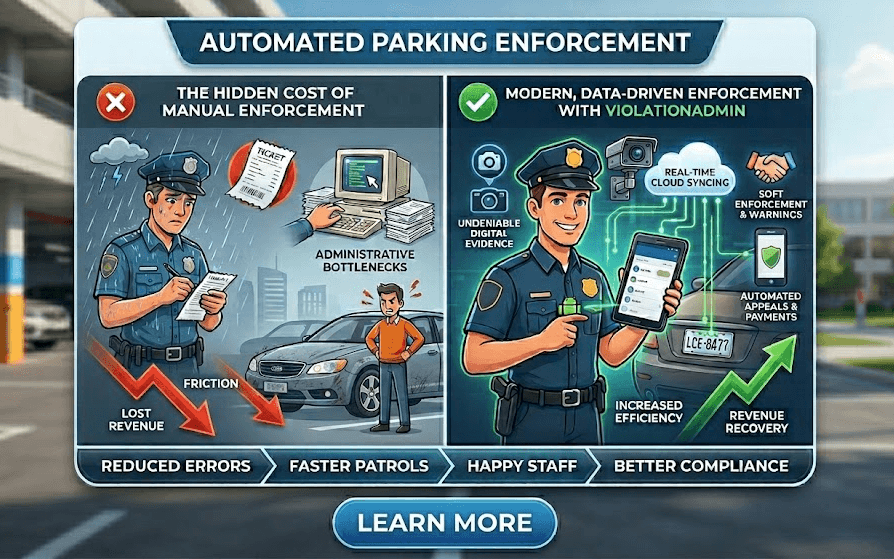
Automated Parking Enforcement
Transform your patrol officers into a highly efficient, data-driven team. OperationsCommander (OPSCOM) replaces handwritten tickets,…