Parking Reporting and Insights: Turning Operational Data Into Decisions

Data and reporting are not the same thing. A parking operation can have rich, connected data and still produce reports that don’t change how decisions are made. The gap between having good data and using it well usually comes down to report design — specifically, whether reports are built around the questions the audience actually needs to answer, at the frequency those questions need answering.
Parking operations serve multiple audiences with different reporting needs. An enforcement officer starting a shift needs different information than a parking director preparing a quarterly budget review. An operations supervisor monitoring afternoon patrol needs different metrics than a university VP reviewing annual revenue performance. Good reporting infrastructure delivers the right information to each audience without requiring them to extract it from a general-purpose database query.
This post covers how parking reporting should be structured across organizational levels, what each report type needs to accomplish, and how connected data makes effective reporting possible without significant manual effort.
The reporting pyramid: levels, audiences, and cadence
Effective parking reporting operates at three distinct levels, each with a different audience, cadence, and purpose.
Operational level: daily and shift-based
The operational level serves enforcement officers, permit administrators, and operations supervisors. These reports answer immediate questions: what happened today, what’s in the queue, what needs attention before the shift ends.
Daily operational reports typically include citations issued by zone and officer, outstanding permits in the approval queue, payment activity for the day, new appeals filed, and any escalation actions triggered automatically. For enforcement supervisors, patrol coverage by zone — which areas were covered and how many reads were recorded — helps identify coverage gaps before they become compliance problems.
At this level, timing matters more than depth. A shift summary that arrives in the supervisor’s inbox at 6pm is actionable for the next morning’s scheduling. The same summary a week later is a historical record with no operational value.
Management level: weekly and monthly
The management level serves parking managers, directors, and department heads. These reports answer trend questions: is compliance improving, is revenue tracking to plan, are there operational issues that need intervention?
Weekly management reports typically include compliance rate by zone compared to the prior week, collection rate for violations issued that week, new permit activity and waitlist movements, and appeal resolution summary. Monthly reports add revenue trending by category, outstanding balance aging, enforcement activity versus comparable prior-year periods, and any escalation backlog analysis.
The most useful management reports are comparative rather than absolute. A citation count of 340 for the week is a number. A citation count of 340 versus 290 the prior week, with a compliance rate that went from 82% to 78% in the same zone, is a trend that indicates something changed and may need attention.
Strategic level: quarterly and annual
The strategic level serves senior leadership — university VPs, city managers, healthcare executives, property management ownership. These reports answer the questions that drive resource allocation and policy decisions: is parking self-sustaining, are we appropriately resourced, what are the significant trends and risks?
Annual strategic reports typically include full-year revenue performance versus plan, permit utilization trends, compliance rate trends across the portfolio, appeal outcomes and their implications for citation quality, and recommendations for permit pricing, zone allocation, or enforcement resource adjustments.
At this level, context matters as much as data. A revenue figure in isolation doesn’t tell leadership whether performance was good or bad. Revenue compared to plan, compared to prior year, and explained by the factors that drove the variance — permit category mix shifts, collection rate changes, enforcement activity levels — gives leadership the narrative they need to ask useful questions and make informed decisions.
What makes a good parking report
The reports that actually change decisions share a few characteristics that distinguish them from reports that get filed and forgotten.
They lead with the conclusion. A parking director reviewing a monthly report doesn’t want to calculate whether revenue is up or down — they want to know at a glance. Reports that organize around KPI summaries with variance flags (up/down versus prior period, versus plan) communicate the status before the reader has to work for it.
They make exceptions visible. The most actionable content in any parking report is the exception — the zone where compliance dropped unexpectedly, the permit category where renewals fell off, the officer whose citation void rate is notably higher than peers. Exception-based reporting focuses attention on what needs intervention rather than requiring the reader to find it in a table of numbers.
They connect metrics to actions. A report that shows a compliance rate decline in Lot C is more useful if it also shows recent patrol coverage for Lot C, making the connection between the metric and a potential cause visible. Reports that connect related metrics in the same view reduce the analytical work required to reach a conclusion.
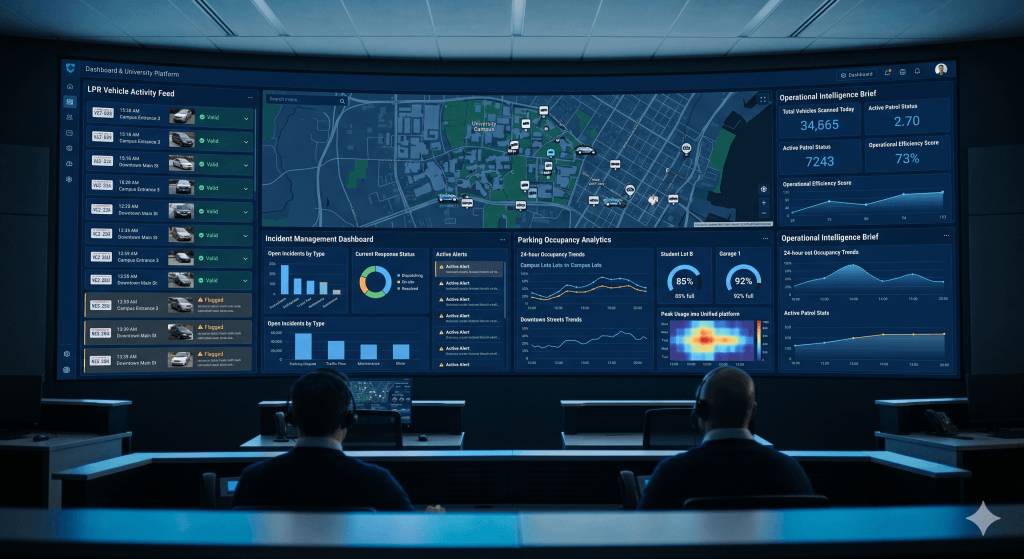
They’re accessible without technical skill. A reporting capability that requires a data analyst to produce outputs isn’t operational reporting — it’s custom analytics. The reports that drive day-to-day decisions need to be available to the people making those decisions without IT involvement. In OPSCOM, standard reports are available to authorized users through the administrative dashboard, without export, without manual joins, and without waiting for someone else to run them.
Carleton University: reporting enabling remote management
Carleton University’s Director of University Safety manages parking and security operations across a large urban campus. The ability to access operational reports remotely — from home, from off-site, from a different building on campus — was specifically cited as a meaningful operational advantage after implementing OPSCOM.
When the parking and security operation’s data lives in a connected cloud platform and reporting is accessible through a web interface, the operational picture isn’t confined to a workstation in the parking office. A director who can review the overnight shift summary from home before arriving, or check compliance rates during a budget meeting on a different floor, is operationally more effective than one who can only access the data from a specific terminal. Read the Carleton University case study.
Reporting as accountability infrastructure
One of the less-discussed functions of parking reporting is accountability. When operations data is visible and consistently reported, it creates accountability structures that improve performance in ways that informal management can’t replicate.
An enforcement officer whose citation count, void rate, and patrol coverage are reported weekly is operating in a different accountability environment than one whose performance is visible only when problems become large enough to escalate. A permit administrator whose queue times and exception resolution rates are tracked is more likely to maintain processing standards than one whose work is invisible until a parker complains.
This isn’t about surveillance — it’s about shared visibility. When the team can see what the operation is producing in aggregate, individuals understand how their contribution fits into the whole. When performance data is discussed regularly in the context of operational goals, improvement becomes a continuous process rather than a periodic intervention.
Explore parking data and analytics in depth
- Parking Data and Analytics: How Parking Operations Become Data-Driven
- Parking Operational Analytics: Measuring What Actually Happens
- Parking Revenue Strategy: Using Data to Improve Financial Outcomes
- Parking Occupancy and Demand Analytics: Understanding How Parking Is Used
- How Unified Parking and Security Data Improves Operational Awareness
- Parking Data and Analytics Knowledge Center