License Plate Recognition (LPR): The Foundation of Modern Parking Enforcement
License plate recognition has been around long enough that most parking professionals have heard of it. But there’s a significant gap between knowing what LPR is and understanding what it actually takes to make it work well in day-to-day enforcement operations.
Read rate accuracy, integration depth, deployment type, privacy compliance, and how plate data connects to the rest of your enforcement system — these are the questions that determine whether LPR becomes a genuine operational asset or an expensive data collection tool that requires manual work to be useful.
This page covers the full picture: how LPR technology works, what differentiates good implementations from poor ones, how to think about deployment options, and what LPR looks like when it’s connected to permits, enforcement, security, and analytics in one unified system.
A note on terminology: LPR and ALPR (automatic license plate recognition) refer to the same technology. In Canadian law enforcement and government usage, ALPR is the more common term and you’ll see it in provincial enforcement regulations, police liaison documentation, and public-sector procurement. In the parking industry, LPR tends to dominate. Throughout this page we use LPR, but everything here applies equally to ALPR systems and ALPR cameras. The hardware, the software process, and the operational considerations are identical regardless of which acronym your team uses.
How license plate recognition actually works
At its core, LPR is an image recognition problem. A camera captures an image of a vehicle — or a stream of images as a patrol vehicle drives past — and software identifies the license plate within that image, reads the alphanumeric characters, and converts them into a searchable text string. That string is then compared against one or more databases: permit records, violation history, watchlists, payment records, or access control systems.
The technical process involves several stages:
- Image capture. A camera — handheld, vehicle-mounted, or fixed — photographs the vehicle. Image quality depends on resolution, lighting, angle, and the distance between camera and plate.
- Plate detection. Software locates the license plate within the image frame, isolating it from the surrounding vehicle body, background, and other visual noise.
- Character recognition. OCR (optical character recognition) reads the individual characters on the plate, accounting for font variations, damage, dirt, shadows, and regional plate formats.
- Database matching. The recognized plate string is compared against configured data sources — permit records, violation history, watchlists — and the system returns a status in real time.
- Action trigger. Based on the match result, the system takes an action: confirming a valid permit, flagging a violation, triggering a watchlist alert, or logging the read for dwell-time tracking.
The speed of this process in a modern system — from image capture to returned status — is measured in fractions of a second. In a vehicle-mounted deployment, a patrol vehicle can drive through a parking area at normal speed and validate every vehicle it passes without stopping.
What read accuracy actually means — and what affects it
Read accuracy is the most commonly cited LPR metric, and also the most commonly misunderstood. A vendor quoting “99% accuracy” may mean something quite different from what you’d expect in field conditions.
In controlled conditions — good lighting, clean plates, standard fonts, optimal camera angles — modern LPR systems can achieve very high read rates. Real-world parking enforcement introduces factors that reduce accuracy in practice:
- Plate condition. Dirty, damaged, faded, or obscured plates reduce read accuracy. A plate that’s 30% covered in mud may not be readable at all.
- Angle and distance. LPR cameras have optimal capture ranges. Plates at extreme angles, very close distances, or beyond the camera’s effective range produce lower-quality images and more errors.
- Lighting conditions. Direct sunlight, deep shadow, headlight glare, and night enforcement all affect image quality. Systems without good exposure control perform inconsistently across different lighting environments.
- Regional plate formats. North America has hundreds of plate formats across US states and Canadian provinces. A system not configured for regional variation will misread or miss plates that fall outside its training data.
- Vehicle speed. Fast-moving vehicles — more relevant to highway tolling than parking enforcement — introduce motion blur. In parking environments, vehicles are typically stationary or slow-moving, which is more forgiving.
What matters operationally isn’t a single accuracy percentage — it’s how the system handles reads it’s uncertain about. Good LPR systems flag low-confidence reads for manual review rather than silently passing them as accurate. That distinction is important: an unconfident read treated as accurate creates enforcement errors; an unconfident read flagged for review creates a manageable workflow.
Jason Dulmage, Systems Administrator at Fleming College, described the read accuracy improvement after switching to OPSCOM’s PL8RDR platform: “Read accuracy, range of read angles and distance are significantly improved. The ability to mount this camera almost haphazardly and get scanning compared to previous troublesome mounting arrangements has been a real time savings.”
The three deployment types — and how to choose
LPR systems are deployed in three primary configurations. Each has different operational characteristics, cost profiles, and use cases. Most parking operations use a combination depending on their environment.
Handheld LPR
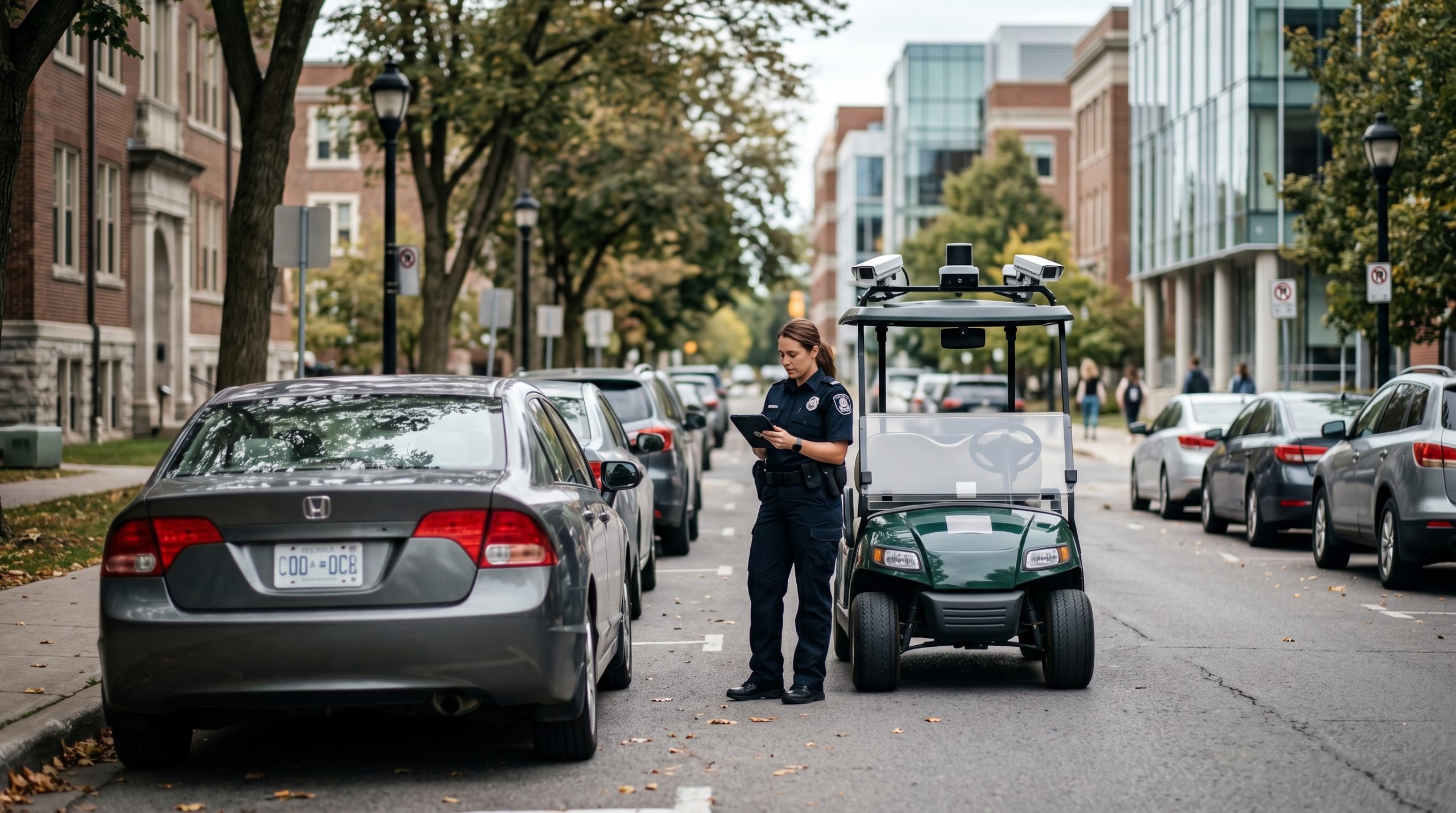
An officer uses a smartphone, tablet, or dedicated handheld device with a built-in or attached camera to photograph license plates. The image is processed on-device or via a connected app, and the system returns a status instantly.
Handheld LPR is the most flexible and lowest-cost deployment option. It works in any environment — lots, garages, on-street spaces, campus walkways — and requires no vehicle or infrastructure investment. The tradeoff is coverage speed: an officer can only scan vehicles they physically approach.
Best for: smaller operations, environments where officers are already on foot, organizations starting with LPR before scaling, and situations where selective validation is more appropriate than blanket coverage.
Vehicle-mounted LPR
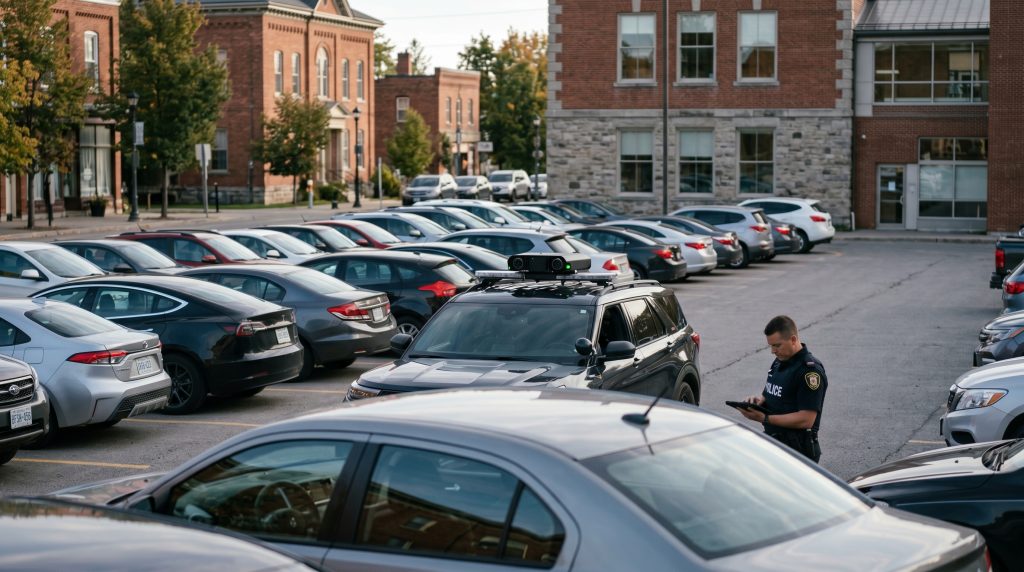
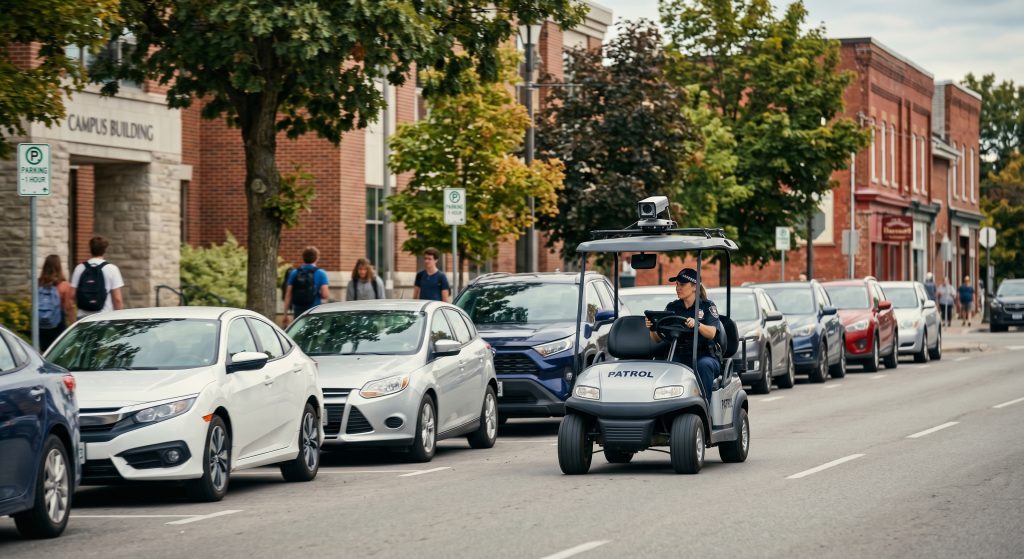
One or more cameras are mounted on a patrol vehicle and connected to an in-vehicle processing unit. As the patrol vehicle drives through a parking area, the cameras automatically capture and process every plate in range without the officer stopping or interacting with individual vehicles.
Vehicle-mounted LPR dramatically increases coverage efficiency. A single patrol vehicle can validate hundreds of vehicles per hour — covering ground that would take multiple officers with handheld devices. The system flags violations automatically so the officer can focus on response rather than manual validation.
Best for: large parking operations, municipal enforcement across multiple zones, operations where coverage speed and consistency are the primary goals.
Fixed camera LPR
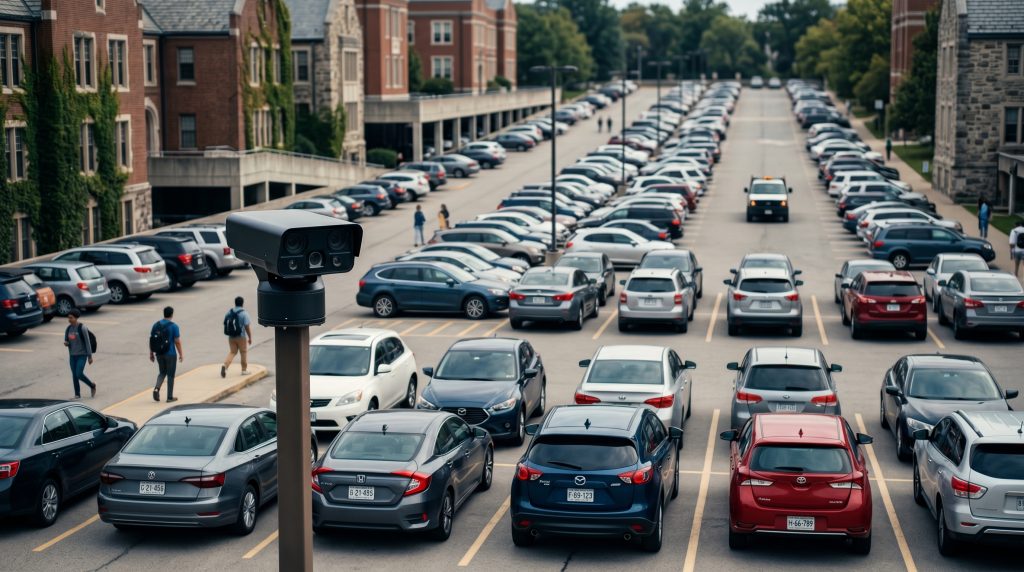
Cameras are permanently installed at specific locations — lot entrances and exits, perimeter points, high-value areas — and monitor vehicle activity continuously. Fixed LPR is particularly useful for gateless parking workflows, access control, and security-focused monitoring.
Fixed cameras provide continuous coverage at specific points without requiring patrol activity. They’re commonly used for entry/exit monitoring, permit validation at controlled access points, and security watchlist enforcement where a specific location needs continuous coverage.
Best for: access-controlled parking, gateless entry/exit validation, security perimeter monitoring, and high-value locations where continuous coverage is required.
OPSCOM’s PL8RDR platform supports all three deployment types within the same system — so organizations can start with handheld and add vehicle-mounted or fixed cameras as needs evolve, without changing platforms or rebuilding workflows.
Why integration determines whether LPR is worth it
This is the point that doesn’t get talked about enough in LPR discussions, and it’s the most important one for organizations evaluating systems.
LPR on its own captures data. What it does with that data depends entirely on what it’s connected to. A standalone LPR system — one that reads plates and stores them in its own database, disconnected from permit records and enforcement workflows — still requires significant manual effort to be useful. Officers return from patrol with a list of plate reads that need to be reconciled against permit data before any enforcement action can be taken. The speed advantage of LPR is partially or fully offset by the manual reconciliation work it creates downstream.
Connected LPR — where plate reads are validated instantly against live permit data, violation history, and watchlists — eliminates that manual step. The system tells the officer immediately whether the vehicle is compliant, in violation, or flagged for attention. No reconciliation. No post-patrol data processing. No delay between observation and action.
In OPSCOM, every plate read from PL8RDR is validated in real time against:
- ParkAdmin permit data — is this vehicle’s permit active, expired, or suspended?
- ViolationAdmin enforcement records — does this vehicle have outstanding violations? Is it a repeat offender?
- Digital chalking records — has this vehicle been observed before in this zone, and if so, when? Has it exceeded its permitted dwell time?
- IncidentAdmin watchlists — is this vehicle flagged for security attention, subject to a BOLO, or associated with an active investigation?
The difference between a standalone LPR system and this kind of connected enforcement platform isn’t incremental — it’s the difference between a data collection tool and a real-time decision engine. Learn more about how this connected approach works in the parking enforcement systems knowledge center.
LPR and digital tire chalking — how they work together
One of the most operationally valuable combinations in modern parking enforcement is LPR paired with digital tire chalking. The two technologies address different aspects of the same enforcement challenge — and together, they create a workflow that’s significantly more efficient and defensible than either alone.
Digital chalking tracks how long a vehicle has been present in a time-limited zone. LPR provides the plate identification that makes that tracking accurate and scalable. In a vehicle-mounted deployment, a single patrol pass captures every plate in a zone, records each vehicle’s presence with a GPS timestamp, and automatically compares subsequent passes to calculate dwell time. Vehicles that have overstayed their limit are flagged without the officer needing to stop, inspect, or manually record anything.
This is how Forks North Portage manages time-based enforcement across 20+ downtown Winnipeg lots — using vehicle-mounted LPR to validate dwell time across a dispersed portfolio that would be impossible to cover consistently with manual chalking. Read the Forks North Portage case study to see how connected LPR and chalking workflows operate at scale.
LPR for security — beyond parking enforcement
In a parking-only system, LPR identifies whether a vehicle has a valid permit. In a unified parking and security platform, LPR does considerably more.
Connected to IncidentAdmin, every plate read is also checked against security watchlists, BOLO alerts, and vehicle records associated with open investigations. When a vehicle of interest enters a monitored area, security and enforcement staff are notified in real time — regardless of whether the vehicle is parked legally or not.
This capability is particularly valuable for:
- University campuses — where trespass orders, restraining orders, and campus safety concerns may require monitoring specific vehicles across a large area
- Healthcare campuses — where patient safety and visitor management create legitimate needs for vehicle monitoring in addition to parking compliance
- Municipal operations — where law enforcement may need to identify vehicles associated with active investigations or outstanding warrants
- Mixed-use developments — where unauthorized vehicles repeatedly accessing residential areas need to be identified and addressed consistently
Carleton University’s connected deployment — integrating PL8RDR with IncidentAdmin across a large urban campus in Ottawa — is one of the strongest examples of LPR operating as a campus safety tool rather than just a parking enforcement tool. Read the Carleton University case study to see how parking and security data share the same operational database.
Privacy considerations — especially for Canadian operations
LPR involves the collection and storage of vehicle location data, which raises legitimate privacy considerations — particularly in Canada, where PIPEDA and provincial privacy legislation impose obligations on organizations collecting personal information.
The key privacy considerations for LPR deployments:
- Data retention. How long are plate reads stored? Reads that don’t result in enforcement actions should generally not be retained indefinitely. Organizations should have clear retention policies that limit storage to operationally necessary periods.
- Access controls. Who can access plate read data? Role-based access controls should limit LPR data to personnel with a legitimate operational need — not available to all staff by default.
- Purpose limitation. LPR data collected for parking enforcement should not be repurposed for unrelated uses without appropriate justification and legal basis.
- Transparency. In many jurisdictions, organizations using LPR should notify parkers that license plate data is being collected — typically through posted signage at parking entrances.
OPSCOM’s platform includes role-based access controls and configurable data retention settings, giving organizations the tools to implement LPR in a manner consistent with their privacy obligations. For Canadian municipalities and institutions operating under provincial privacy frameworks, these controls are essential to responsible deployment.
The ROI case for LPR — what the numbers actually look like
LPR represents a meaningful technology investment. The return on that investment comes from three sources: enforcement efficiency, compliance improvement, and administrative cost reduction.
Enforcement efficiency. A vehicle-mounted LPR system allows one officer to cover the same ground as three to five officers using manual or handheld methods. For operations where patrol coverage is the limiting factor — too many spaces to monitor consistently with available staff — LPR directly solves the capacity problem without adding headcount.
Compliance improvement. Consistent enforcement changes parker behavior. When parkers know that a patrol vehicle scans every vehicle on every pass — rather than one officer checking a fraction of vehicles manually — compliance rates improve. That behavioral change is the ultimate goal of time-based enforcement: not more violations, but better turnover and availability.
Administrative cost reduction. Connected LPR eliminates manual reconciliation between plate reads and permit databases. Post-patrol data processing that previously took staff hours per shift is reduced to seconds. The time savings compound across every patrol, every day.
The Town of Perth’s 91% ticket collection rate — achieved through connected enforcement and payment workflows that include LPR — is one of the clearest outcome metrics in OPSCOM’s client library. Read the full Town of Perth case study to understand how the connected system produced that result.
Explore license plate recognition in depth
Each of the following posts covers a specific aspect of LPR in more detail:
- License plate recognition: how it works in modern parking enforcement
- LPR in parking enforcement operations: how patrols actually work
- LPR ROI: what license plate recognition delivers in parking enforcement
- Using LPR for compliance monitoring in parking enforcement
- LPR parking enforcement software: why integration defines performance
Ready to see how connected LPR works in a live enforcement environment?