Parking and Security on the Same Campus Team

On most campuses, parking services and campus security are separate departments — separate reporting lines, separate budgets, separate software, and often separate cultures. Parking is an auxiliary service, usually revenue-neutral or revenue-generating. Security is a cost center, operationally oriented, focused on safety rather than compliance and collections.
The separation makes organizational sense on paper. In practice, it creates friction at exactly the points where the two functions most need to work together — vehicle incidents, perimeter awareness, watchlist enforcement, documentation for compliance obligations. The cost of that friction tends to be invisible until something goes wrong, at which point it becomes very visible very quickly.
The question isn’t whether parking and security need to merge organizationally. They don’t. The question is whether they need to share a platform — and what that actually changes when they do.
Where the silos create operational gaps
The gaps created by disconnected parking and security systems tend to cluster around a few recurring scenarios.
Vehicle incidents. A security officer responding to a vehicle-related incident — a hit and run, a theft from a vehicle, a suspicious vehicle report — needs to know whether the vehicle is registered on campus, what permit it holds, and whether it has any enforcement history. In a disconnected environment, that’s a phone call or email to the parking office, a wait for someone to pull records from a separate system, and a delay in the investigation while the parking team locates and transmits information that should be immediately accessible.
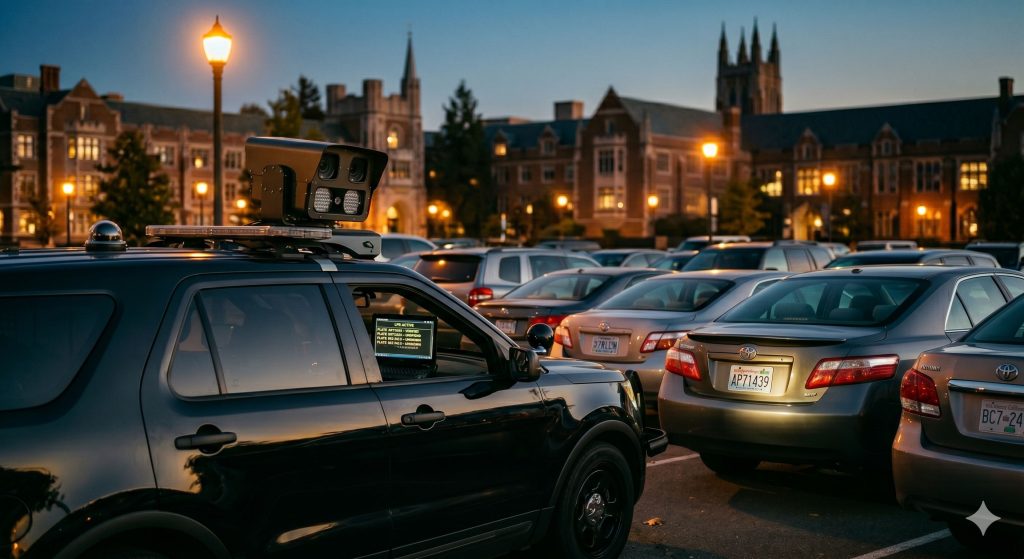
Watchlist enforcement. Campus security maintains records of vehicles subject to trespass orders, associated with open investigations, or flagged for monitoring. In a disconnected environment, getting those records in front of parking enforcement officers — the people who are actually out on the lots scanning plates — requires a manual notification process that’s easy to miss and harder to verify. A vehicle banned from campus gets a citation for a permit violation and drives away, because the enforcement officer had no way to know there was a more significant concern attached to that plate.
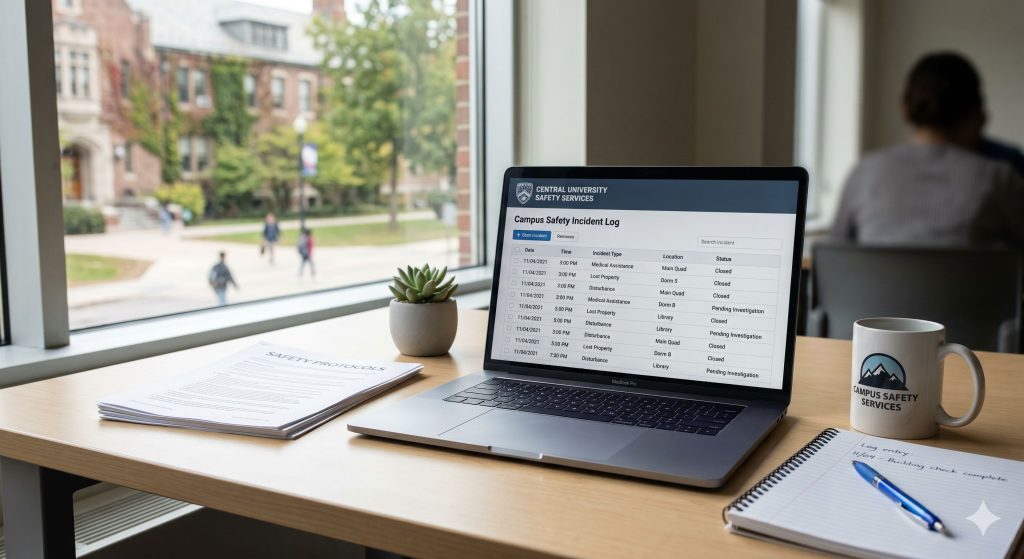
Incident documentation. Incidents that occur in or near parking areas often fall between the documentation practices of two departments. Campus security logs the incident in their system. Parking has relevant context — permit status, enforcement history, LPR scan data — that never makes it into the incident record. The documentation that exists is less complete than what the situation warranted, and that gap becomes a problem if the incident ever requires external review.
Pattern recognition. A vehicle that appears repeatedly near locations where incidents have occurred, or that accumulates a pattern of enforcement activity alongside security attention, is visible as a pattern only when the data lives in the same place. In separate systems, the pattern is invisible until someone happens to compare notes across departments — which typically happens after something significant occurs, not before.
What a shared platform actually changes
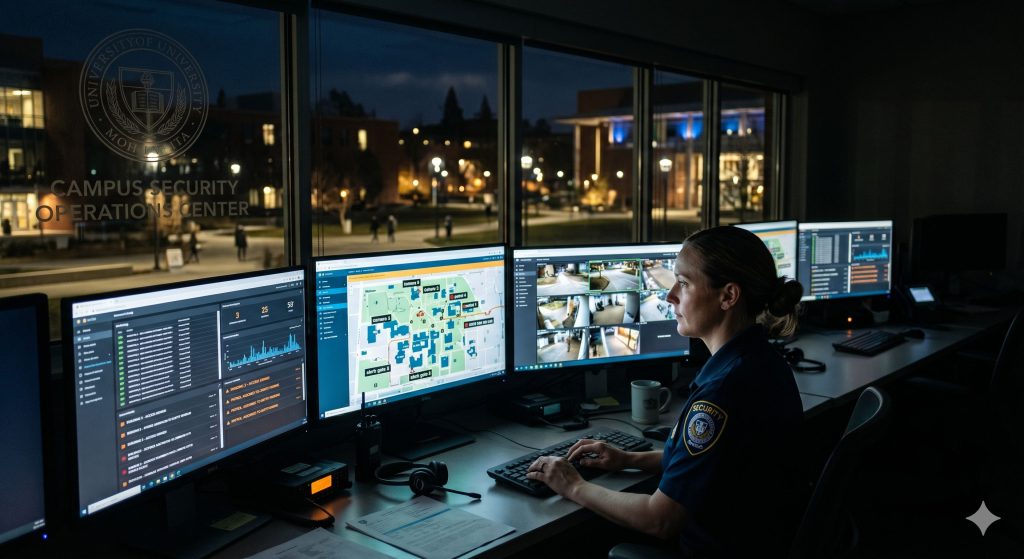
A unified parking and security platform doesn’t reorganize departments or change reporting structures. It changes what information is available, to whom, and when.
In OPSCOM, ParkAdmin, ViolationAdmin, PL8RDR, and IncidentAdmin share one database. The permit record that parking services maintains is the same record that security investigators access when a vehicle is involved in an incident. The watchlist that security maintains in IncidentAdmin is the same watchlist that surfaces as an alert on an enforcement officer’s device during a routine patrol scan. The LPR scan history that accumulates through parking patrol is the same history that security investigators search when a vehicle’s campus presence is relevant to an investigation.
The operational picture is shared automatically, in real time, without manual coordination between departments.
Role-based access controls mean that sharing a platform doesn’t mean sharing everything with everyone. Parking enforcement officers see the watchlist alerts relevant to their patrol function — not full access to sensitive security investigations. Security investigators see vehicle permit and enforcement history — not administrative control over the parking operation. Administrators see the operational reporting they need — calibrated to their role and responsibilities.
The right information reaches the right people. The gaps close without requiring anyone to pick up the phone and ask for data that should already be accessible.
The organizational argument for VP-level decision makers
For Vice Presidents of Administration, Directors of Campus Safety, and the institutional decision-makers evaluating platform investments, the case for unified parking and security operations comes down to three practical realities.
Liability exposure decreases. When incidents in parking areas are documented with complete context — vehicle records, permit history, LPR scan data, precise geographic classification — the institution’s position in any subsequent review, legal proceeding, or regulatory inquiry is stronger. Incomplete documentation is the most common avoidable vulnerability in campus safety operations. A connected platform addresses it structurally rather than through training and discipline alone.
Operational efficiency improves without additional headcount. The coordination work that currently requires manual effort between departments — information requests, watchlist distribution, incident documentation reconciliation — largely disappears when the systems share a database. Staff in both departments spend less time bridging information gaps and more time on the work those gaps were preventing.
The platform scales with the operation. A campus that adds LPR to a vehicle-mounted patrol program, expands into fixed camera monitoring, or integrates additional facilities into a centralized security operation doesn’t need to reconfigure the relationship between parking and security systems — the architecture already supports it. Growth and operational expansion build on the foundation rather than requiring it to be rebuilt.
What this looks like at institutions running it today
Carleton University’s Department of University Safety runs parking, enforcement, LPR, and incident management as a single OPSCOM operation. The department manages both the parking function and the campus security function — which makes the unified platform a natural fit — but the operational model translates directly to campuses where the two functions report separately. The shared database, not the org chart, is what makes the coordination work.
Saint Mary’s University consolidated parking management, enforcement, incident management, and locker administration into one OPSCOM platform. Their security team gained structured incident exports compatible with local police reporting formats, vehicle watchlists connected directly to enforcement patrol, and role-based access controls that kept sensitive records protected while making relevant operational data accessible across functions.
Brandon University, Cambrian College, Canadian Mennonite University, Anderson University, Taylor University, Indiana Institute of Technology, and the University of North Alabama all run connected parking and security operations on OPSCOM — across a range of institutional sizes, organizational structures, and operational models. The through-line is the same: one platform, one database, parking and security operating from a shared operational picture.
Read the Carleton University and Saint Mary’s University case studies for the detailed operational view, or browse the full client case studies library.
Starting the conversation internally
The biggest practical obstacle to unified parking and security operations usually isn’t technology — it’s organizational. Two departments that have operated independently often have different procurement timelines, different budget cycles, and different stakeholders who need to be aligned before a shared platform evaluation can move forward.
The most effective approach is usually to start with the shared operational problems rather than the platform. What vehicle incidents last year would have been handled better with immediate access to parking data? Where did watchlist gaps create enforcement misses? What documentation challenges complicated the last Clery reporting cycle? Those are questions that parking and security directors can answer independently — and when the answers point to the same structural gaps, the case for a shared solution makes itself.
From there, a platform evaluation becomes a joint exercise rather than a departmental one — which is the right frame for a decision that affects both operations and produces the most value when both are involved in shaping the implementation.
One platform, both functions
Campus parking and campus security don’t need to merge to work better together. They need shared data, shared visibility, and the structural connection that makes routine operations in one function contribute automatically to the other.
That’s what a unified platform provides — not a reorganization, but an operational foundation that closes the gaps between two functions that have always needed to work in closer coordination than their separate systems have allowed.
Explore the full picture in the Campus Security Operations Knowledge Center, or see how the platform works across the higher education environments OPSCOM serves.
Related reading
- Campus Parking as a Security Layer: It Starts in the Lot
- LPR on Campus: Beyond Permit Enforcement
- Campus Incident Management: How Safety Teams Coordinate in Real Time
- Clery Act Compliance: Why Incident Documentation Is the Real Work
- Campus Security Operations — Knowledge Center
- OPSCOM for Higher Education
- Client Case Studies