Campus Parking as a Campus Security Layer
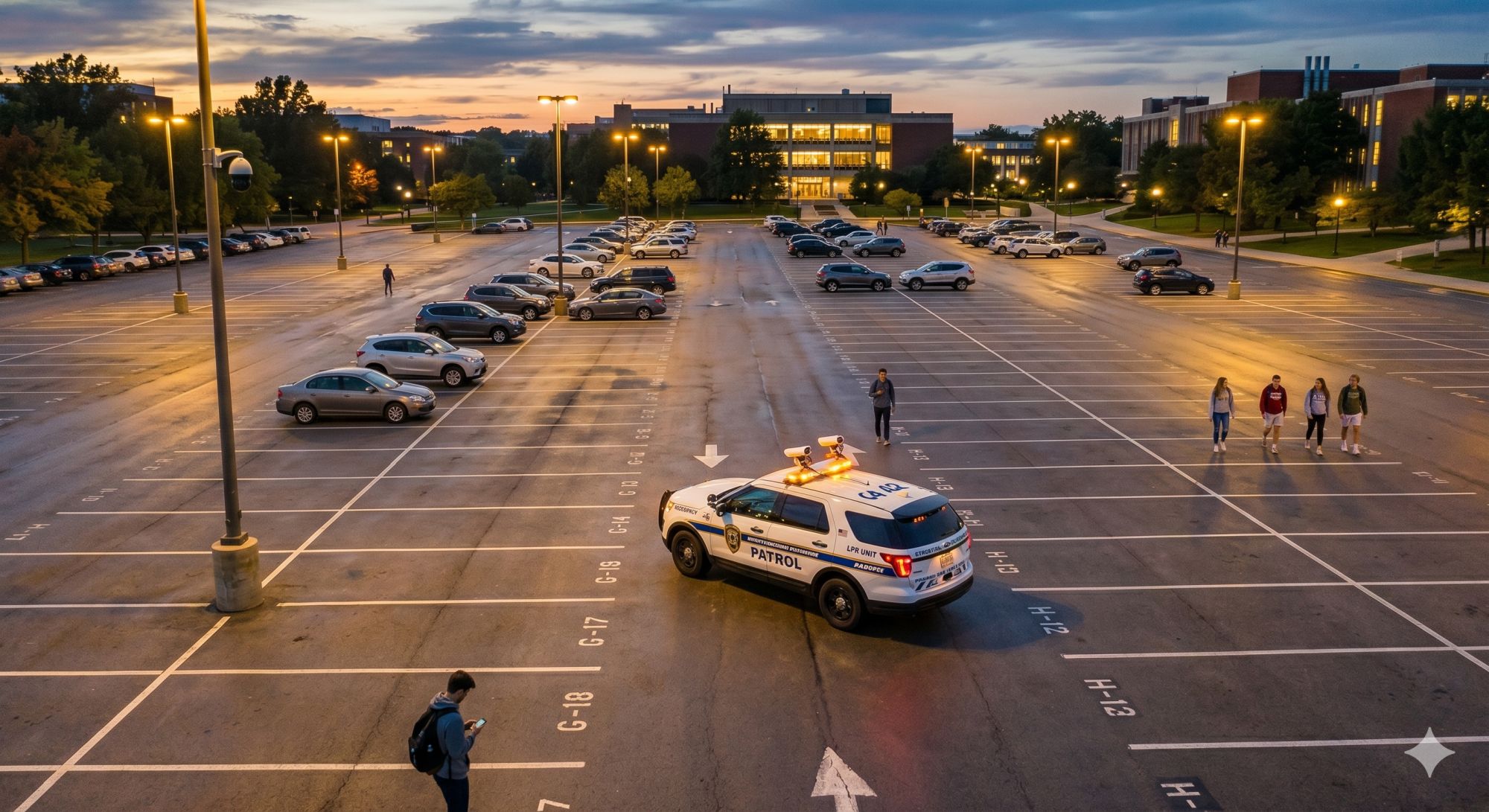
Campus security planning has traditionally focused on buildings — access control at residence halls, cameras in hallways, emergency call stations near academic facilities. All of that still matters. But there’s a part of campus that often gets underestimated in the security conversation: the parking lot.
That’s starting to change, and for good reason.
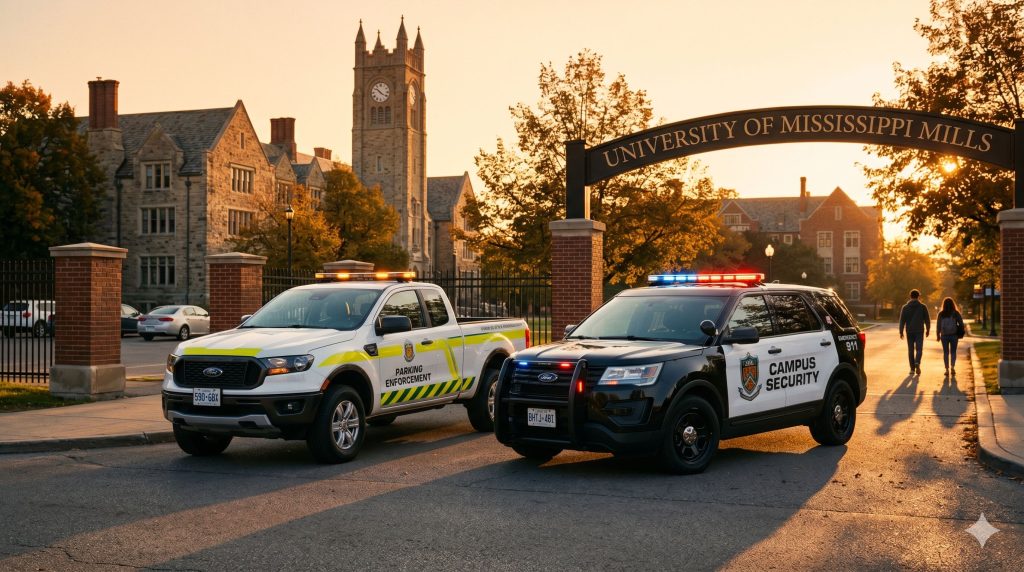
Parking facilities are where virtually everyone who comes to campus arrives first — students, faculty, staff, visitors, vendors, contractors, and, occasionally, people who shouldn’t be there at all. On an open-access campus, parking areas are often the least monitored points of entry. They’re high-traffic, spread across large physical areas, and historically staffed around enforcement rather than security.
The question worth asking isn’t whether your parking operation is doing its job. It’s whether it’s doing two jobs — and whether those jobs are connected.
The perimeter security problem on modern campuses
Post-pandemic campus life has made the parking challenge more complex. Hybrid schedules mean traffic patterns are less predictable. Event-driven peaks bring large volumes of unfamiliar vehicles onto campus in short windows. Rideshare, delivery, and contractor activity adds movement that doesn’t follow the standard permit model.
Meanwhile, campuses remain open by design. Unlike secured facilities with controlled entry points, universities typically allow relatively free movement — which is what makes them great places to learn and work, and also what makes perimeter awareness genuinely difficult.
In that environment, parking operations occupy a unique position. Enforcement officers are already out on the lots, moving through the same areas that present the most exposure. Every patrol pass through a lot is a presence moment — a visible deterrent, a potential observation point, a touchpoint that connects the physical campus to the operational system behind it.
The question is whether that presence is doing double duty, or whether it’s just writing tickets.
What changes when parking and security share a platform
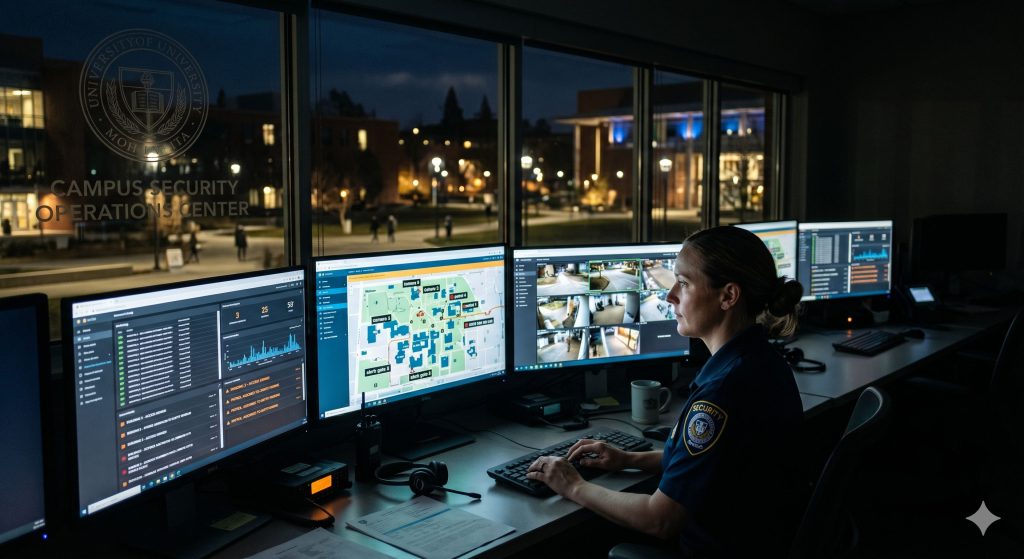
The operational shift happens at the data layer. When parking management, enforcement, license plate recognition, and incident management run on a unified platform — sharing the same database, the same vehicle records, the same interface — enforcement patrol becomes something more than permit validation.
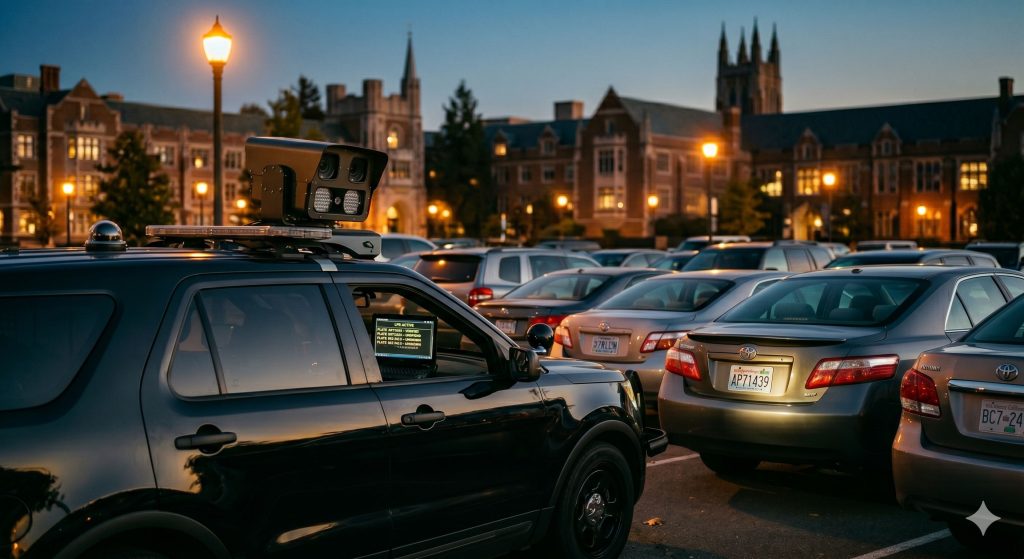
Every LPR scan during a routine enforcement patrol is also checked against the incident management system in real time. A vehicle flagged as a BOLO, associated with an open investigation, or restricted from campus surfaces as an alert on the enforcement officer’s device — through the same workflow used for a permit violation. The officer doesn’t need to check a separate system or wait for a radio call. The security context comes through automatically.
That’s not a feature bolted on top of a parking system. It’s what happens when parking and security operations are designed around a single source of truth.
The connection works the other way, too. When a security incident involves a vehicle — a hit and run in a parking structure, a suspicious vehicle report, a theft near a surface lot — investigators have immediate access to that vehicle’s permit history, enforcement activity, and LPR scan records from within the incident file. No data request to another department. No waiting for someone to pull records from a separate system. The information is already there.
LPR as a perimeter intelligence tool
License plate recognition is often evaluated as an enforcement efficiency tool — which it is. Faster scans, better coverage, less manual logging. The ROI case is straightforward.
But on a campus with security responsibilities, LPR also functions as a perimeter intelligence layer. Every read is a data point: this vehicle was in this location at this time. Over time, that produces a record of campus vehicle activity that has operational value well beyond permit compliance.
When a security incident occurs, that historical scan data is searchable. Patterns become visible. Vehicles that appear repeatedly in areas where incidents cluster, vehicles that enter during off-hours, vehicles that match descriptions in watchlists — these become findable rather than invisible.
The enforcement patrol that scanned those plates didn’t know it was contributing to a security investigation. It was just doing its job. That’s the point: when the systems are integrated, routine operations generate security intelligence as a byproduct, without adding burden to the officer in the field.
Visitor visibility and the open-campus challenge
Academic institutions have robust identity infrastructure for their own community — student IDs, staff credentials, access cards. Visitors are a different story.
Prospective students, alumni, conference attendees, vendors, contractors, and members of the public typically access campus through parking. They may receive a visitor permit — virtual or physical — but beyond that, visibility is limited. Parking facilities often lack the staffing levels present at building entrances, and the sheer volume of visitor vehicles makes manual monitoring impractical.
A connected parking and security platform extends that visibility. Visitor vehicle records, permit issuance, LPR scans, and any enforcement or incident activity involving a visitor vehicle are all captured in the same system. If a security concern arises involving a visitor, that record exists — and it’s searchable.
This isn’t surveillance for its own sake. It’s operational awareness that supports the response and documentation requirements that modern campus safety demands.
Clery Act compliance and why the parking lot matters
For US colleges and universities participating in federal financial aid programs, the Clery Act creates specific, documented obligations around campus crime reporting — including incidents that occur in parking facilities and on public property adjacent to campus.
Parking lots, parking structures, and the roads and pathways immediately surrounding campus are all Clery geography. Incidents that occur there — theft, assault, vehicle crimes, suspicious activity — need to be captured, categorized, and reported accurately. That’s difficult to do consistently when parking and security operate in separate systems with separate records.
When IncidentAdmin and the parking platform share a database, incidents involving vehicles or occurring in parking areas are documented with the location, vehicle, and permit context already attached. Clery-required records are built through consistent daily documentation — not reconstructed from scattered notes at reporting time. Learn more about how OPSCOM supports Clery Act reporting workflows.
What this looks like in practice: Carleton University
Carleton University’s Department of University Safety built their parking and security operation around a fully integrated OPSCOM platform — parking management, enforcement, LPR, and incident management running as a connected system.
For their enforcement officers in the field, every patrol pass through a lot is simultaneously a permit validation exercise and a security check. BOLO vehicles and campus safety flags surface through the same interface as permit violations. The officer’s workflow doesn’t change — the intelligence layer is just there, working in the background.
Brian Billings, Director of Campus Safety Services at Carleton, put it plainly: “As the Director of University Safety, I needed a solution I could access from anywhere — in the office, at home, or out of town. OperationsCommander delivered.”
Read the Carleton University case study for the full operational picture. Saint Mary’s University took a similar approach — consolidating parking, enforcement, incident management, and locker administration into one platform, with vehicle watchlists connected directly to enforcement patrol. Read the Saint Mary’s University case study.
The security layer that’s already there
Most campuses already have the foundational elements of a perimeter security layer in their parking operation — officers in the field, vehicles being recorded, lots being patrolled on a schedule. The question is whether those elements are connected to the security infrastructure, or whether they’re running in parallel with it, generating data that never makes it into the security picture.
With the right platform, the parking operation you already have becomes something more. Not by adding headcount or changing workflows in ways officers will resist, but by connecting what’s already happening in the lot to the incident management system that needs to know about it.
That’s the argument for treating parking as a critical perimeter security layer — not because it requires a major operational overhaul, but because the infrastructure is often already in place, waiting to be connected.
Explore further
- OPSCOM for Higher Education — how the platform serves campus parking and security operations
- IncidentAdmin — campus incident and security management
- Clery Act Reporting — how connected incident documentation supports compliance
- PL8RDR — LPR for enforcement and campus perimeter awareness
- LPR in Parking Enforcement Operations — how LPR integrates with enforcement workflows
- Parking System Architecture: Why a Single System Matters — the case for unified operations
- How Unified Parking and Security Data Improves Operational Awareness
- Client Case Studies — see how campuses across North America run parking and security on OPSCOM