LPR in Parking Enforcement Operations: How Patrols Actually Work
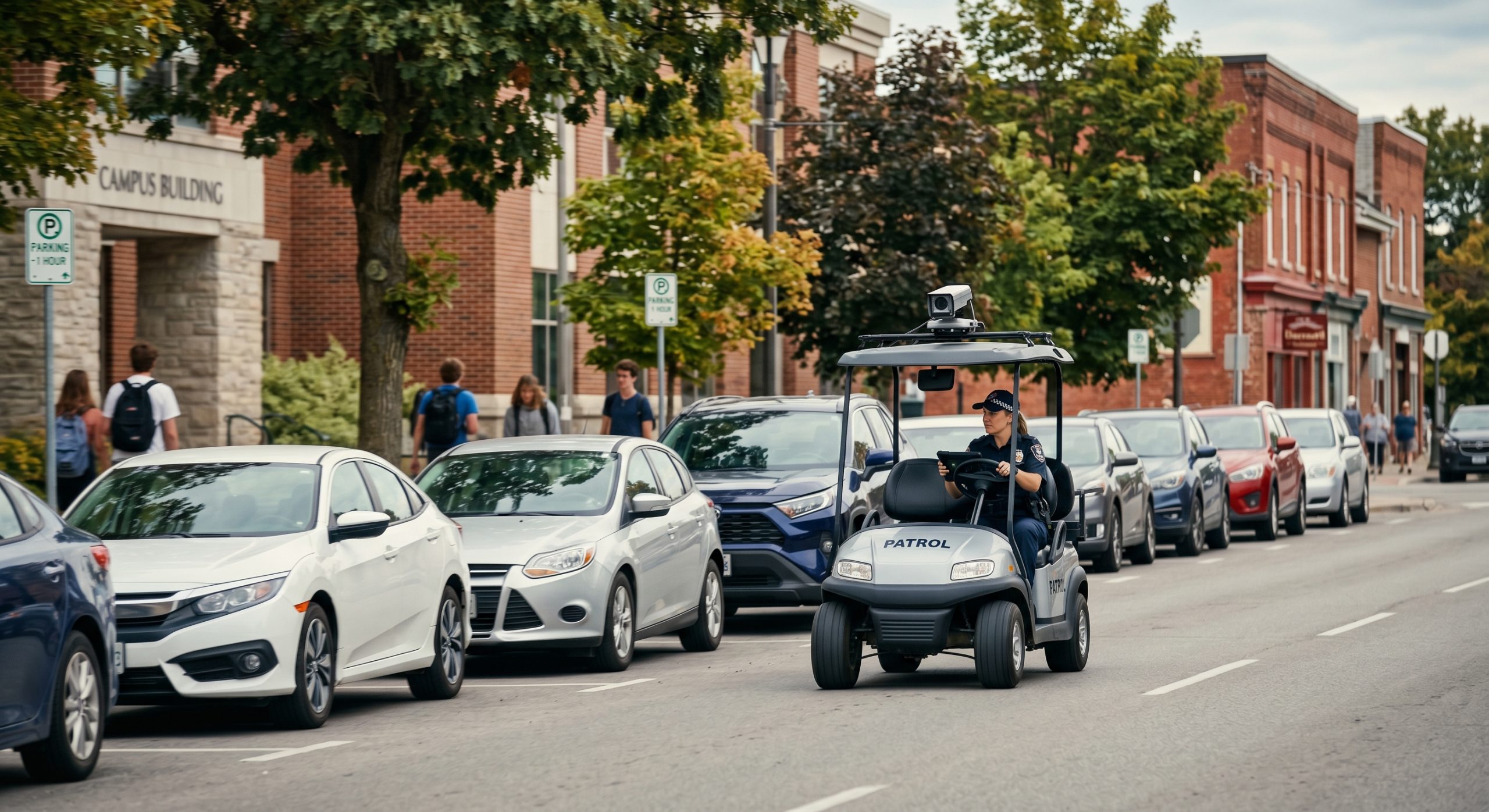
The case for LPR in parking enforcement is often made in terms of accuracy and efficiency statistics. What gets talked about less is what enforcement patrol actually looks like when LPR is part of it — how an officer’s shift runs differently, what the experience is for the parker, and what operational capabilities become available that simply weren’t possible with manual validation.
This post covers LPR enforcement operations from the ground up: the patrol workflow for both vehicle-mounted and handheld deployments, what changes operationally when validation is automated, and how the data generated by LPR patrol feeds the broader enforcement system.
The manual validation problem LPR solves
Before getting into how LPR patrol works, it’s worth being specific about what it replaces — because the limitations of manual validation aren’t always obvious until you try to scale an operation.
In a manual validation environment, an officer approaches a vehicle, looks for a permit display (hangtag, sticker, dashboard placard), and either confirms compliance visually or checks a handheld device to look up the plate. For simple permit environments with a single permit type, this works at small scale. As operations grow — more vehicles, more zones, more permit types, more time-limit enforcement — manual validation becomes the constraint.
An officer who takes fifteen seconds to manually validate each vehicle can cover around 240 vehicles per hour at a sustained pace. In a 500-space lot, that’s over two hours for a single coverage pass — before any citation paperwork, before addressing anything that requires attention, before moving to the next zone. In a multi-lot operation, thorough coverage becomes structurally difficult without proportional staffing.
LPR doesn’t just make validation faster. It changes the relationship between coverage and staffing in a way that makes comprehensive enforcement operationally achievable.
Vehicle-mounted LPR patrol: how a shift runs
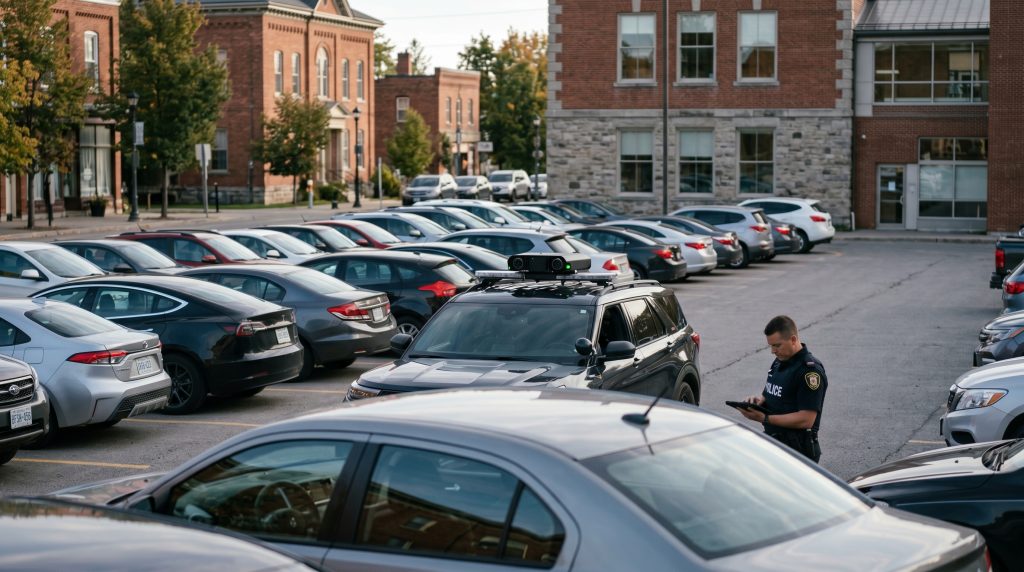
A patrol officer starting a vehicle-mounted LPR shift begins by logging into the OPSCOM enforcement app on their in-vehicle device. The system confirms connectivity to the live permit and enforcement database. Cameras — typically mounted on the vehicle roof or bumper — begin capturing plate images immediately once the vehicle starts moving.
Active patrol
As the patrol vehicle moves through the lot at normal driving speed, each camera frame is processed in real time. Plates are read, compared against the live permit database, and either cleared or flagged. The officer’s screen shows a running status — green for compliant vehicles, alerts for violations, watchlist matches, or uncertain reads that need manual confirmation.
The officer doesn’t stop for compliant vehicles. They slow or stop only when an alert appears — a vehicle with no valid permit, an expired permit, a time-limit overstay flagged by the digital chalking system, or a security watchlist match from IncidentAdmin.
When an alert triggers, the system has already pre-populated the citation workflow with the plate read, vehicle image, GPS coordinates, timestamp, and violation type. The officer reviews, confirms, and issues the citation — or dismisses the alert if a manual check reveals a valid permit the camera missed. Either way, the action takes seconds rather than minutes.
Coverage efficiency in practice
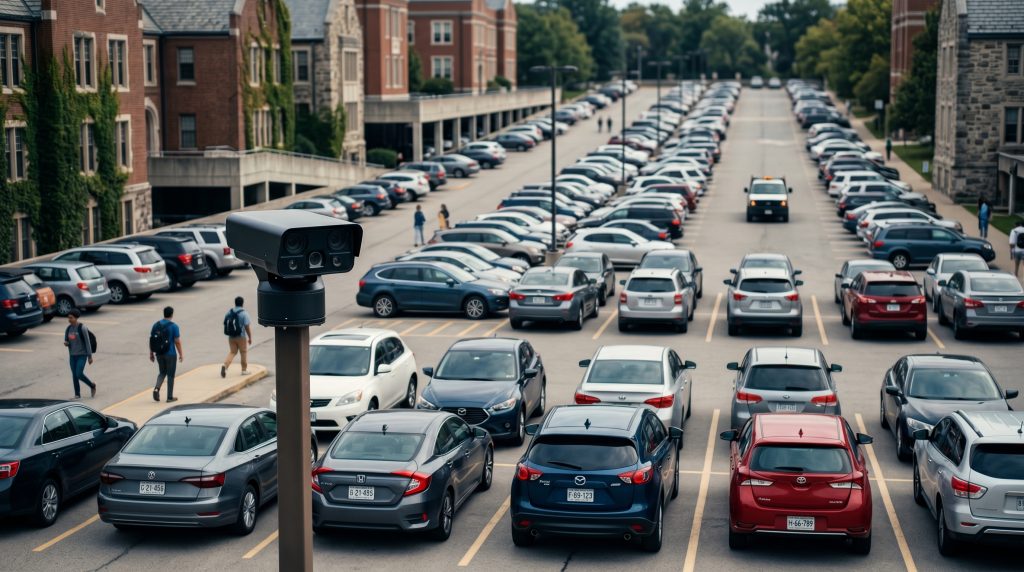
A vehicle-mounted LPR patrol can cover a 500-space lot in a single slow drive-through pass, typically 10-15 minutes depending on lot layout. Every vehicle was validated. Every violation was flagged. The officer’s attention was only required for the exceptions — the vehicles that actually needed intervention.
Compare that to the same lot covered on foot with manual validation: two hours of continuous walking, bending to check plates, looking for displayed permits, entering plates into a handheld device one at a time. By the time the officer completes a manual pass through a large lot, some of the early sections have been sitting unpatrolled for two hours.
For large campuses and multi-lot operations, this efficiency difference is the argument for vehicle-mounted LPR. Victor Valley College uses vehicle-mounted LPR as part of their campus police patrol so that comprehensive permit validation happens across the entire campus on every routine patrol pass — not as a dedicated enforcement effort but as standard operating procedure. See how higher education operations deploy LPR on OPSCOM.
Handheld LPR patrol: how it differs
In environments where officers are on foot — urban on-street enforcement, indoor garages, gated residential communities, pedestrian-only zones — handheld LPR through OPSCOM’s mobile app (available on both iOS and Android) provides the same real-time validation capability without the vehicle infrastructure.
The officer uses their device camera to photograph a plate. The app processes the image, queries the live database, and returns the vehicle’s status. The workflow for issuing a citation if a violation is found is identical to the vehicle-mounted workflow — the same evidence capture, the same real-time database write, the same immediate availability in the back-office system and payment portal.
The coverage rate is lower than vehicle-mounted LPR — the officer is still approaching each vehicle — but the validation accuracy and data quality are the same. And compared to manual permit checking without LPR, handheld LPR still delivers significant improvements: no visual searching for permit displays, no cross-referencing plate numbers manually against a device, instant confirmation rather than a multi-step lookup.
For many operations, handheld and vehicle-mounted LPR are complementary rather than competing. Vehicle-mounted covers large open lots efficiently; handheld covers the spaces and environments where vehicle access is limited.
Time-based enforcement with LPR: the chalking connection
Permit validation is one part of what LPR patrols accomplish. Time-based enforcement — two-hour limits, loading zone windows, short-term visitor zones — requires tracking when a vehicle was first observed in a zone, not just whether it has a permit.
In OPSCOM, LPR patrol integrates directly with digital tire chalking. When the LPR system reads a plate in a time-limited zone, it checks the chalking database for a prior observation. If none exists, it creates a first-observation record with the plate, zone, GPS location, and timestamp. On the next patrol pass through the same zone, the LPR read triggers a dwell time calculation — current time minus first observation. If the limit has been exceeded, a violation is flagged automatically.
This connection is what makes time-based enforcement across multiple officers and shifts operationally clean. Officer A’s first observation is recorded in the system. Officer B’s second-pass read finds that record and calculates the dwell time correctly — without Officer B needing to know what Officer A saw, without any inter-shift communication, and without any manual chalking or note-taking.
For the full picture of how digital chalking and LPR work together, see Digital Tire Chalking and LPR: How They Work Together in Modern Enforcement.
What LPR patrol data produces for the back office
Every LPR read — not just violations — is logged in the OPSCOM database with the plate, location, timestamp, and status. This means LPR patrol produces a continuous record of vehicle presence across the operation, not just a record of violations issued.
That comprehensive read log is valuable beyond enforcement. It’s the raw material for occupancy analytics — understanding how lots fill and empty through the day. It’s the audit trail that supports appeals — showing exactly when a vehicle was first observed and what status it returned at each read. And it’s the compliance pattern data that informs patrol scheduling — which zones have the highest violation rates, which time windows need more coverage, which areas are being patrolled thoroughly and which are seeing gaps.
For how LPR read data feeds operational analytics, see the Parking Data and Analytics Knowledge Center.
Security integration during patrol
Parking enforcement officers patrol the same spaces as the broader security operation. In organizations where those two functions share OPSCOM’s platform, every LPR read during an enforcement patrol is also a security check.
Plates flagged in IncidentAdmin — BOLO vehicles, campus safety concerns, access-restricted plates — surface as alerts on the enforcement officer’s device during routine permit validation patrol. The officer doesn’t need to access a separate system or be manually notified by radio. The security alert comes through the same interface as the permit violation alert.
Carleton University’s Department of University Safety built their entire parking and security operation around this integration — enforcement patrol contributes to campus situational awareness on every pass through every lot. Read the Carleton University case study.
Explore LPR in depth
- License Plate Recognition (LPR): How It Works in Modern Parking Enforcement
- LPR ROI: What License Plate Recognition Delivers in Parking Enforcement
- Using LPR for Compliance Monitoring in Parking Enforcement
- LPR Parking Enforcement Software: Why Integration Defines Performance
- PL8RDR: OPSCOM’s LPR platform
- License Plate Recognition Knowledge Center