Parking Enforcement Software: The Complete Lifecycle
Parking enforcement software is often evaluated based on how quickly it can issue tickets. That approach misses the bigger picture.
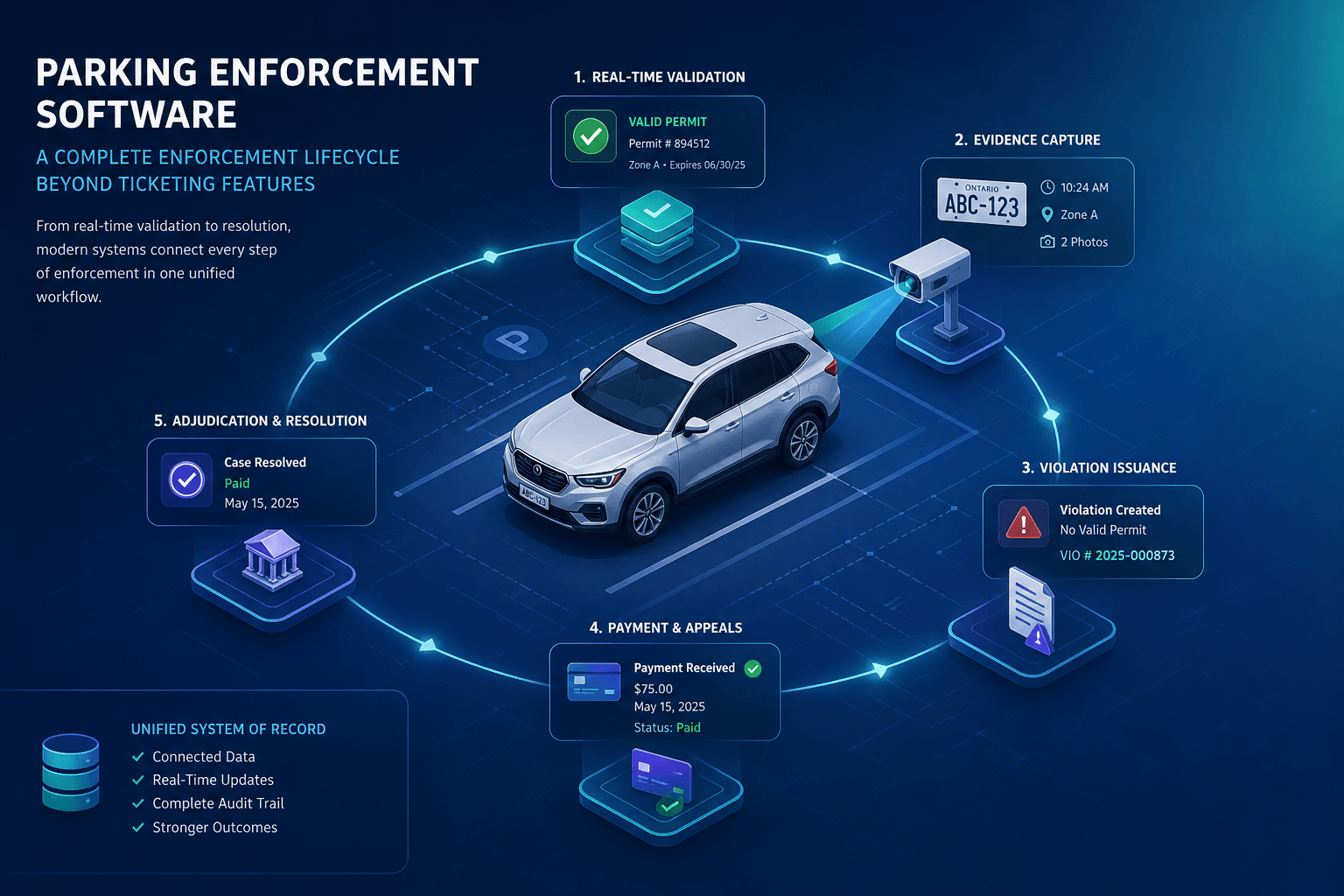
Enforcement is not a single action. It is a continuous operational lifecycle that starts with validation and ends with resolution.
The most effective platforms are not defined by how many features they offer. They are defined by how well those features work together in real time.
For a broader overview of how enforcement fits into modern operations, see the Parking Enforcement Systems guide.
The Problem with Feature Checklists
Most comparisons of parking enforcement software focus on a familiar set of capabilities:
- License Plate Recognition (LPR) or ANPR
- Mobile ticketing tools
- Payment integration
- Reporting dashboards
These features are important, but they are often implemented as separate tools.
This creates common operational gaps:
- Vehicles are not validated consistently before enforcement
- Evidence is stored separately from violations
- Payments and appeals are disconnected from the original citation
- Audit trails are incomplete or difficult to reconstruct
The result is more manual work, more disputes, and less confidence in enforcement outcomes.
What Actually Matters: The Enforcement Lifecycle
Modern parking enforcement systems should support the full enforcement lifecycle, not just individual steps.
1. Real-Time Vehicle Validation
Before any action is taken, vehicles should be validated against active permits, sessions, or exemptions.
This connects directly to systems like ParkAdmin, where permit and parking data are managed in real time.
2. Evidence Capture
When a vehicle is in violation, the system should automatically capture license plate reads, timestamp, GPS location, and contextual images.
This is often supported through License Plate Recognition and tools like PL8RDR LPR.
3. Violation Issuance
Citations should be generated with validated data, attached evidence, and consistent rule application.
This is managed within enforcement workflows such as ViolationAdmin.
4. Integrated Payment and Appeals
After issuance, the same system should handle online payments, dispute submission, and status tracking.
Keeping this within a unified workflow reduces administrative overhead and improves response time.
5. Adjudication and Audit Trail
Every step should be connected and traceable, from issuance to resolution.
In municipal environments, this also supports court-ready workflows and compliance processes, as seen in the Town of Perth case study.
The Difference: Tools vs Systems
| Traditional Enforcement Tools | Unified Enforcement System |
|---|---|
| Ticketing-focused workflows | Full lifecycle management |
| Manual or partial validation | Real-time validation before action |
| Evidence stored separately | Evidence tied directly to violations |
| Disconnected payment and appeals | Integrated resolution workflow |
| Limited audit visibility | Complete, traceable audit trail |
The Role of a Unified System of Record
To support a true enforcement lifecycle, all activity must exist within a single system of record.
This means permits, enforcement, payments, and appeals all share the same data, updates happen in real time, and every action is traceable.
Platforms like OperationsCommander are designed around this model, where enforcement is part of a unified operational system rather than a standalone function.
Explore the full OPSCOM platform to see how these components connect.
How This Changes Day-to-Day Operations
- Officers can validate and act with confidence in the field
- Evidence is captured once and reused throughout the lifecycle
- Administrators spend less time reconciling data
- Disputes are resolved faster with full context
- Organizations maintain a clear audit trail
See how this works in practice in the Carleton University case study.
What to Look for When Evaluating Enforcement Software
- Does the system validate vehicles in real time before issuing violations?
- Is evidence automatically captured and tied to each citation?
- Are payments and appeals handled within the same platform?
- Can every enforcement action be audited from start to finish?
- Do all workflows operate within a single system of record?
Moving Beyond Ticketing
Parking enforcement is evolving from a reactive process into a connected operational workflow.
The goal is not just to issue citations. It is to manage enforcement as a complete, unified process.
Explore Enforcement in Practice
- Explore Parking Enforcement Systems
- Learn about ViolationAdmin
- Understand LPR in enforcement
- See PL8RDR in action
- Connect permits with enforcement