Parking Citation Lifecycle: From Issuance to Resolution

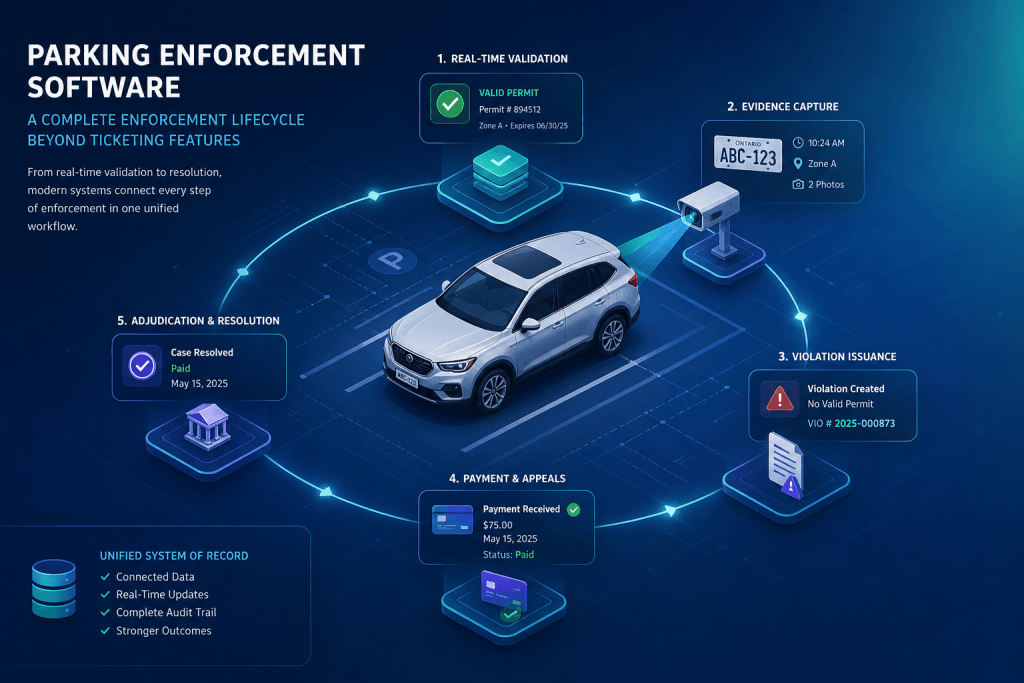
A parking citation doesn’t end when it’s printed or sent. For the officer who issued it, that moment is the finish line. For the enforcement operation, it’s the starting gun.
What happens after issuance determines whether violations get paid, whether disputes are resolved fairly and efficiently, and whether the enforcement operation generates the revenue and compliance outcomes it was designed to produce. It also determines how much administrative time the back-office team spends on each case — and whether that time is spent making decisions or just finding information.
This post covers the complete parking citation lifecycle: what each stage involves, what the parker’s experience looks like at each step, what the administrator’s experience looks like, and what a connected system handles automatically that fragmented systems leave to manual process.
Stage 1: Issuance and immediate system availability
In ViolationAdmin, a citation issued from a field device is available in the back-office system and the parker-facing payment portal the moment the officer confirms it. Not after a sync. Not at end of shift. Immediately.
That immediacy matters for three reasons. First, parkers who go looking for their citation — to confirm the fine amount, review the evidence, or simply understand what they were cited for — find it right away. Second, parkers who want to pay quickly can do so before they’ve even left the area. Third, administrators monitoring an active enforcement patrol can see cases as they’re issued and act on anything that requires attention without waiting for a batch report.
What gets captured at issuance is the foundation everything else depends on. The citation record in OPSCOM includes the license plate, vehicle make and colour, violation type and description, zone and lot, timestamp, GPS coordinates, officer identity, and photographic evidence — all created automatically as part of the issuance workflow rather than entered manually afterward. This evidence package travels with the citation through every subsequent stage.
Stage 2: Parker notification
A physical notice on the windshield has always been the traditional notification method — and for walk-up enforcement, it still is. In OPSCOM, that physical notice is printed via Bluetooth-enabled printer from the officer’s handheld device at the moment of issuance. But notification doesn’t stop there.
For parkers whose plate is registered in the system — permit holders, repeat visitors, registered accounts — an electronic notification can be sent automatically, providing the citation details, the full evidence record, and a direct link to the online payment and appeals portal. This matters particularly for permit holders, who may return to a car without a physical notice (paperless enforcement environments) or who move through high-traffic lots where physical notices can be displaced or removed.
For parkers not previously in the system, the citation is discoverable through the online lookup tool by entering their plate number. The citation record they find includes everything the administrator sees — the same evidence, the same details, the same options to pay or dispute.
Stage 3: Payment
Online payment is the highest-leverage intervention in the citation lifecycle. When payment is immediately available, clearly structured, and frictionless — no office visit, no phone call, no waiting for a cheque to clear — most parkers who accept the citation as valid simply pay it.
The Town of Perth, Ontario saw a 91% ticket collection rate in Year 1 after implementing OPSCOM’s connected enforcement and online payment workflows. That number reflects what happens when the friction between “I should pay this” and “I have paid this” is minimized. Read the Town of Perth case study for the full operational context.
OPSCOM’s payment portal accepts payment by credit card with PCI-compliant processing, provides an immediate receipt, and updates the citation record to Paid status instantly. Early payment discounts can be configured — common in municipal enforcement programs — automatically expiring after the defined window. Partial payments and payment plans can also be supported for operations that offer them.
Stage 4: Appeals and dispute resolution
Not every parker accepts a citation as valid. Appeals are a normal and legitimate part of the enforcement lifecycle — and how they’re handled shapes the operation’s reputation with the community it serves almost as much as the enforcement itself.
In OPSCOM, parkers submit appeals through the online portal, providing their explanation and any supporting information. The appeal triggers a review task for the administrator, who opens the citation record and sees the complete evidence package immediately: plate image, vehicle photos, GPS location, timestamp, officer notes, permit status at the time of the violation, and the digital chalking record if it’s a time-based violation.
That completeness is what makes fair, defensible appeal decisions possible. An administrator who can see exactly what the officer observed, at exactly what time, in exactly what zone, with exactly what permit status, can evaluate the dispute on its actual merits rather than on competing claims about what happened. Appeals that should be upheld get upheld. Appeals that shouldn’t aren’t.
Columbus College of Art and Design noted the improvement in their dispute resolution process after implementing OPSCOM — specifically the ability to access complete evidence records quickly and follow up with parkers directly, which made the appeals experience more transparent and responsive for both parties. Read the CCAD case study.
For operations with high appeal volumes, OPSCOM supports configurable appeal workflows — defined response windows, automated acknowledgment notifications, and reporting on appeal outcomes by violation type that helps administrators identify whether specific violation categories are generating disproportionate disputes (which often signals a rule clarity or communication issue rather than an enforcement problem).
Stage 5: Adjudication
Some disputes escalate beyond the initial appeal review — to a formal hearing, a committee review, or in municipal contexts, to the courts. The citation lifecycle needs to support these escalation paths without losing the evidence integrity that the case depends on.
In OPSCOM, the complete citation record — evidence, history, payment status, appeal submissions and responses, all timestamped and audit-trailed — is the adjudication record. For Ontario municipalities operating under the Provincial Offences Act, this includes the automated generation of Notices of Impending Conviction and court-ready documentation within the same system that handled the original enforcement. There’s no case file to reconstruct from separate sources; it was built continuously from the moment of issuance.
For university disciplinary processes, the violation history and case record exported from OPSCOM feeds directly into the institution’s standard administrative review process. For property management towing cases, the systematic violation history — showing the first, second, and third violations that triggered the towing authorization — is the documentation that makes the towing defensible. The Village at Valley Forge runs exactly this workflow for their three-strike policy.
Stage 6: Escalation for unpaid violations
Violations that aren’t paid and aren’t disputed need to move through a structured escalation path — and that escalation needs to happen automatically, on schedule, without requiring administrator intervention at each step.
OPSCOM’s escalation workflows are configurable to the operation’s policies. Late fees trigger automatically after the defined window. Reminder notifications go out at configured intervals. Cases that reach the escalation threshold move into the appropriate resolution path — financial hold, plate denial, collections referral, or court workflow — based on rules the operation has defined.
For universities, the most important escalation path is the Student Information System integration. Unpaid violations automatically generate financial holds on student accounts through Banner or PeopleSoft, ensuring that the enforcement system and the institution’s financial system stay synchronized without manual reconciliation. See how higher education operations manage this on OPSCOM.
For municipalities in Ontario, the escalation path runs through the provincial system — MTO plate denial requests and Notice of Impending Conviction workflows generated within OPSCOM and integrated with the court administration process. See how municipal enforcement handles this on OPSCOM.
Brandon University’s enforcement program was generating declining revenue with no way to diagnose why — violations were being issued but escalation and tracking weren’t closing the loop. The Brandon University case study shows what systematic escalation tracking revealed and what changed as a result.
Stage 7: Case closure and reporting
A case closes when it reaches a final state: paid, voided, written off, adjudicated, or referred to collections. In OPSCOM, closed cases remain in the system with their complete history — accessible for audit, reporting, and pattern analysis.
The aggregated data from closed cases is what drives operational improvement over time. Collection rate by violation type and zone. Average time from issuance to resolution. Appeal success rate by violation category. Repeat offender patterns by plate and by zone. Revenue by permit category and enforcement activity.
None of this analysis is possible when citation data is scattered across systems or archived in ways that make it hard to query. When the complete lifecycle — from issuance through final disposition — lives in one system, the reporting that emerges reflects what actually happened rather than a partial picture assembled from available sources.
For a deeper look at how enforcement data feeds operational decision-making, see the Parking Data and Analytics Knowledge Center.
Explore the enforcement system in depth
- How automated parking enforcement works as a connected system
- The parking enforcement workflow, step by step
- How compliance automation drives consistent enforcement decisions
- Officer tools that enable real-time validation and enforcement
- ViolationAdmin: OPSCOM’s parking enforcement platform
- Parking Enforcement Systems Knowledge Center