LPR ROI: What License Plate Recognition Delivers in Parking Enforcement

LPR hardware has a price tag that makes most parking operations pause. Cameras, mounting hardware, processing units, installation, software licensing — even a modest vehicle-mounted deployment represents a meaningful capital investment. The question isn’t whether LPR is impressive technology. The question is whether the operational returns justify the cost in your specific environment.
This post works through what LPR actually delivers in practice — where the returns are real and quantifiable, where they’re more qualitative, and what operational conditions determine whether the investment makes sense.
Coverage efficiency: the most direct ROI driver
The most straightforward LPR ROI calculation starts with coverage. How many vehicles can an enforcement officer validate per hour with LPR versus without it — and what does that difference mean for enforcement outcomes?
A manual validation pass through a parking lot — approaching each vehicle, checking for a permit display, looking up the plate when there’s doubt — takes roughly fifteen to twenty seconds per vehicle under good conditions. That’s around 180-240 vehicles per hour for an experienced officer working at a sustained pace.
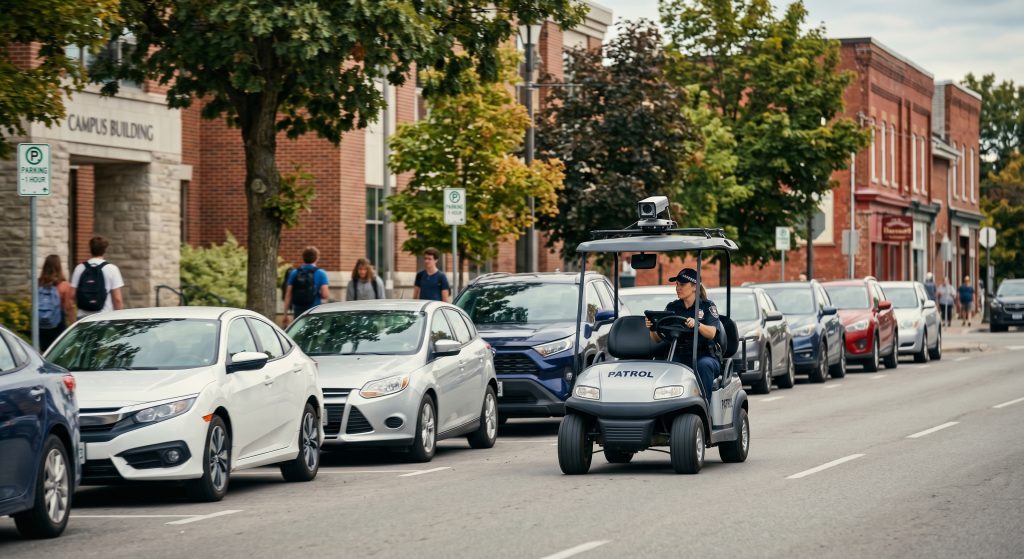
A vehicle-mounted LPR patrol validates every vehicle the patrol vehicle passes. At typical patrol speed through a parking lot, that’s several hundred vehicles per hour — with the officer’s attention only required when an alert fires. The officer isn’t spending time on compliant vehicles at all.
The practical implication depends heavily on your operation’s scale. For a 200-space lot with a single enforcement officer, the difference between manual and LPR validation may not change staffing requirements. For a 2,000-space multi-lot campus where thorough coverage is currently impossible with available staff, LPR changes what the operation can actually accomplish — not by adding speed, but by changing the coverage-to-staffing ratio fundamentally.
Victor Valley College deployed OPSCOM’s LPR system specifically to achieve campus-wide permit coverage as part of standard police patrol. Before LPR, comprehensive validation across the full campus required dedicated enforcement effort that competed with other patrol priorities. After, validation is a byproduct of security patrol — coverage improved without additional staffing. See how higher education operations deploy LPR on OPSCOM.
Compliance improvement: the indirect ROI driver
Higher coverage frequency changes parker behavior. When parkers know that a lot is patrolled thoroughly and regularly — rather than sporadically or only during dedicated enforcement windows — compliance improves. The deterrent effect of consistent, visible enforcement is real and well-documented in parking operations that have tracked compliance rates before and after implementing LPR patrol.
The mechanism is straightforward: parkers who previously knew that enforcement was infrequent enough to make the risk of non-compliance acceptable update their behavior when the risk changes. A lot that was patrolled manually once per morning and once per afternoon had a predictable enforcement window that sophisticated non-compliant parkers learned to work around. A lot covered by LPR on every patrol pass — multiple times per shift — doesn’t have that predictable gap.
Compliance improvement compounds over time. As the parker population learns that enforcement is consistent, the baseline compliance rate rises and stays elevated — reducing the overall enforcement load even as coverage increases. Fewer violations means less citation processing, fewer disputes, less administrative work downstream.
Collection rate impact: the Perth example
LPR contributes to collection rates in two ways. First, by improving citation accuracy — fewer invalid tickets means fewer disputes and voids, which means a higher percentage of issued citations are legitimate and collectible. Second, by improving evidence quality — citations with complete photographic evidence, GPS, and timestamp are harder to dispute successfully, which means the citations that are disputed are more likely to be upheld.
The Town of Perth, Ontario achieved a 91% ticket collection rate in Year 1 after implementing OPSCOM’s connected enforcement — including LPR patrol. That figure reflects the combined effect of accurate citations (fewer invalid tickets entering the collection pipeline), online payment availability (frictionless resolution for parkers who accept the citation as valid), and evidence quality (disputed citations backed by complete records). Read the Town of Perth case study for the full operational context.
Read accuracy and enforcement error reduction
Invalid citations are expensive. Each one requires administrative time to investigate, a void to process, and often a follow-up communication to the parker. In operations that issue hundreds of citations per week, even a modest invalid citation rate creates meaningful ongoing administrative cost.
The primary source of invalid citations in permit-based enforcement is stale permit data — the enforcement system not reflecting a valid permit because it loaded permit data at the start of shift and the permit was purchased afterward. LPR doesn’t solve this problem on its own. Connected LPR — where plate reads query live permit data rather than a cached export — does.
In OPSCOM, LPR plate reads query the live permit database in real time. A permit purchased at 10:15am is visible to an LPR patrol at 10:20am. The category of invalid citation caused by data currency problems is essentially eliminated. The remaining sources of invalid citations — genuine system errors, damaged plates that were misread, edge cases in complex permit rule application — are handled through the low-confidence read flagging and the standard appeals process.
Fleming College’s Systems Administrator specifically noted the read accuracy improvement after switching to PL8RDR — improved accuracy at varied angles and distances, simpler camera mounting, and fewer manual corrections during patrol. Fewer correction events means less officer time spent on exception handling and more time on productive patrol.
Staff productivity: what LPR changes for enforcement teams
The ROI of LPR isn’t only about how many vehicles get validated. It’s about what enforcement officers can do with the time and attention that manual validation was consuming.
An officer freed from manual plate-by-plate validation — either because LPR is handling it automatically during vehicle-mounted patrol, or because handheld LPR has reduced the time per vehicle — can cover more ground, respond to issues in adjacent zones, conduct more thorough checks when alerts fire, or take on additional enforcement responsibilities. The productivity gain from LPR is partially captured in citations issued; the rest shows up in coverage quality and officer capacity.
For operations that have been unable to enforce certain zones consistently due to staffing constraints, LPR doesn’t just make existing enforcement faster — it makes enforcement in under-resourced zones possible at all. That expanded coverage has enforcement value that shows up in both compliance rates and in revenue from previously under-enforced violations.
Fixed LPR: the virtual permit environment ROI
For operations that implement fixed LPR at lot entry and exit points, the ROI calculation includes the elimination of physical permit costs — printing, distribution, replacement processing, hangtag stock — and the reduction in permit fraud.
Physical permits can be shared, lent, stolen, or counterfeited. Virtual permits enforced through fixed LPR camera coverage eliminate these fraud vectors entirely — the permit is tied to a registered plate, and the plate is what the camera reads. Operations that have run audits comparing their permit holder list against LPR entry records frequently find a meaningful gap between the number of permits issued and the number of distinct vehicles using them — reflecting the sharing that physical permits enable.
Carleton University eliminated physical hangtags entirely after implementing connected LPR. The administrative overhead of physical permit management — printing, distribution, replacement processing — was eliminated alongside the fraud exposure. Read the Carleton University case study.
Evaluating LPR ROI for your operation
The ROI calculation for LPR deployment is specific to your operational environment. The factors that determine whether it’s favourable include:
- Scale: Large lots and multi-lot operations see higher coverage efficiency gains. Smaller operations may see ROI primarily through accuracy improvement and fraud reduction rather than coverage efficiency.
- Current invalid citation rate: Operations with a meaningful stale-data invalid citation problem see faster ROI from connected LPR than those whose permit data is already current.
- Enforcement frequency: Operations that currently under-enforce due to staffing constraints see the largest compliance and revenue improvement from LPR-enabled coverage expansion.
- Permit fraud exposure: Operations with physical permit programs where sharing is suspected see direct revenue recovery from virtual permit transition enabled by LPR.
- Integration depth: The ROI of LPR hardware is significantly higher when it’s connected to live permit data, enforcement workflows, and analytics than when it’s operating as a standalone read tool.
For the full case on why integration determines LPR performance — and therefore ROI — see LPR Parking Enforcement Software: Why Integration Defines Performance.
Explore LPR in depth
- License Plate Recognition (LPR): How It Works in Modern Parking Enforcement
- LPR in Parking Enforcement Operations: How Patrols Actually Work
- Using LPR for Compliance Monitoring in Parking Enforcement
- LPR Parking Enforcement Software: Why Integration Defines Performance
- PL8RDR: OPSCOM’s LPR platform
- License Plate Recognition Knowledge Center