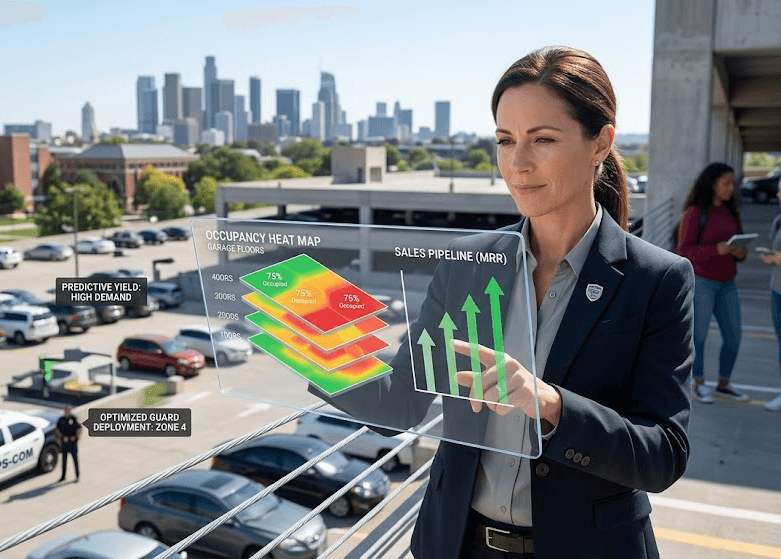
How Unified Parking and Security Data Improves Operational Awareness
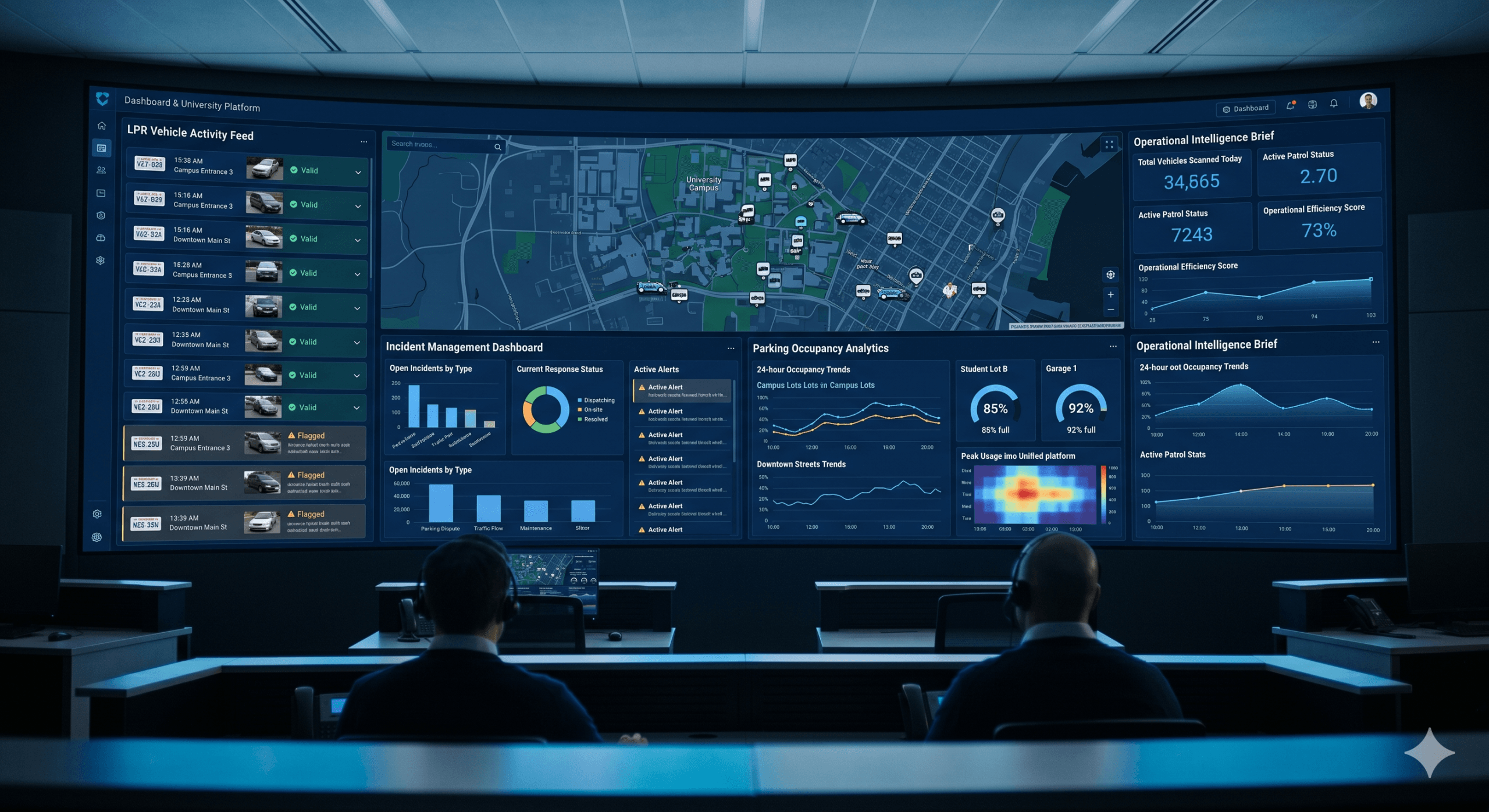
Most organizations manage parking and security as separate functions. Separate departments, separate tools, separate reporting. Parking enforcement handles permits and violations. Security handles incidents, access, and safety. The data each produces lives in separate systems and is reviewed by separate teams.
This separation is operationally costly in ways that aren’t always obvious until an incident reveals the gap. A vehicle connected to a security concern is parked on campus, observed by parking enforcement during routine patrol, and not identified as a concern because parking and security aren’t sharing watchlist data. An incident occurs near a parking structure, and the investigation needs to reconstruct which vehicles were present — data that parking enforcement collected but that’s in a different system from the incident record. A pattern of incidents in a specific lot correlates with a pattern of unauthorized vehicles that parking data would reveal — if the two data sets were ever compared.
Unified parking and security data doesn’t require merging two departments. It requires connecting their data in one platform — so the operational picture each team sees includes context from the other, without requiring active coordination to make it happen.
The shared vehicle record
The vehicle is the entity that parking and security operations share. A vehicle appears in parking data when it’s scanned during enforcement patrol. It appears in security data when it’s associated with an incident, placed on a watchlist, or flagged for access control reasons. When those records live in the same system, the vehicle’s history is complete and connected.
In OPSCOM, ParkAdmin (permits), ViolationAdmin (enforcement), and IncidentAdmin (security and incidents) share the same vehicle and plate database. A plate that’s flagged in IncidentAdmin as a security concern is visible to enforcement officers during routine LPR patrol. A plate with a significant enforcement history is visible to security officers when they investigate a related incident. The full history of how that vehicle has interacted with the organization is in one place, accessible to the teams that need it.
This shared record is what Carleton University’s Department of University Safety built their operation around. Parking enforcement, LPR patrol, and incident management all operate from the same database. Security teams see parking activity. Enforcement officers see security alerts. When an incident involves a vehicle, the complete parking and enforcement history for that plate is immediately available for investigation — without any request to another department or access to a separate system. Read the Carleton University case study.
For US universities subject to the Clery Act, this connected record also simplifies annual compliance reporting. Incident data, geographic crime statistics, daily crime logs, and emergency notification records that feed the Annual Security Report are captured within IncidentAdmin as part of normal operations — not assembled from separate sources at reporting time. See how Clery Act reporting works within IncidentAdmin.
LPR patrol as security intelligence
Parking enforcement patrol generates a continuous record of vehicle presence across the organization. In operations where parking and security are connected, that record is security intelligence — not just an enforcement audit trail.
Every LPR read during a parking patrol is logged with the plate, zone, GPS location, and timestamp. Aggregated across multiple patrol passes over time, these reads show where specific vehicles have been present, how frequently, and when. For a security investigation that needs to establish whether a vehicle of interest was present on campus on specific dates, the LPR patrol log is a queryable record that may contain exactly that information — without any additional surveillance infrastructure required.
Conversely, security watchlist entries in IncidentAdmin are visible to enforcement officers during routine patrol. A plate flagged as a BOLO vehicle, a plate associated with a campus safety concern, or a plate placed on an access restriction list — all of these surface as alerts on the enforcement officer’s device when that plate is scanned during permit validation. The officer who encounters the vehicle during routine parking patrol receives the security alert through the same interface as the permit violation alert. No additional communication required. No separate system to check.
This bidirectional data flow turns every parking patrol into a security sweep, and every security alert into something that every officer on patrol is actively looking for — without any change to either team’s operational routine.
Incident-to-parking connections
Incidents that occur in or near parking facilities often have parking data components that are relevant to investigation and response. A vehicle left in a no-parking zone that turns out to be connected to a safety concern. Vandalism in a parking structure that occurred during a window when specific vehicles were present. A parking dispute that escalated into a security incident.
In a fragmented system, connecting incident records to parking records requires a manual process: retrieve the incident report, identify the vehicles of interest, submit a request to the parking department for enforcement records, wait for those records to be extracted and shared. In a connected system, those records are in the same database. An incident record in IncidentAdmin can be directly linked to LPR reads, permit records, and violation history for the same vehicles or the same location, in the same interface, immediately.
This connection is particularly valuable for pattern analysis. A series of incidents in Lot D over three months looks different if parking data shows that the same small set of unauthorized vehicles was present during each incident window. Identifying that pattern in a fragmented system requires a data analyst and a deliberate investigation. In a connected system, it’s a query.
Access restriction enforcement
Some organizations need to enforce not just parking rules, but access restrictions — specific vehicles or individuals who are not permitted on the premises regardless of permit status. Restraining orders, terminated employee access revocations, trespass notices, and prior-incident-based restrictions all create access control requirements that go beyond standard permit enforcement.
In OPSCOM, IncidentAdmin manages access restriction records. These restrictions appear as watchlist entries visible to enforcement officers during LPR patrol — flagging the vehicle regardless of permit status. A vehicle with a valid permit that is also subject to an access restriction doesn’t get cleared by the permit check; the IncidentAdmin restriction overrides it.
Managing these restrictions through the same system that handles parking enforcement means they’re enforced during routine patrol without requiring a dedicated access control sweep. The enforcement officer who encounters a restriction-flagged vehicle during regular permit validation gets the alert and can respond appropriately — without the organization needing to run a separate security patrol specifically to enforce access restrictions.
The unified operational picture
The operational benefit of unified parking and security data is ultimately about the quality of situational awareness available to the people responsible for both functions. A campus safety director who can see permit activity, enforcement patterns, incident history, and LPR patrol coverage in one view has a more complete operational picture than one who has to request data from multiple departments to assemble that view manually.
That completeness matters most when something requires rapid response — an incident that needs vehicle identification quickly, a security concern that needs enforcement cooperation immediately, a pattern that needs to be recognized before it becomes a crisis. Unified data supports that speed of response. Fragmented data, however good each piece is individually, introduces delays and coordination overhead that erode the speed advantage.
For organizations — particularly universities, healthcare campuses, and municipalities — where parking and safety operations are genuinely intertwined, the question isn’t whether to connect the data. It’s how quickly the connection can be made and what it will reveal once it is.
Explore parking data and analytics in depth
- Parking Data and Analytics: How Parking Operations Become Data-Driven
- Parking Operational Analytics: Measuring What Actually Happens
- Parking Revenue Strategy: Using Data to Improve Financial Outcomes
- Parking Occupancy and Demand Analytics: Understanding How Parking Is Used
- Parking Reporting and Insights: Turning Operational Data Into Decisions
- Parking Data and Analytics Knowledge Center