Parking Operational Analytics: Measuring What Actually Happens

Operational analytics in parking management is about measuring enforcement and compliance outcomes — not just whether violations were issued, but whether they changed behavior, produced revenue, and held up under challenge. The metrics that matter most aren’t always the ones that appear first in a reporting dashboard.
This post covers the operational KPIs that parking managers and directors actually track to understand whether their operation is functioning as intended, where the gaps are, and what needs to change.
Violation collection rate
Collection rate — the percentage of issued violations that are actually paid — is one of the most direct indicators of enforcement system effectiveness. It’s not a measure of how many tickets are written. It’s a measure of whether the enforcement system is producing real financial and behavioral outcomes.
A low collection rate tells you something specific: either the citations aren’t valid (high dispute and void rate), or the payment process is too difficult (parkers who intend to pay don’t follow through), or escalation isn’t working (parkers who don’t pay face no meaningful consequences). Each of these causes has a different fix, and identifying which one applies requires looking at the collection rate alongside dispute rates, void rates, and escalation activity.
The Town of Perth, Ontario achieved a 91% collection rate in Year 1 after implementing OPSCOM’s connected enforcement and online payment workflows. That result reflects accurate citations (fewer disputes), frictionless online payment (fewer parkers who intend to pay but don’t follow through), and automated escalation (unpaid violations generating consequences on schedule). Read the Town of Perth case study.
For most operations, collection rate is tracked monthly and trended over time. A collection rate that was 75% last year and is 68% this year deserves investigation — something in the citation-to-payment pipeline has changed. In a connected system, the underlying data to diagnose what changed is in the same database as the collection rate itself.
Compliance rate by zone
Compliance rate measures the percentage of observed vehicles that are compliant with applicable rules — valid permit, within time limits, correct zone. Tracking it by zone and by time window reveals enforcement patterns that aggregate numbers hide.
A campus with an overall 85% compliance rate might have Lot A at 95% and Lot C at 62%. That difference matters — and it’s actionable. Lot C’s compliance problem might reflect inadequate patrol frequency, an unclear zone boundary, a permit type that’s frequently misapplied, or a group of repeat offenders who’ve learned the lot is rarely checked. None of those diagnoses is possible without zone-level compliance data.
Compliance rate trending over time is equally important. A zone that went from 70% to 85% compliance over a semester of regular enforcement demonstrates that enforcement is working. A zone that stays at 70% despite consistent enforcement suggests the problem isn’t patrol frequency — it’s something else (rule clarity, permit structure, physical signage) that enforcement alone won’t fix.
Repeat offender rate and escalation tracking
Repeat offender rate — the percentage of violations issued to vehicles with prior enforcement history — tells you whether enforcement is changing parker behavior or whether the same vehicles keep cycling through the system.
A high repeat offender rate with low escalation activity is a specific diagnostic: violations are being issued but consequences aren’t escalating. Parkers who receive multiple violations without meaningful consequence learn that non-compliance is a manageable cost. The fix isn’t more enforcement — it’s better escalation.
Brandon University was experiencing declining parking revenue with no clear explanation. Violations were being issued regularly, but the data to track repeat offenders and measure escalation outcomes lived in spreadsheets that didn’t connect to each other. When OPSCOM’s connected system revealed that a significant share of violations were going to a small number of repeat vehicles — and that those vehicles faced no meaningful escalation — the revenue problem became diagnosable. Read the Brandon University case study.
In OPSCOM, repeat offender tracking is automatic. Every plate read during enforcement checks the violation history database. Officers see prior violation counts and outstanding holds in real time. Administrators can query which plates have the most citations, which zones produce the most repeat activity, and whether escalation thresholds are being applied on schedule. See how parking enforcement systems handle escalation on OPSCOM.
Patrol coverage efficiency
Enforcement outcomes depend on patrol coverage — which zones are being covered, how frequently, and whether the coverage pattern matches where the compliance problems actually are. Patrol coverage efficiency measures the relationship between patrol activity and enforcement outcomes.
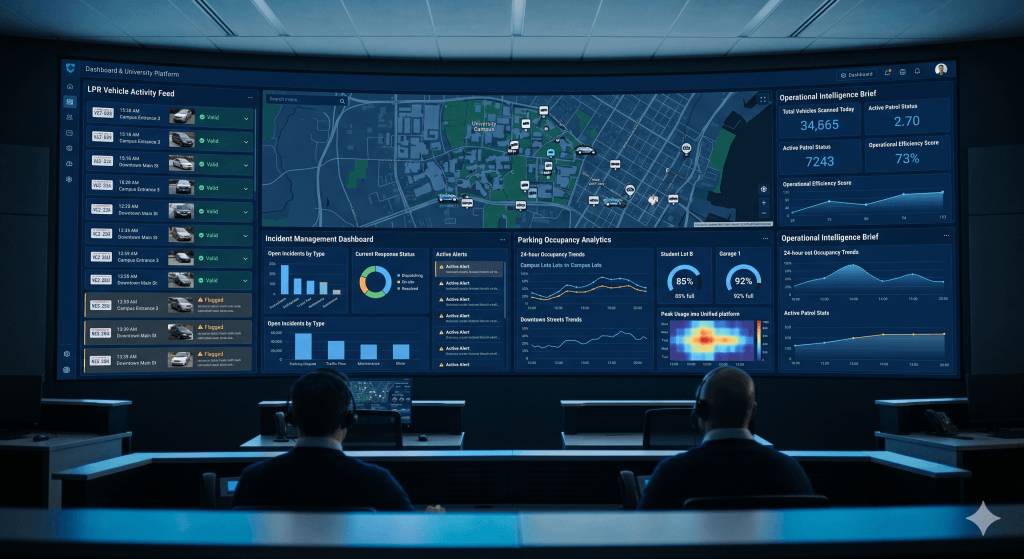
Coverage data in OPSCOM comes from LPR read logs and citation activity. Every LPR read records the zone and timestamp. Aggregate read counts by zone and time window show which areas are receiving regular coverage and which are being skipped or underserved. When this coverage data is compared against zone-level compliance rates, the gaps become visible: zones with low coverage and low compliance are the areas where additional patrol activity would produce the most improvement.
This is the data that informs patrol scheduling. Instead of assigning officers to the same routes on the same schedule because that’s how it’s always been done, coverage analytics makes the case for route adjustments based on actual compliance patterns and coverage gaps. For the full picture of how enforcement data feeds operational decisions, see Parking Enforcement Workflow: How Modern Enforcement Operates.
Appeal success rate and evidence quality
Appeal success rate — the percentage of disputed violations that are overturned — is a proxy metric for citation evidence quality. A high appeal success rate tells you that violations are being successfully disputed, which typically means one of two things: citations are being issued on insufficient evidence, or the evidence that exists isn’t being documented well enough to survive challenge.
In operations with digital enforcement and connected evidence capture, appeal success rates tend to be low — not because appeals aren’t filed, but because complete evidence records (photographs, GPS coordinates, timestamps, permit status at time of citation) make valid citations difficult to successfully dispute. When all of that evidence is attached to the citation record automatically and available for administrator review immediately, the appeals that deserve to be upheld are upheld and those that don’t aren’t.
Tracking appeal success rate by violation type adds further diagnostic value. A high appeal success rate for time-limit violations specifically might indicate that the digital chalking process isn’t capturing adequate evidence at first observation. A high success rate for permit violations in a specific zone might indicate a rule configuration error or a signage problem. These are fixable problems — but only identifiable if the data is available to find them.
Administrative efficiency metrics
Beyond the enforcement-facing KPIs, operational analytics includes metrics that reflect back-office efficiency — how much staff time the operation requires per citation issued, per permit processed, per appeal resolved.
Administrative efficiency tends to improve significantly in connected systems not because staff work faster, but because the work itself changes. Reconciliation tasks disappear when data is unified. Manual data entry decreases when systems are connected. Exception handling becomes a larger share of staff time as routine transactions become automated — and exception handling is generally more valuable work than data entry.
Tracking administrative efficiency metrics over time — citations processed per staff hour, permit transactions handled without staff intervention, average time from appeal submission to resolution — provides the data to make staffing decisions, justify system investments, and demonstrate operational improvements to leadership. For how operations management metrics translate to leadership reporting, see Parking Reporting and Insights: Turning Operational Data Into Decisions.
Explore parking data and analytics in depth
- Parking Data and Analytics: How Parking Operations Become Data-Driven
- Parking Revenue Strategy: Using Data to Improve Financial Outcomes
- Parking Occupancy and Demand Analytics: Understanding How Parking Is Used
- Parking Reporting and Insights: Turning Operational Data Into Decisions
- How Unified Parking and Security Data Improves Operational Awareness
- Parking Data and Analytics Knowledge Center