Digital Tire Chalking: Modern Time-Based Parking Enforcement
Time-based parking enforcement has always relied on a simple idea: mark a tire, come back later, and check whether the vehicle has moved. It works well enough on paper. In practice, it creates problems that compound over time — inconsistent enforcement, evidence gaps, legal exposure, and officers spending more time managing a manual process than actually patrolling.
Digital tire chalking replaces the physical chalk mark with something more reliable: a structured record of vehicle presence using license plate data, GPS coordinates, and precise timestamps. The vehicle doesn’t need to be touched. The record doesn’t depend on one officer’s memory or whether the weather washed a mark away. And when a parker disputes a violation, the evidence is right there — timestamped, photographed, and auditable.
This page explains how digital tire chalking works, why it matters legally and operationally, and what it looks like as part of a connected enforcement system.
What digital tire chalking actually does
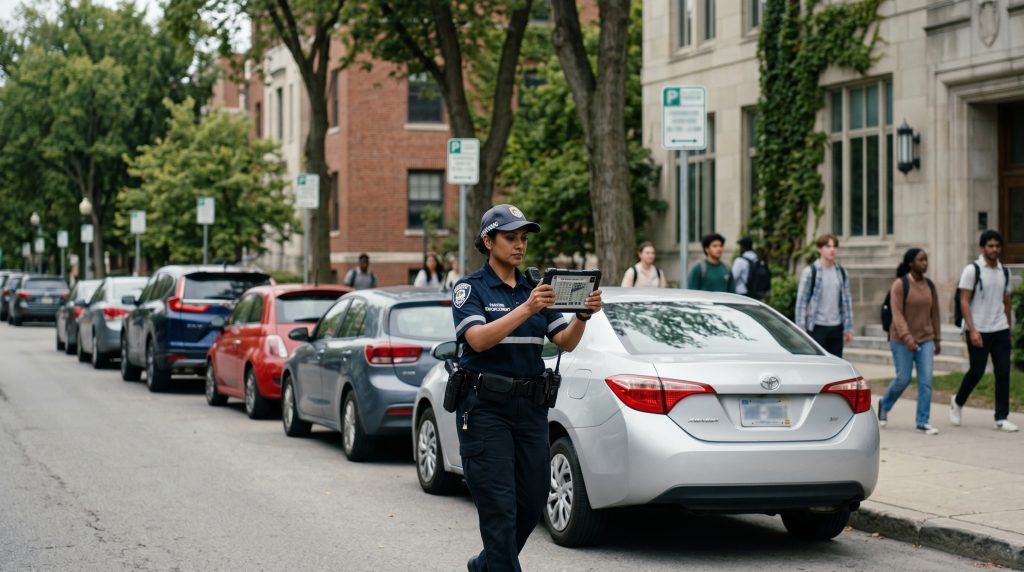
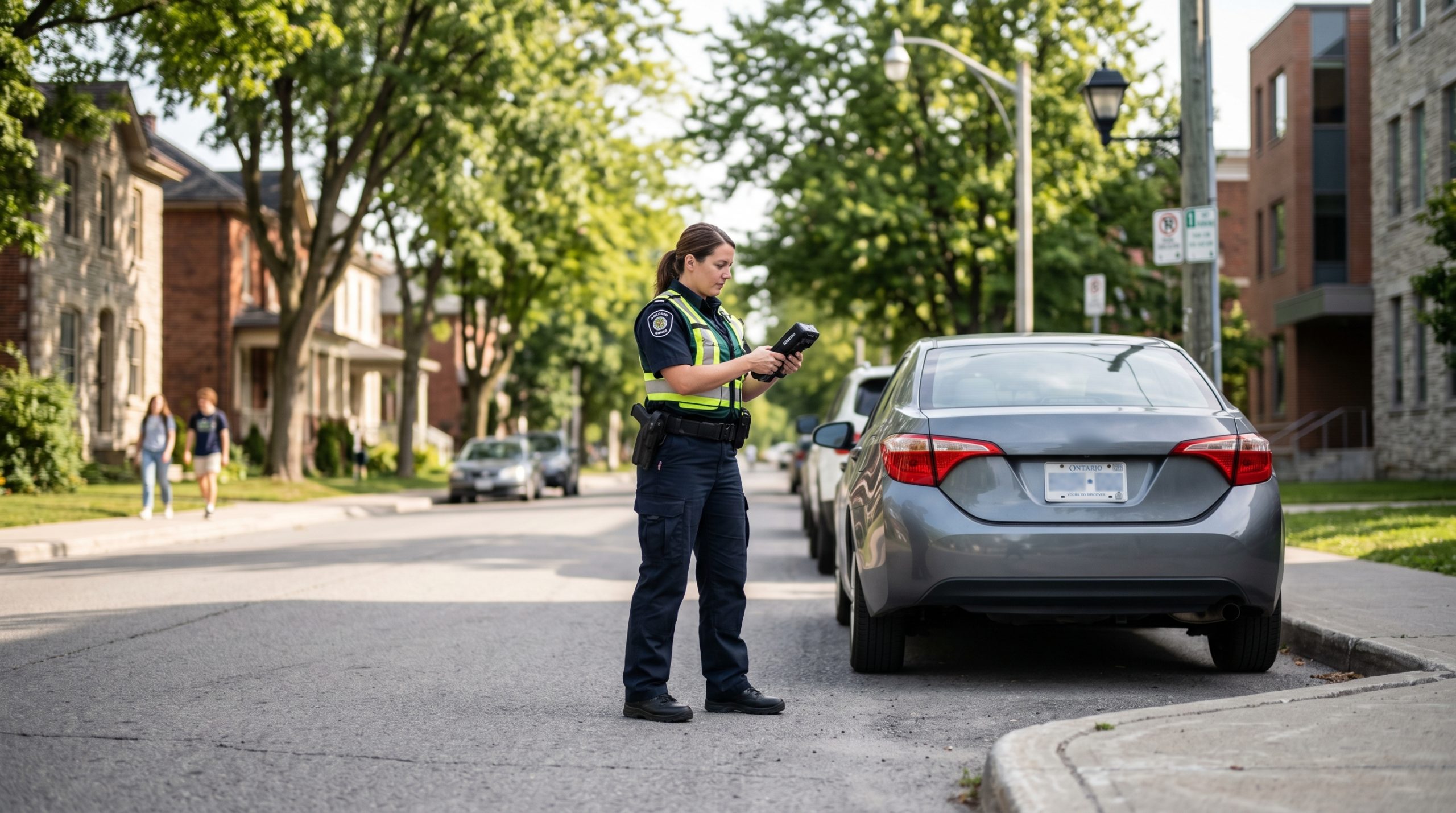
The concept is straightforward. Instead of marking a tire with chalk, an enforcement officer scans a vehicle’s license plate using a handheld device or license plate recognition camera. The system records the plate, the time, and the GPS location. On a subsequent patrol, the same vehicle is scanned again. The system compares the two observations, calculates dwell time, and — if the time limit has been exceeded — flags the vehicle for a violation.
No chalk. No physical contact with the vehicle. No relying on a mark that could be washed away, rubbed off, or disputed.
What makes this powerful isn’t just the absence of chalk. It’s that the record becomes part of a connected enforcement database. Every observation is stored, timestamped, and linked to a specific location. Officers on different shifts share the same records — so a vehicle that was first observed by one officer in the morning can be acted on by a different officer in the afternoon without any manual handoff. The enforcement workflow runs continuously rather than resetting with each patrol.
How the workflow looks in practice
Understanding digital chalking in the abstract is one thing. Seeing how it plays out across a real enforcement shift makes the operational advantage clearer.
First patrol — 8:30am. An officer scans vehicles along a two-hour free parking zone. Each scan records the plate, timestamp, and GPS location. Nothing is written, nothing is marked. The officer moves on.
Second patrol — 10:45am. The same officer — or a different one — scans the same zone. The system instantly compares this observation against the earlier record. Any vehicle that was present at 8:30am and is still present at 10:45am has exceeded the two-hour limit. A violation is triggered automatically, with both observations attached as evidence.
Parker disputes the violation. They claim they arrived after the first observation. The enforcement record shows the exact GPS location, timestamp, and — if photos were captured — images of the vehicle at both points in time. The evidence is clear, consistent, and produced automatically. The dispute takes minutes to resolve rather than hours.
This is what the Town of Smiths Falls found after implementing OPSCOM’s digital chalking system. Officers previously relied on manual chalk marks to enforce the town’s free two-hour parking policy — a policy designed to support downtown business by turning over parking regularly. Digital chalking made that enforcement consistent, defensible, and significantly less labor-intensive. Read the full Town of Smiths Falls case study.
Why manual chalking creates problems that add up
Manual chalk-based enforcement isn’t fundamentally broken — it’s just brittle. Each individual failure is small, but they compound across a patrol shift, across a team of officers, and across months of enforcement activity.
The most common failure points:
- Rain and weather. A chalk mark applied at 9am may be gone by 10am. The officer who returns finds no mark and can’t issue a violation — even if the vehicle has clearly been there for hours.
- Coverage gaps between shifts. Officer A marks a vehicle at the end of their shift. Officer B starts their shift without knowing which vehicles were marked, when, or by whom. The chalk mark is the only record, and it doesn’t travel.
- Inconsistency between officers. Different officers patrol at different speeds, mark different vehicles, and have different thresholds for what constitutes a violation. The result is enforcement that parkers perceive as arbitrary — even when individual officers are acting in good faith.
- Limited dispute evidence. When a parker appeals, the enforcement record is often limited to “I marked the tire and the mark was still there when I returned.” That’s not strong evidence if the parker claims they moved and returned, or that the mark was already there from a previous patrol.
- No data trail. Manual enforcement produces no usable data about parking patterns, turnover rates, or enforcement effectiveness. There’s nothing to report, nothing to optimize, and no way to demonstrate compliance outcomes to stakeholders.
None of these failures are the officer’s fault. They’re the predictable result of relying on a physical mark in a dynamic environment. Digital chalking eliminates each of them by replacing the physical mark with a database record.
The legal dimension — why it matters more than you might expect
Tire chalking has faced significant legal scrutiny over the past several years, particularly in the United States. The most consequential case was Taylor v. City of Saginaw (6th Circuit, 2019), in which the court ruled that physical tire chalking constituted a search under the Fourth Amendment — potentially requiring a warrant or reasonable suspicion before an officer could mark a vehicle.
While the legal landscape varies by jurisdiction — and physical chalking remains common practice in many places — the case introduced real uncertainty for municipalities and organizations that rely on time-based parking enforcement. For a deeper look at how the legal considerations have evolved, read our full analysis: Is tire chalking legal?
Digital tire chalking addresses this concern directly. Because digital chalking doesn’t involve physical contact with the vehicle — it observes and records a vehicle’s presence from a distance using plate recognition — it doesn’t raise the same Fourth Amendment questions as physical marking. Courts have generally treated LPR-based observation more similarly to general surveillance in public spaces than to the physical search analysis applied to chalk marking.
For organizations operating in jurisdictions where physical chalking has been challenged, or where legal defensibility is a priority, the shift to digital chalking isn’t just an operational improvement — it’s a risk management decision.
The Town of Smiths Falls, operating under Ontario’s Provincial Offences Act, implemented OPSCOM specifically because the digital evidence trail supports court proceedings reliably. When violations go to adjudication, the system produces court-ready documentation automatically. That’s a significant operational and legal advantage over manual methods. See how Smiths Falls enforces its free parking policy with digital chalking.
Shared chalking records — the feature that changes team operations
One of the most practically valuable aspects of digital chalking — and one that’s easy to overlook — is that the records are shared in real time across all connected devices.
In a manual chalking system, each officer’s marks exist only in the physical world. If Officer A marks a vehicle, Officer B has no way of knowing that unless they’re told directly or happen to see the mark themselves. Coverage continuity depends on officers being in the same place at the same time, or on manual communication between shifts.
In ViolationAdmin, every chalking observation is immediately visible to every officer on the system. When Officer B arrives in a zone Officer A patrolled two hours ago, they can see exactly which vehicles were observed, when, and where — without any communication from Officer A. Enforcement coverage becomes continuous rather than fragmented by shift boundaries.
For larger operations — like Forks North Portage, managing 20+ lots across downtown Winnipeg — shared chalking records are essential. A vehicle that moved from one lot to another can be tracked across locations. Officers patrolling different zones see the same data. And enforcement coverage across a dispersed portfolio is coordinated through the platform rather than through radio calls and manual handoffs.
Digital chalking with LPR — the fastest enforcement workflow
Digital chalking on a handheld device is a significant improvement over manual chalk. Digital chalking combined with license plate recognition is a different category of capability entirely.
With vehicle-mounted or fixed LPR cameras, an enforcement vehicle can scan an entire street or parking area at driving speed — reading dozens of plates per minute and automatically comparing each one against the chalking database. Vehicles that have exceeded their time limit are flagged immediately. The officer doesn’t need to stop, scan manually, or physically inspect each vehicle.
This dramatically increases enforcement coverage without proportionally increasing staffing. A single patrol vehicle with LPR can cover the same ground that would take multiple officers with handheld devices — and do it more consistently, because the system applies the same rules to every vehicle rather than relying on individual officer discretion.
PL8RDR, OPSCOM’s LPR platform, integrates directly with the digital chalking system in ViolationAdmin. Plate reads from patrol vehicles feed automatically into the chalking database, trigger violation flags for overstays, and attach to enforcement records as evidence — all without manual data entry. Learn more about how license plate recognition works as part of a connected enforcement system.
What digital chalking data tells you about your operation
Every chalking observation is a data point. Accumulated over days, weeks, and months, that data tells a story about how parking is actually being used — not how it’s supposed to be used.
With digital chalking connected to a parking analytics platform, organizations can answer questions that manual enforcement can’t:
- Which zones have the highest overstay rates — and at what times of day?
- Are time limits set correctly, or are most parkers leaving well before the limit expires?
- Which locations generate the most violations — and does that reflect enforcement frequency or actual non-compliance?
- How has turnover changed since enforcement was implemented or adjusted?
For municipalities trying to support downtown businesses with accessible parking, this data is directly relevant to policy decisions. If a two-hour limit is generating high turnover in most zones but chronic overstays in one specific block, that’s information that can inform signage changes, enforcement prioritization, or time limit adjustments — none of which is visible from manual chalk records.
Digital chalking across different environments
Digital tire chalking is useful in any context where time-based parking rules need consistent enforcement. The specific implementation varies by environment:
Municipal downtown cores typically use digital chalking to enforce free time-limited parking — the same model used by Smiths Falls and the Town of Perth. The goal is turnover: making sure parking spaces are available for customers and visitors throughout the business day. Digital chalking makes that enforcement consistent enough to actually change parker behavior. Read how the Town of Perth achieved a 91% ticket collection rate using connected enforcement and payment workflows.
University campuses use digital chalking for a mix of time-limited visitor zones, loading areas, and short-term permit spaces. The shared records feature is particularly valuable on campuses where multiple officers patrol different zones throughout the day. University of North Alabama and Brandon University both use digital chalking as part of their connected enforcement workflow.
Mixed-use developments and property managers use digital chalking to enforce time limits in visitor and retail parking areas — particularly where the goal is protecting residential parking from commercial overflow. The Village at Valley Forge implemented digital chalking as part of a broader enforcement platform designed to address unauthorized overnight parking across a 122-acre mixed-use community.
Healthcare campuses use digital chalking for short-term patient and visitor zones where high turnover is critical — ensuring patients can always find accessible parking near entrances. For organizations like healthcare parking operations, enforcement consistency directly affects patient experience.
How digital chalking fits into the OPSCOM platform
Digital chalking in OPSCOM isn’t a standalone feature — it’s one component of a connected enforcement workflow that ties together permit validation, violation issuance, evidence capture, appeals processing, and reporting.
When an officer observes a vehicle for the second time and the dwell time has been exceeded, the chalking record becomes the foundation for a violation — with timestamps, GPS location, and photos attached automatically. That violation feeds into the appeals workflow if the parker disputes it, and into the analytics system for reporting. Everything operates from the same database, so there’s no manual transfer of records between systems and no risk of evidence being lost or inconsistent.
This is what distinguishes a connected enforcement system from a collection of individual tools: the data flows automatically, the evidence is built in, and every part of the workflow benefits from what every other part produces.
Explore digital tire chalking in depth
Each of the following posts goes deeper on a specific aspect of digital chalking and how it works in practice:
- Digital tire chalking: replacing manual tracking with a connected system
- How digital chalking works step by step in real enforcement workflows
- Is tire chalking legal? The legal considerations of time-based parking enforcement
- How LPR enhances digital chalking and vehicle tracking
- How digital chalking software supports enforcement operations
Ready to replace manual chalk with a defensible digital enforcement system?