How Digital Tire Chalking Works: A Step-by-Step Guide for Enforcement Teams

Time-based parking enforcement is one of the most common and most operationally challenging aspects of parking management. Two-hour downtown limits. Thirty-minute loading zones. Short-term visitor parking. These rules exist for good reasons — supporting business turnover, keeping access zones functional, preventing long-term storage in short-term spaces. Enforcing them consistently is a different matter.
For decades, enforcement relied on a chalk mark on a tire. Come back, check whether the mark has moved. Simple in concept, brittle in practice — vulnerable to weather, shift changes, officer inconsistency, and legal challenge. Digital tire chalking replaces the physical mark with something more reliable: a structured database record of vehicle presence using license plate data, GPS coordinates, and precise timestamps.
This post covers what digital tire chalking is, how it works operationally, which environments benefit most from it, and what it changes about time-based enforcement outcomes.
The core idea: a record instead of a mark
Physical chalking puts information on the vehicle. Digital chalking puts information in the system. That’s the fundamental shift — and it changes everything about how the record performs when enforcement is challenged.
When an officer physically chalks a tire, the evidence that a vehicle was present at a specific time is the chalk mark itself. If the mark washes away in rain, the evidence is gone. If the parker disputes the time, there’s nothing to cross-reference. If a different officer returns for the second patrol, they’re interpreting someone else’s mark without any context about when it was applied or to which specific tire.
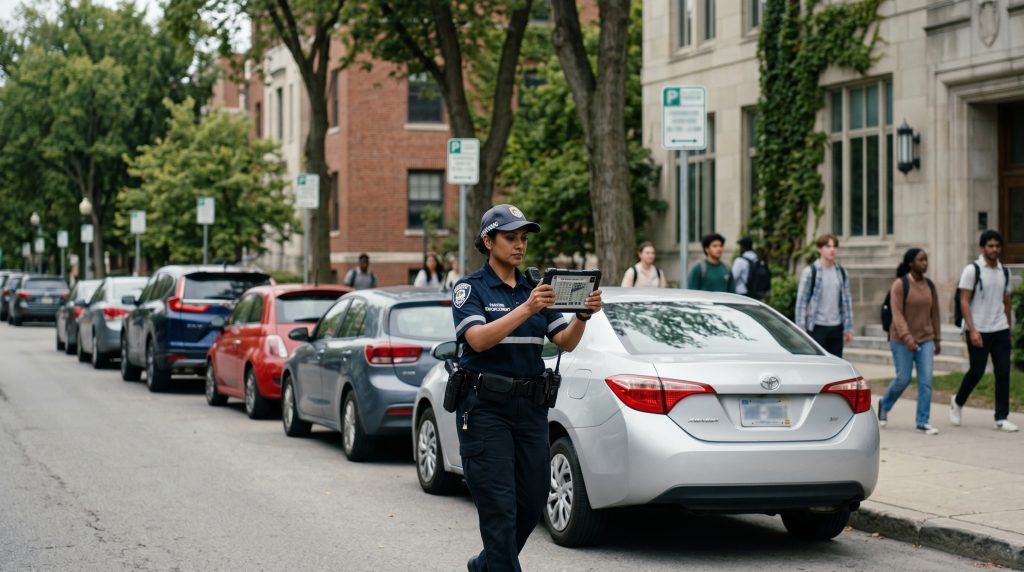
When an officer uses digital chalking, the system creates a record at the moment of first observation: the license plate, the GPS coordinates, the timestamp, and optionally a photograph of the vehicle. That record persists in the database regardless of weather. It’s visible to every officer on every device. It carries a precise timestamp that can’t be disputed. And it’s associated with a specific plate rather than a physical mark that might belong to any vehicle that parked in that general area.
The second observation works the same way. The officer scans the plate again. The system retrieves the first observation record, calculates the elapsed dwell time, and either clears the vehicle or flags a violation — automatically, based on the zone’s configured time limit. The officer doesn’t need to remember anything from a previous patrol. The system does.
How the workflow runs in practice
A practical example makes the workflow concrete. Consider a municipality enforcing a two-hour free parking limit in a downtown commercial zone — the scenario that applies to the Town of Smiths Falls, where OPSCOM’s digital chalking system replaced manual chalk enforcement.
First patrol, 9:00am. The enforcement officer moves through the zone, scanning each vehicle with the OPSCOM mobile enforcement app on their iOS or Android device. Each scan records the plate, GPS location, and timestamp. No marks are made. No notes are taken. The officer finishes the zone and moves on to the next.
Second patrol, 11:15am. The officer — same person or different, doesn’t matter — returns to the zone. Each vehicle scan checks the database for a prior observation. Vehicles that arrived after the first patrol are cleared. Vehicles with first observations before 9:15am (two hours prior) are flagged for a violation.
Violation issued. For a flagged vehicle, the system pre-populates the citation workflow with the plate, both observation timestamps, GPS locations, and any photos captured. The officer reviews, confirms, and issues the citation. The complete evidence record — both observations, timestamps, locations — is attached automatically.
Parker disputes the violation. They claim they arrived at 10:30am and couldn’t have been there two hours. The enforcement record shows a first observation at 9:02am with GPS coordinates matching the specific space. The dispute takes minutes to assess with evidence rather than hours of reconstruction from memory.
Who needs digital tire chalking
Not every parking operation relies heavily on time-based enforcement. For operations that primarily enforce permit-based rules — valid permit or not — digital chalking is a secondary capability. For operations where time limits are a primary enforcement mode, it’s central.
Municipalities enforcing downtown free parking limits, loading zone windows, and short-term visitor spaces use time-based enforcement extensively. The political and community sensitivity of downtown parking enforcement makes evidence quality particularly important — a disputed citation in a small municipality can become a public trust issue quickly. See how municipal enforcement is managed on OPSCOM.
Healthcare facilities depend on short-term drop-off and visitor zones functioning as intended. Patient drop-off areas occupied by long-term parkers create real operational and patient experience problems. Consistent, evidence-based time enforcement is the mechanism that keeps those zones available. See how healthcare parking enforcement works on OPSCOM.
Property managers enforcing visitor parking time limits in residential communities need enforcement that’s consistent enough that residents trust it — and defensible enough that dispute outcomes are clear. See how property management enforcement is managed on OPSCOM.
University campuses with loading zones, short-term visitor areas, and mixed-use zones near high-traffic buildings need time enforcement that works across multiple officers and shifts without requiring constant coordination. See how higher education enforcement is managed on OPSCOM.
What digital chalking changes about enforcement outcomes
The operational improvements from digital chalking compound across three areas.
Evidence quality. Every time-limit violation issued with digital chalking has a complete, system-generated evidence record attached: two timestamped observations, GPS coordinates for each, and any vehicle photographs taken during patrol. This evidence record is the same regardless of which officer patrolled, what the weather was, or whether the violation is disputed immediately or six weeks later. Manual chalk produces whatever evidence survived the interval between marking and citation — which is often fragmentary.
Multi-officer and multi-shift continuity. Digital chalking records are shared across the entire enforcement operation. Officer A’s 9am first observations are visible to Officer B’s 11am second patrol. A vehicle that was first observed before Officer B’s shift started can still be cited on dwell time that Officer B can verify directly from the system. Manual chalk has no equivalent — the chalk mark doesn’t tell Officer B when it was applied or by whom.
Patrol efficiency. Officers using digital chalking spend less time managing the chalking process and more time patrolling. There are no marks to apply carefully, no notes to keep about observation times, no mental overhead of tracking which vehicles were marked on which patrol. The system handles the record-keeping; the officer handles the patrol. When LPR is part of the picture, first observations can be recorded automatically as the patrol vehicle drives through the zone — without any officer action at all. For how LPR and digital chalking work together, see Digital Tire Chalking and LPR: How They Work Together in Modern Enforcement.
The legal context
Physical tire chalking has faced meaningful legal scrutiny, particularly in the United States. The 2019 Taylor v. City of Saginaw ruling found that physical chalking may constitute a warrantless search under the Fourth Amendment — introducing legal uncertainty for operations that rely on it.
Digital chalking doesn’t involve physical contact with the vehicle. The record is created by observing and photographing the vehicle from the public right-of-way — a legally distinct activity from physically marking the vehicle. For operations concerned about their exposure under evolving case law, digital chalking offers a legally stronger foundation for time-based enforcement. The full legal context is covered in Is Tire Chalking Legal? Understanding the Shift to Digital Enforcement.
Digital chalking as part of a connected enforcement system
Digital chalking delivers its full value when it’s part of a connected enforcement system — not as a standalone tool that produces records the officer has to manually reference. In OPSCOM, digital chalking records live in the same database as permit data, citation records, payment status, and security watchlists.
When an officer scans a plate in a time-limited zone, the system simultaneously checks the permit database (is this vehicle exempt from the time limit?), the chalking database (when was this vehicle first observed here?), the violation history (does this vehicle have outstanding issues?), and the watchlist (has security flagged this plate?). The officer sees one result that reflects all of these checks — not four separate lookups.
For more on how the chalking system is designed to support this connected workflow, see Digital Tire Chalking Software: Why System Design Matters.
Explore digital tire chalking in depth
- Is Tire Chalking Legal? Understanding the Shift to Digital Enforcement
- Digital Tire Chalking Workflow: How Enforcement Teams Track Time Accurately
- Digital Tire Chalking and LPR: How They Work Together in Modern Enforcement
- Digital Tire Chalking Software: Why System Design Matters
- ViolationAdmin: OPSCOM’s parking enforcement platform
- Digital Tire Chalking Knowledge Center