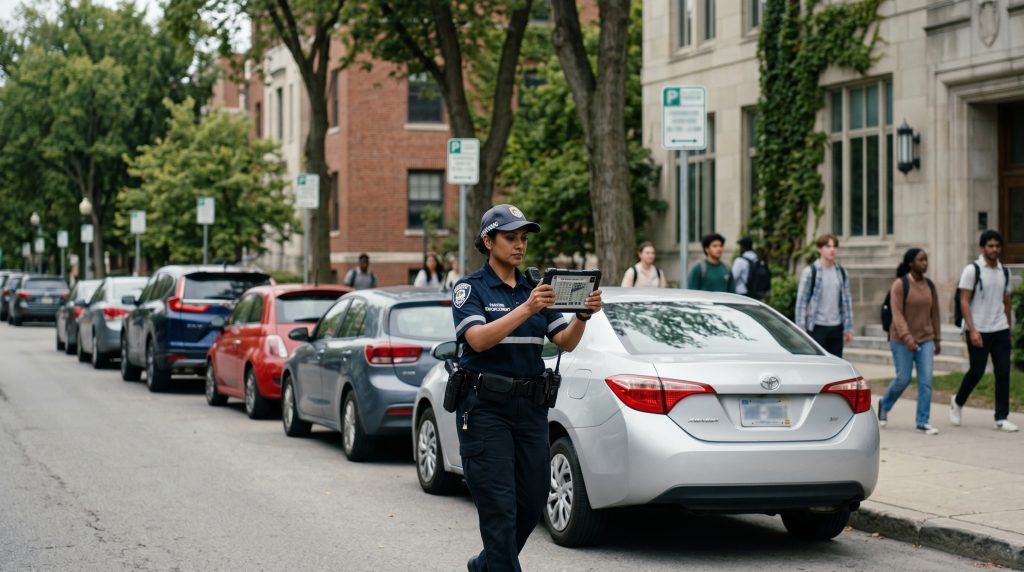
Is Tire Chalking Legal? Understanding the Shift to Digital Enforcement
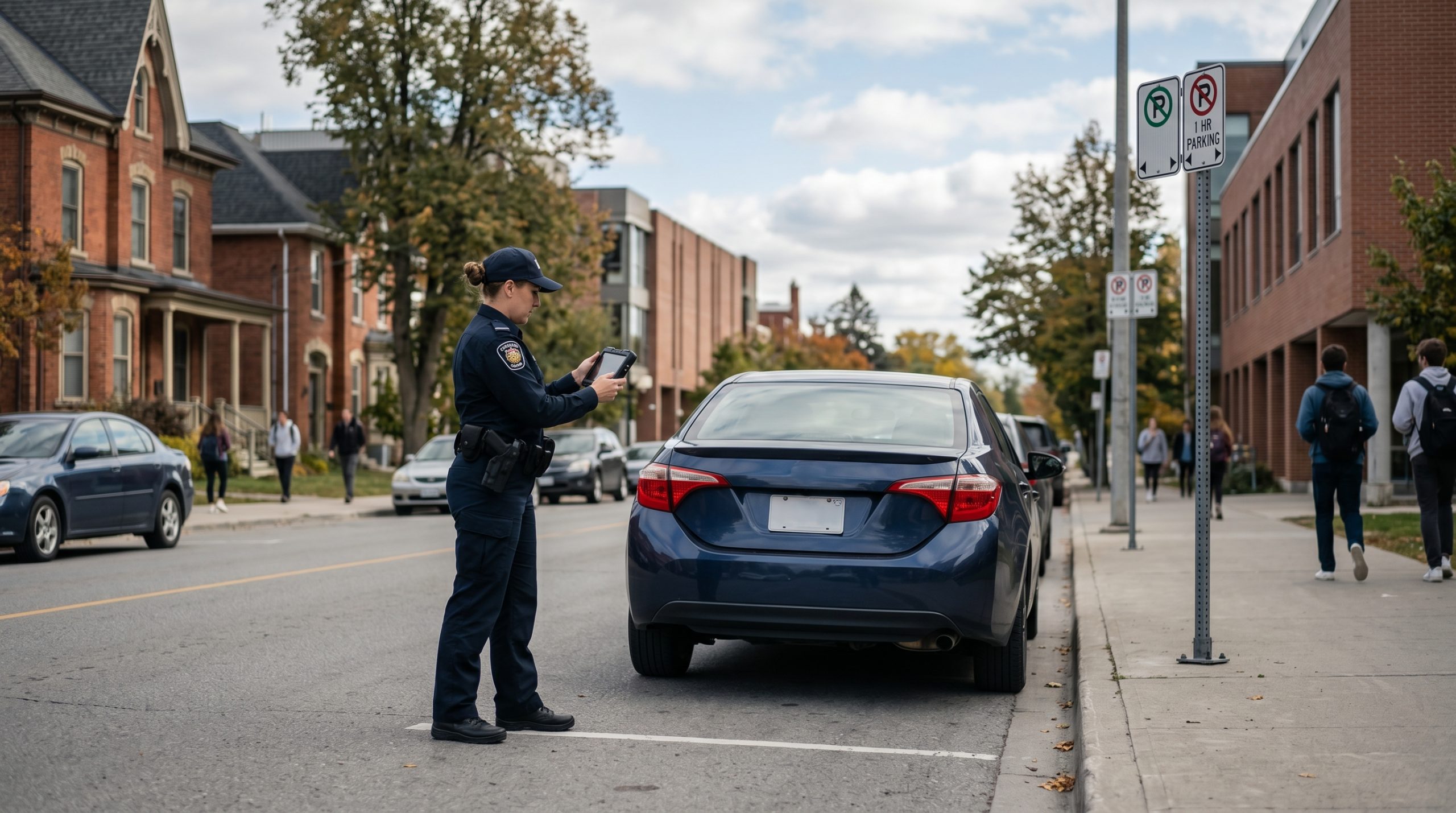
For most of parking enforcement’s history, the legality of tire chalking wasn’t seriously questioned. Officers marked tires. Courts accepted the practice. The chalk mark was treated as an unremarkable component of routine parking management.
That changed in 2019. A federal appeals court ruling put physical tire chalking in a new legal light — one that has prompted genuine reconsideration among municipalities, universities, and other organizations that rely on time-based parking enforcement. And while the legal landscape hasn’t resolved uniformly, the direction of travel is clear enough that operations evaluating their enforcement approach should understand what’s at stake.
This post covers the legal context around tire chalking in the United States, how Canadian privacy law applies to LPR-based enforcement, and why digital chalking occupies a legally stronger position than physical chalk regardless of jurisdiction.
Taylor v. City of Saginaw: what the court actually decided
In April 2019, the Sixth Circuit Court of Appeals issued its ruling in Taylor v. City of Saginaw. Alison Taylor had received multiple parking citations in Saginaw, Michigan, each based on a chalk mark placed on her tire during a prior patrol pass. She sued, arguing that physically chalking her tire — touching her vehicle without her consent and without a warrant — constituted an unreasonable search under the Fourth Amendment.
The Sixth Circuit agreed, at least in principle. The court ruled that physically placing chalk on a vehicle’s tire was a trespassory act that triggered Fourth Amendment protection. The city’s argument that the chalking served a “community caretaking” function — not a criminal investigative purpose — did not exempt it from Fourth Amendment scrutiny under the court’s analysis.
The ruling didn’t ban tire chalking nationwide or declare every chalking-based citation invalid. It applied to the Sixth Circuit’s jurisdiction (Michigan, Ohio, Kentucky, and Tennessee), and subsequent courts in other circuits have not uniformly followed the same reasoning. But the decision introduced serious legal uncertainty for operations relying on physical chalking in affected jurisdictions — and signalled the direction in which Fourth Amendment jurisprudence around parking enforcement was moving.
The practical response from many operations in affected jurisdictions was to either add probable cause requirements to their chalking procedures (complicating what had been a simple workflow) or transition to digital methods that don’t involve physical contact with the vehicle.
Why digital chalking is legally distinct from physical chalking
The Fourth Amendment analysis that made physical chalking vulnerable in Taylor rested on the trespassory nature of physically touching the vehicle. Digital tire chalking doesn’t touch the vehicle at all.
The digital chalking process involves observing and photographing a vehicle from the public right-of-way, recording a license plate through LPR or manual scan, and storing a timestamped record of that observation. Courts have generally held that observing and photographing vehicles in publicly accessible spaces doesn’t constitute a search requiring Fourth Amendment justification — the vehicles are visible to anyone present, and the license plates are intentionally public identifiers.
This distinction is legally significant. The activity that made physical chalking constitutionally problematic — physically touching a vehicle without consent or warrant — simply doesn’t occur in digital chalking. An enforcement officer using OPSCOM’s digital chalking system is doing something legally equivalent to noting the presence of a vehicle and recording what any observer could see from the street.
That said, legal landscapes evolve, and organizations with specific concerns about their jurisdiction should consult legal counsel. The point here isn’t that digital chalking is universally pre-approved by every court in every jurisdiction — it’s that the specific vulnerability that Taylor identified doesn’t apply to it.
The evidence defensibility advantage
Beyond the constitutional question, digital chalking produces evidence that’s more defensible in any dispute — not just legally, but operationally.
A physical chalk mark is a weak evidence record. It establishes that a vehicle was present at some point before the mark was applied. It doesn’t record when the mark was applied, by which officer, at what GPS location, or what the vehicle looked like at that time. When a parker disputes a time-limit citation based on physical chalk, the officer’s testimony about when they marked the vehicle is often the primary evidence — which is subjective, unverifiable, and weakens with time.
A digital chalking record contains the plate, the exact timestamp of first observation, the GPS coordinates of the vehicle’s location, the officer identity, and optionally a photograph of the vehicle at the time of first observation. Every element of that record is system-generated — not recalled from memory, not subject to the officer’s interpretation of what they wrote in a notebook. When a parker disputes the citation, the record speaks for itself.
This evidentiary strength matters in municipal environments particularly. The Town of Perth operates under Ontario’s Provincial Offences Act, where enforcement evidence needs to meet a standard that supports court proceedings when violations are contested. Digital chalking records, with their complete audit trail, are substantially more court-ready than manual chalk notes. See how municipal enforcement is managed on OPSCOM.
Canadian privacy law and LPR-based enforcement
Canadian parking operations face a different legal framework than their US counterparts — one governed by PIPEDA (Personal Information Protection and Electronic Documents Act) at the federal level and provincial privacy legislation in Quebec, British Columbia, and Alberta.
The relevant question for LPR-based digital chalking in Canada is whether collecting and storing license plate reads constitutes the collection of “personal information” under applicable privacy legislation. License plates are registered to individuals, which creates at least an arguable case that plate data connected to location and time records is personal information subject to privacy obligations.
The practical implications for parking enforcement organizations in Canada include:
- Retention limits. Data retained beyond what’s needed for enforcement purposes may exceed what’s permissible under privacy legislation. OPSCOM’s configurable retention policies for non-enforcement LPR reads support compliance with these requirements.
- Purpose limitation. Data collected for parking enforcement purposes shouldn’t be used for unrelated purposes without fresh consent or legal authority.
- Transparency. Organizations collecting LPR data as part of parking enforcement should have a clear privacy notice describing what data is collected, how long it’s retained, and how it can be accessed or corrected.
These obligations don’t make LPR-based digital chalking impermissible in Canada — the collection is for a legitimate law enforcement purpose that generally satisfies the “reasonable purpose” requirement under PIPEDA. They do mean that the data architecture and retention policies of the enforcement system matter. OPSCOM’s approach to LPR data is covered in the Security and Trust section.
The broader shift: away from physical contact, toward digital records
The legal trajectory in parking enforcement — in both US Fourth Amendment jurisprudence and Canadian privacy law — is toward greater scrutiny of physical contact with vehicles and greater emphasis on the handling of personally identifiable data. These trends point in the same direction: enforcement methods that don’t involve touching vehicles and that manage data with documented retention and purpose policies are more defensible than methods that don’t.
Digital chalking sits squarely on the right side of that trajectory. It doesn’t touch vehicles. It creates transparent, auditable records. Its data retention is configurable to match organizational policy and applicable law. And it produces enforcement evidence that holds up better under challenge than the alternatives.
For operations that are currently using physical chalk and haven’t thought carefully about their legal exposure, the question isn’t whether to eventually transition to digital methods — it’s how quickly it makes sense to move.
Explore digital tire chalking in depth
- Digital Tire Chalking: How Time-Based Parking Enforcement Works Today
- Digital Tire Chalking Workflow: How Enforcement Teams Track Time Accurately
- Digital Tire Chalking and LPR: How They Work Together in Modern Enforcement
- Digital Tire Chalking Software: Why System Design Matters
- ViolationAdmin: OPSCOM’s parking enforcement platform
- Digital Tire Chalking Knowledge Center