Hybrid and Flexible Parking: Managing Changing Demand

Parking demand used to be predictable. Faculty parked in faculty lots Monday through Friday. Students arrived in the morning and left in the afternoon. Visitors went to visitor parking. The permit structure reflected a stable, repeating pattern that didn’t change much from semester to semester.
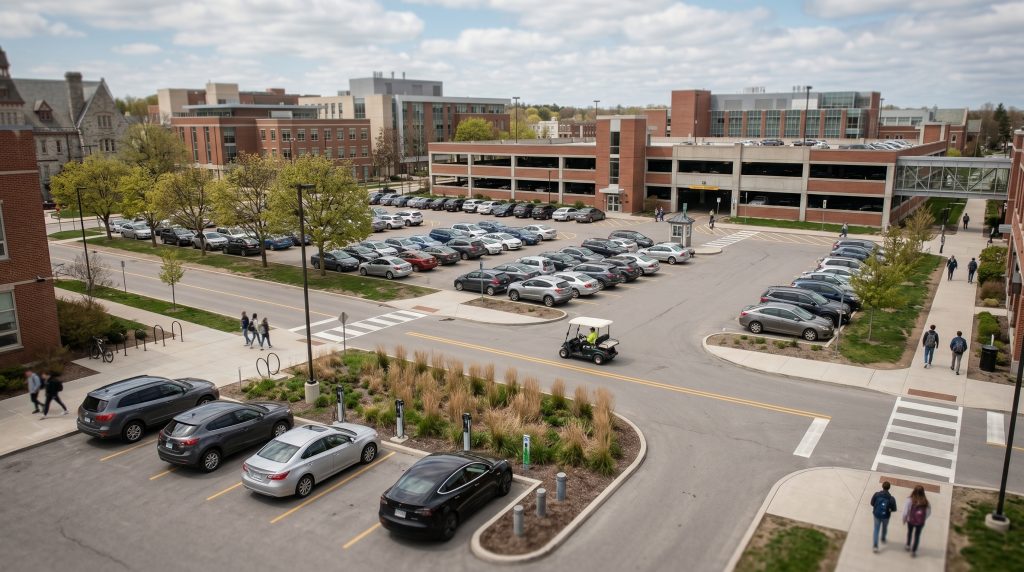
That model still exists in some operations, but it’s increasingly the exception. Hybrid work schedules have broken the five-day occupancy pattern for institutional and office campuses. Event-driven demand creates peaks that overwhelm permanent permit allocations. Contractor and construction activity generates temporary access needs that change week to week. Visitor volumes vary in ways that are hard to anticipate and harder to accommodate with a fixed permit structure.
The parking operations that handle this well aren’t doing it with elaborate manual workarounds. They’re doing it with systems flexible enough to manage demand that doesn’t fit neat categories — temporary permits, dynamic allocation, event overlays, and visitor management — alongside permanent permit programs, in one connected system.
This post covers how modern parking management systems handle the parking that doesn’t fit the standard permit model, and why flexibility in the system design matters more than ever as the nature of parking demand continues to evolve.
Hybrid work and the changed occupancy pattern
Remote-first and hybrid work arrangements have created a new operational challenge for parking operations at institutional and corporate campuses: lots that were sized for five-day-a-week occupancy are now experiencing highly variable demand, with Monday/Friday attendance significantly lower than Tuesday through Thursday peaks.
For operations that sold permanent permits sized to five-day occupancy, this creates two simultaneous problems: over-supply on slow days (lots that are nominally sold out have significant empty space), and under-supply on peak days (the lots that are theoretically full are actually fuller than ever because the people who do come tend to come on the same days).
Modern permit systems address this through flexible permit structures. Daily or weekly permits instead of semester-long ones. Zone-sharing arrangements where different permit types can access the same lot on alternating days. Permit oversell strategies for zones where not all permit holders are likely to be present simultaneously — with occupancy monitoring to manage the balance. For more on how permit overselling is managed responsibly, see Parking Permit Management Systems.
Anderson University used OPSCOM to modernize their permit structure specifically to handle changing campus attendance patterns — moving from a rigid annual permit model to one that accommodated different commuter patterns without creating constant exceptions and override requests. Read the Anderson University case study.
Temporary and day permits
Not everyone who needs to park on a campus or facility has — or should have — a permanent permit. Contractors working a two-week project. A conference attendee visiting for a single day. A student who normally takes transit but drove today because of an early morning obligation. A family member dropping off a move-in load during orientation week.
These are all legitimate temporary parking needs, and managing them well requires a system that can issue, validate, and expire temporary credentials without creating administrative overhead proportional to the frequency of the need.
In OPSCOM’s ParkAdmin, temporary permits are issued as plate-based virtual credentials with defined validity windows — a specific date, a date range, or a number of uses. They’re issued through the self-service portal (for parkers who can purchase directly), through the administrative interface (for staff who need to issue credentials on behalf of visitors or contractors), or through a delegated portal where department administrators can issue day passes to their own guests without going through central parking services.
Temporary permits appear in the enforcement database immediately, exactly like permanent permits. An officer validating a contractor’s vehicle at 9am on their first day of a two-week project sees the valid temporary permit — not a missing permit that generates an incorrect citation and a phone call to clear up.
Event parking management
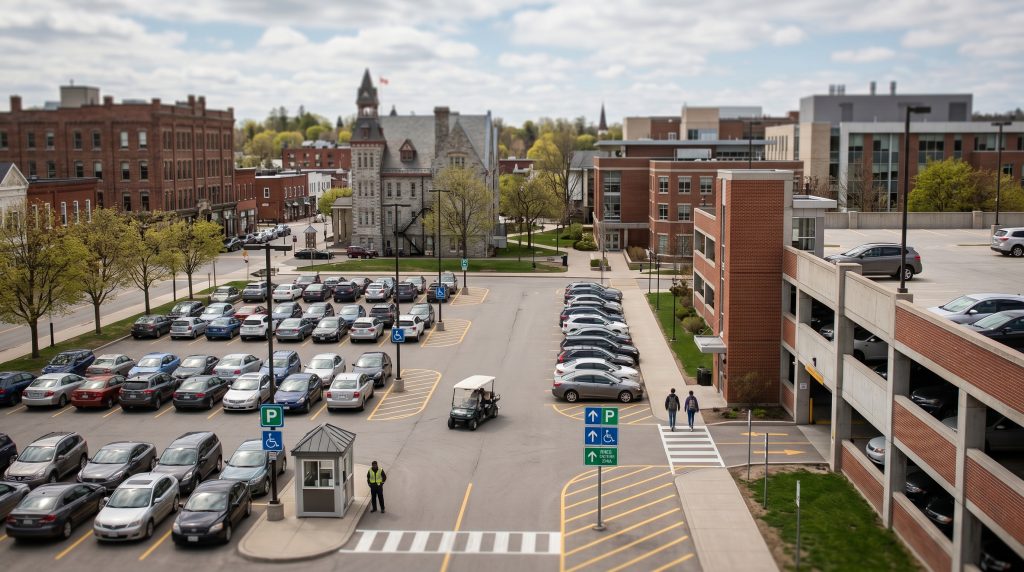
Events create parking demand that exists outside the normal permit structure and can’t be accommodated within it. A major conference, a sporting event, a graduation ceremony, a public lecture series — each brings a volume and distribution of vehicles that’s different from the normal operational pattern and requires different zone rules, different access authorizations, and often different enforcement postures.
Managing events within a connected parking system means creating event-specific permit types with defined validity windows, applying zone access rules that apply only during the event period, and generating temporary credentials for expected attendees — all within the same system that handles normal operations.
During the event, enforcement operates with awareness of the event permits. Officers validating plates see event credentials as valid in the zones where they apply, for the windows when they apply, without needing separate briefings or printed exception lists. When the event window closes, the credentials expire automatically and normal enforcement rules resume.
For multi-lot operations like Forks North Portage — which manages parking across a major Winnipeg mixed-use destination that hosts events, markets, and concerts throughout the year — the ability to overlay event-specific parking rules on top of the permanent permit structure, within one system, is central to how the operation functions during high-demand periods. Read the Forks North Portage case study.
Visitor and guest management
Visitor parking is a perennial management challenge. Too little visitor parking frustrates guests and reflects poorly on the host organization. Too much dedicated visitor parking wastes capacity that could serve daily permit holders. And managing visitor access manually — through front-desk guest passes, phone authorizations, or informal arrangements — creates enforcement blind spots.
In a connected system, visitor management can be structured and self-service without being cumbersome. Permit holders can authorize visitor vehicles directly through the parker portal — entering a guest plate that’s valid for a specific date or date range in a defined zone. The authorization is immediate and appears in the enforcement database without any staff intervention.
For property management environments — residential communities, condominiums, mixed-use developments — this guest authorization model is particularly valuable. Residents can authorize their visitors without calling the management office. Enforcement validates accurately against the authorization database. Unauthorized vehicles are flagged without the operation needing to contact the resident to verify whether their guest is expected. See how property management operations handle visitor access on OPSCOM.
Contractor and construction access
Construction projects, facility maintenance, vendor deliveries, and service contractor access create temporary vehicle access needs that are more complex than day permits — longer durations, potentially multiple vehicles, access to specific zones that aren’t normally available to visitors, and the need to revoke access when the project ends or personnel change.
In OPSCOM, contractor credentials are managed as a distinct permit type with configurable parameters. A construction project gets a permit type valid for Lot C service access from 6am to 6pm Monday through Friday, for the duration of the project, for up to four registered vehicles. When the project ends, the permit type is deactivated. When a contractor’s vehicle changes, the registration is updated. The enforcement system reflects all of this in real time.
This matters particularly for healthcare campuses and university facilities operations, where contractor access is frequent, the zones being accessed are sensitive, and the need to maintain enforcement integrity alongside active construction is constant. See how healthcare parking operations manage contractor access on OPSCOM.
Dynamic allocation: making better use of existing capacity
Fixed permit structures assume that every permit holder will use their assigned space at the same time. In practice, they don’t — and the unused capacity that results represents real value that most operations don’t capture.
Dynamic allocation models — where zones can be shared between different permit types at different times of day, or where temporary permits can access spaces that permanent permit holders aren’t using — require a system that can apply time-based rules accurately and validate against them in real time.
An evening lot that’s primarily a faculty lot during the day can open to event parking after 5pm. A staff zone that peaks on Tuesday through Thursday can allow commuter overflow on Monday and Friday when occupancy is low. A visitor zone that’s typically full from 10am to 2pm can overflow into an adjacent zone during that window.
These allocations only work when enforcement can validate accurately against the current rules for the current time in the current zone. An enforcement system operating on a morning export doesn’t have the time-sensitivity to support this kind of dynamic allocation. A connected enforcement system that’s querying live rules does. For how time-based rule enforcement works, see Compliance Automation in Parking Enforcement.
Text-based mobile payment for transient parking
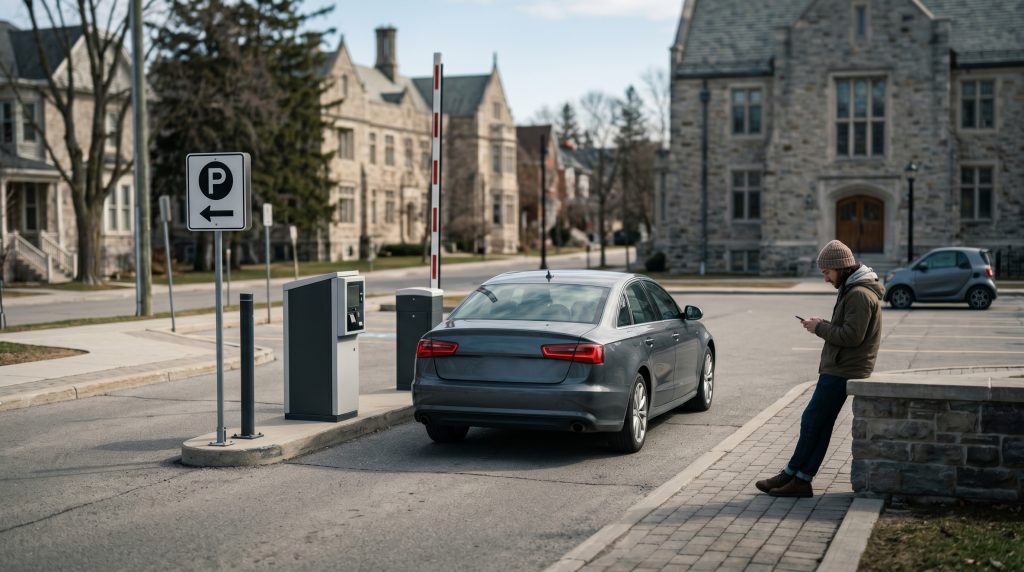
Not all parking is permit-based. Municipal lots, visitor areas, and pay-to-park zones require transient payment options that work for people who don’t have — and don’t want — an account or a registered vehicle.
OPSCOM integrates with Text2ParkMe and other pay-by-phone operators, bringing transient payment sessions into the same enforcement validation database as permit records. An officer validating a vehicle in a pay zone sees the active payment session alongside permit records — no separate system to check, no gap in validation coverage.
Forks North Portage uses Text2ParkMe alongside OPSCOM for exactly this reason — their mix of monthly parkers, event visitors, and daily transient users required a system that could handle all of these in one enforcement environment rather than three separate ones. Read the Forks North Portage case study.
Explore parking management systems in depth
- Modern Parking Management Systems: How Parking Operations Actually Work Today
- Parking Permit Management Systems: How Digital Permits Actually Work
- Parking System Architecture: Why a Single System Matters
- Parking Operations Management: How to Run Efficient Parking Programs
- ParkAdmin: OPSCOM’s parking management platform
- Parking Management Systems Knowledge Center