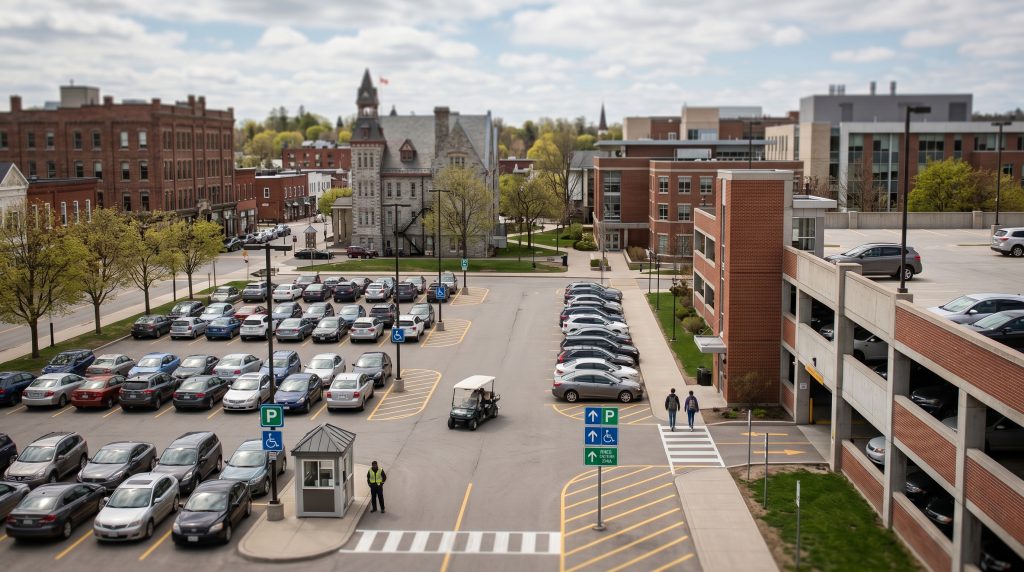
Small-Operation Parking: What Right-Sized Parking Looks Like

Most parking guidance is written for operations with a dedicated parking office, an IT department, and a budget cycle that can absorb a multi-year platform rollout. That is not most parking operations.
A small parking operation usually looks like this: one or two lots, somewhere between a few dozen and a few hundred permits, a team of one to five people, and nobody whose actual job is parking software. The parking manager is also the person who answers the phone, approves the refund, and walks the lot when a space needs checking.
Those operations have the same requirements as a large campus. Permits have to be valid when an officer checks a plate. Violations have to produce revenue. Visitor and tenant parking has to be controlled without creating phone calls. What differs is the tolerance for overhead: a small team cannot absorb a system that needs a dedicated administrator, weeks of configuration, or modules they will never use.
This article covers what actually breaks in small parking operations, what a right-sized system needs to do, and how to evaluate options without buying capacity you will never use.
What small parking operations have in common
Scale varies more than the label suggests. A small operation can be a private operator running a single surface lot with around 150 permits. It can be a smaller college managing two lots, roughly 100 spaces, and around 500 permits a year. It can be a property manager handling parking for a commercial building, an HOA administrator covering resident and visitor spaces, or a towing and security company enforcing on behalf of the properties it serves.
The operating constraints are remarkably consistent, regardless of which of those describes your situation:
- Permit and payment processes consume staff time out of proportion to the size of the operation
- There is no online payment path for violations, so collection depends on parkers showing up in person
- Enforcement records are inconsistent, which makes disputes and towing decisions hard to defend
- There is no searchable violation history by plate, so repeat offenders cannot be tracked systematically
- Visitor and tenant validation runs through phone calls, paper logs, or informal arrangements
- Revenue comes in lower than it should because the payment path has too much friction
- The system in place (if there is one) was built for a larger organization and needs more configuration, training, and maintenance than a small team can support
- There is no reliable data on how parking is actually used, so allocation decisions and performance reporting are guesswork
Where the time actually goes
Manual parking administration is rarely one big problem. It is a steady accumulation of small handling costs that never appear on a budget line.
The permit cycle. Selling permits by hand means someone takes the form, takes the payment, and enters the record. Then they handle the renewals, the address changes, the lost permits, and the questions. A self-service portal moves all of that to the parker: they purchase, manage, and renew their own account, and the office stops being the bottleneck.
Visitors and tenants. Validation handled by phone or a paper log works until nobody is at the desk. The result is either unenforced visitor parking or a staff member pulled away from something else to authorize a car. A validation tool that a tenant or front-desk employee can use without training removes the phone call entirely.
Violation payment. When the only way to pay a citation is in person, during office hours, a predictable share of citations are never paid. Online payment available as soon as the citation is recorded changes the collection rate without adding staff time.
Reconstruction. When a violation is disputed, someone has to assemble the evidence: which officer, which time, which photo, which rule. If that evidence lives in a notebook and a phone camera roll, the reconstruction is the expensive part of the citation.
What enterprise overhead costs a small operation
The problem with a platform built for a large institution is not that the features are bad. It is that they arrive with obligations: configuration decisions, training, administration, and an implementation timeline designed around a large organization’s project plan.
For a one-person parking office, an unused module is not neutral. It is a screen someone has to learn, a setting someone has to understand, and a support conversation someone has to have. The right question is not which platform has the most capability but which platform lets you run only the capability you need.
Modular architecture is what makes that possible. A private operator managing one surface lot and roughly 150 permits does not need the full feature set used by a 30,000-student campus. That operation needs online permits, connected enforcement, and online payment. It does not need to buy capacity it will never use.
The capabilities that matter at small scale
Five capabilities do most of the work in a small operation.
Self-service permits. Online purchasing, virtual permits tied to license plates, self-service account management, temporary permits for short-term needs, and automated renewal reminders. Virtual permits matter more at small scale than they look: there is no physical inventory to print, distribute, or replace.
Enforcement on hardware you already have. Handheld enforcement on a phone or tablet, iOS or Android, with live permit and violation data in the field. No specialized citation hardware, no morning export to carry around. Citation issuance captures evidence automatically, including photos, GPS location, and timestamp.
Online payment and appeals. Parkers pay from their phone, and appeals are submitted and reviewed with the full evidence record attached. This is the difference between an enforcement program that produces revenue and one that produces paperwork.
Defensible records. Complete violation history by plate, repeat offenders identified without manual lookups, digital tire chalking for time-limited zones, and towing authorization documentation with the evidence to support the decision. A small operation is more exposed to disputes, not less, because there is no compliance department to absorb them.
Reporting you can hand to a stakeholder. Permit revenue, utilization, and payment activity in a form you can present without a day of spreadsheet work. Small operations are asked to justify their parking program as often as large ones, usually with less data to work from.
Plate recognition: when it earns its place
License plate recognition is often assumed to be out of reach for small operations, or unnecessary. Neither is reliably true. The question is which deployment fits.
Handheld LPR is the practical starting point for most smaller deployments: an officer walks or drives the lot, and plates validate against live permit and violation data without stopping at each vehicle. Vehicle-mounted options suit operations covering larger surface areas. Automatic virtual chalking tied to plate reads extends the same approach to time-limited zones.
The value at small scale is straightforward. An operation that cannot assign a person to check every vehicle can still gain systematic coverage, and repeat offenders get flagged during patrol rather than after a manual record search.
Starting small and growing without migrating
A small operation should not have to choose between a system that works today and one that can carry the operation at three times its current size.
Modular platforms resolve that by letting you start with the essentials: permit management and enforcement, connected to the same database so that a permit sold today is a permit an officer can validate today. As the operation grows, license plate recognition, incident management, or financial administration can be added to the same platform, without switching systems or rebuilding workflows from scratch.
That progression is common rather than theoretical. Operators that begin with the essentials keep expanding their use of the platform year over year, adding capability as their portfolio grows instead of replacing their system each time it does.
What smaller institutions changed
Two documented examples show what right-sizing looks like in practice.
Canadian Mennonite University runs two lots with approximately 100 spaces and around 500 permits annually. The institution moved to online permit management, digital tire chalking for free two-hour parking enforcement, and hosted payment processing, at a startup cost and recurring fee that fit a smaller institution’s budget. Read the Canadian Mennonite University case study.
Cambrian College achieved 37% annual budget savings after replacing manual processes with a connected platform. Its general manager’s summary of the fit: “Since we are a smaller college with smaller budgets, this product met our requirements while offering support that has been outstanding.” Read the Cambrian College case study.
For a private operator’s perspective, the Smaller Operations page covers the same ground from the operator side: support workload, tenant validation, and what changes operationally after implementation.
How to evaluate a system at small scale
Feature comparisons are the least useful evaluation method for a small operation, because they reward capability you may never configure. These questions are more predictive:
- Does the deployment price to the size and complexity of my actual operation, or to the largest operation the platform supports?
- Can I run enforcement on phones or tablets we already own, or does this require specialized hardware?
- Do I have to buy or configure modules I will not use, and can I leave them out cleanly?
- What does implementation require from staff with no IT support, and how long before the first permit is sold online?
- If the operation doubles, do I add capability to this system or replace it?
- When a violation is disputed, can I produce the complete evidence record without reconstructing it by hand?
The answers matter more than module counts. A small operation gets value from a system it can configure in a week, run without an administrator, and grow into later.
Frequently asked questions
Is parking software worth it for a small operation?
It depends on how much handling cost the operation carries today. The clearest cases are operations selling permits by hand, collecting violation payments in person, or validating visitors by phone. Those are the processes where a connected system removes work rather than adding a system to manage.
Do I need license plate recognition to start?
No. Handheld enforcement with live permit and violation data on a phone delivers most of the benefit at small scale. LPR is an addition, most commonly handheld first, for operations that want coverage without assigning a person to check every vehicle.
What is the smallest deployment that makes sense?
A single lot with a few hundred permits is a viable deployment, not a compromise. What matters is the completeness of the loop: permits sold online, enforcement validating against the same data, violations payable online, and one record that ties all three together.
Can we add modules later without changing systems?
On a modular platform, yes. Permit management and enforcement are typically first, with plate recognition, incident management, or financial administration added later on the same platform and the same database, rather than requiring a migration.
Explore small-operation parking in depth
- Smaller Operations and SMB Parking
- ParkAdmin: OPSCOM’s permit and parking management platform
- ViolationAdmin: enforcement and collections
- Parking Management Systems
- Parking Enforcement Systems
- Digital Tire Chalking
- License Plate Recognition
- Parking and Security Operations Knowledge Center