Automated Parking Enforcement: How Connected Systems Drive Consistent Compliance

Parking enforcement sounds like a straightforward operation. A vehicle is parked illegally, an officer issues a ticket, the parker pays or disputes it. In practice, every one of those steps depends on data moving accurately and quickly between systems, people, and locations.
In fragmented enforcement environments, that data movement breaks down constantly. The consequences show up fast: unpaid violations, lost appeals, frustrated parkers. Administrative teams end up spending their days reconciling systems instead of managing outcomes.
Automated parking enforcement doesn’t just speed up the ticket-writing process. It connects the entire enforcement operation into a single workflow. Every decision is informed by current data. Every action is recorded. Every case moves forward without manual intervention.
This post explains what that actually means in practice, and why the difference between connected and disconnected enforcement shows up so clearly in collection rates, compliance levels, and operational overhead.
What “automated” actually means in parking enforcement
Automated parking enforcement connects patrol, validation, citation, and resolution into one continuous workflow, so no step depends on someone re-entering data by hand. That’s the core idea. It’s also where a lot of systems on the market fall short, including T2 Systems: they automate individual pieces without connecting them.
The word “automated” gets applied to a lot of things in parking enforcement: automated ticket printers, automated payment portals, automated plate readers. But automation at the component level isn’t the same thing as an automated enforcement system.
A truly automated enforcement system is one where the workflow itself is automated. Data captured in the field flows immediately into back-office systems without re-entry. The system applies compliance rules consistently, instead of leaving them open to interpretation by each officer. Evidence gets captured automatically at the moment of violation, not assembled after the fact. Payment and appeals workflows trigger the moment a citation enters the system.
That distinction matters. Organizations that automate individual components but not the workflow between them still end up with most of the problems that plagued paper-based enforcement. They just have more sophisticated tools doing the same disconnected work.
The enforcement workflow, step by step
Understanding what automation changes requires understanding the workflow it operates within. A complete parking enforcement operation involves six connected stages. They map directly onto the Patrol, Enforce, and Resolve stages of OPSCOM’s Command Loop, the same operational logic behind ParkAdmin, ViolationAdmin, IncidentAdmin, and PL8-RDR.
1. Patrol planning and zone coverage
Effective enforcement starts before an officer enters the field. In a connected system, compliance data informs patrol schedules. The system already knows which zones have the highest violation rates, which time windows need more coverage, and which areas have repeat offenders. Officers aren’t just covering ground. They’re deploying against patterns the system has identified.
In fragmented environments, patrol planning usually runs on experience and intuition instead of data. That’s not worthless. Experienced officers know their areas, but it doesn’t scale, and it creates coverage gaps that systematic data would close.
2. Vehicle validation in the field
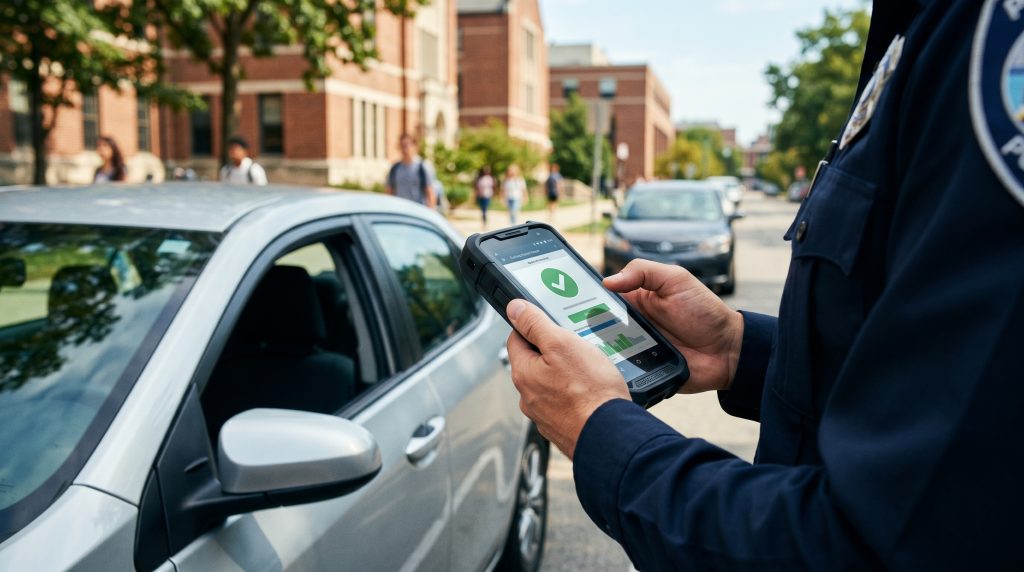
The most critical moment in field enforcement is vehicle validation: checking whether a specific vehicle, in a specific zone, at a specific time, is compliant. In a connected system, this happens in real time. The officer’s handheld device or vehicle-mounted LPR camera queries live permit data the moment a plate is read. A permit purchased twenty minutes ago shows up. An expired permit that was valid yesterday doesn’t.
This is where fragmented systems fail most visibly. Say permit data gets exported each morning and loaded onto handheld devices at the start of shift. Any permit purchased after that export is invisible to field enforcement. The officer issues a ticket. The parker disputes it. The ticket gets voided. Everyone’s time is wasted, and the parker’s trust in the operation takes a hit that’s hard to repair.
3. Violation detection and rule application
Once a vehicle is validated, the system determines whether a violation exists. Permit-based violations are straightforward: the plate either has a valid permit for that zone or it doesn’t. For time-based violations, the system checks the digital chalking record to calculate dwell time. For watchlist violations, meaning vehicles flagged for security reasons, scofflaw holds, or prior enforcement actions, the system surfaces that alert automatically.
The key word is “consistently.” When the system applies the rules instead of individual officers interpreting them, outcomes are predictable and defensible. The same vehicle, in the same situation, gets the same result no matter which officer is on patrol. That’s the same standard the International Parking & Mobility Institute trains enforcement officers toward through its compliance credentialing.
4. Citation issuance and evidence capture
When a violation is confirmed, the officer issues a citation from their device. In OPSCOM’s ViolationAdmin, that citation captures and attaches the plate, vehicle description, violation type, zone, timestamp, GPS coordinates, officer identity, and one or more photographs automatically. The citation appears in the back-office system the moment it’s issued. The payment portal updates in real time.
There’s no batch upload at the end of shift. No manual data entry. No delay between what the officer did in the field and what the administrator sees in the office.
5. Back-office processing and self-service resolution
Once a citation is in the system, the workflow continues without manual intervention. The parker gets a notification with a link to their citation record and the full evidence package. They can pay online immediately, from any device, at any time. If they want to dispute the violation, they submit an appeal through the same portal. The administrator reviewing that appeal sees the complete evidence record without pulling anything from a separate system.
This matters for collection rates more than most operations realize. The Town of Perth, Ontario achieved a 91% ticket collection rate in Year 1 after implementing connected enforcement. The connection is direct: when payment is immediately available and frictionless, most parkers simply pay. Read the Town of Perth case study for the full picture.
6. Escalation and case closure
For violations that go unpaid, a connected system manages escalation automatically. Late fees trigger on schedule. Reminder notifications go out at configured intervals. Universities running Student Information Systems like Banner or PeopleSoft see unpaid violations generate financial holds on student accounts automatically. Ontario municipalities get Notice of Impending Conviction generation and MTO plate denial workflows without administrative follow-up.
Brandon University implemented OPSCOM specifically because their previous system couldn’t tell them why parking revenue had dropped year-over-year. Repeat offenders weren’t tracked, violations lived in spreadsheets, and there was no escalation path. The Brandon University case study shows what visibility into that data actually changed.
Why evidence quality is the hidden factor in enforcement outcomes
Organizations evaluating enforcement systems tend to focus on issuance speed, payment workflows, and reporting capabilities. Those matter. But the factor that most directly determines whether enforcement holds up under scrutiny is evidence quality, and it’s consistently underweighted in purchasing decisions.
A citation that can’t be defended isn’t worth issuing. A parker might dispute a violation by claiming their permit was valid, the zone wasn’t clearly marked, or the time calculation was wrong. The outcome depends entirely on what evidence was captured at the time of the violation.
In a connected system, evidence capture is automatic and comprehensive. The officer doesn’t need to remember to photograph the vehicle; the workflow prompts it. The device records GPS coordinates, not a person. The system generates the timestamp, not a hand. It pulls the permit status at the exact time of the violation from the live permit database and attaches it to the record.
The Village at Valley Forge implemented OPSCOM specifically because their three-strike towing policy was difficult to defend without consistent evidence records. After implementation, towing disputes became far easier to defend, because every citation in the chain had a complete, consistent evidence package. Read the Village at Valley Forge case study.
How automated enforcement looks across different environments
The enforcement workflow stays the same regardless of operational context: validate, detect, issue, evidence, resolve. What changes is the specific rules, integrations, and escalation paths.
University campuses manage a mix of permit zones, visitor areas, loading zones, and accessible parking. Enforcement needs to be consistent without being adversarial to the campus community. Integration with student financial systems routes unpaid violations into the university’s standard financial processes, instead of requiring a separate collections effort. LPR’s ability to validate virtual permits at patrol speed, without physical hangtags that can be shared or stolen, is particularly valuable here. See how higher education parking operations run on OPSCOM.
Municipalities operating under provincial or state enforcement frameworks need court-ready documentation, automated notice generation, and integration with court and collections systems. Ontario municipalities working under the Provincial Offences Act need specific notice workflows, MTO vehicle owner lookup, and Notice of Impending Conviction generation. All of it runs within the same system that handled the original field enforcement. The Town of Smiths Falls and Town of Perth both use OPSCOM for the full POA lifecycle. See how municipal enforcement is managed on the platform.
Property managers typically enforce against unauthorized vehicles and repeat offenders rather than expired permits or time limits. Here, the most important enforcement capability is tracking violation history by plate and escalating consequences systematically. See how property management enforcement works on OPSCOM.
Healthcare campuses face a unique balancing act: enforcing firmly enough to keep accessible and patient drop-off zones available, while staying sensitive to the stress staff and visitors are already under. See how healthcare parking enforcement is managed on OPSCOM.
The reporting picture that connected enforcement produces
Automated enforcement isn’t just better at processing individual violations. It produces a fundamentally different quality of operational data. When every field action gets recorded in real time within a single system, the reporting that emerges reflects what actually happened, not what got manually entered after the fact.
Collection rates by violation type. Compliance rates by zone and time. Patrol coverage efficiency. Repeat offender patterns. Appeal success rates by violation category. This is the data that lets operations teams make decisions about staffing, zone coverage, fee structures, and escalation policies. None of it is available when enforcement data lives in disconnected systems or spreadsheets.
The Parking Data and Analytics Knowledge Center covers this in depth: how unified enforcement data becomes the foundation for operational decision-making, rather than just a record of what happened.
The connection between enforcement and security operations
In many organizations, parking enforcement and security operations run on separate systems with separate reporting. That separation creates gaps that matter operationally.
A vehicle on a security watchlist needs to be visible to enforcement officers during routine patrol, not just to security staff in a separate system. An incident near a parking structure should be documentable in the same system that manages that structure’s permit and enforcement activity. A vehicle involved in a campus safety concern may have a parking history that’s directly relevant to the security investigation.
OPSCOM connects ViolationAdmin and IncidentAdmin within a single platform, so these connections happen without manual coordination between departments. Carleton University’s Department of University Safety built their entire parking, LPR, and incident management operation around this integrated model. Read the Carleton University case study.
Frequently asked questions
What’s the difference between automated enforcement and just using LPR?
LPR automates plate reading. Automated enforcement goes further and connects that read to live permit data, rule application, citation issuance, and back-office resolution, all in one workflow. A system can have LPR cameras and still be fragmented if that data doesn’t flow anywhere automatically.
How does automated enforcement affect appeal and dispute rates?
Disputes drop when evidence is captured automatically and consistently at the moment of violation. Most successful appeals happen because evidence was missing or inconsistent, not because the violation itself was wrong.
Does automated enforcement work for mixed permit and time-limit zones?
Yes. A connected system applies the correct rule set per zone automatically. That’s true whether it’s permit validation, dwell-time calculation from digital chalking, or a combination of both. Officers don’t need to switch tools or manually cross-reference zone rules.
What data does an automated system capture as evidence?
Typically the plate, vehicle description, violation type, zone, timestamp, GPS coordinates, officer identity, and photographs. All of it attaches to the citation automatically at the moment it’s issued.
Explore the enforcement workflow in depth
- How the parking enforcement workflow operates step by step
- The parking citation lifecycle: from issuance to resolution
- How compliance automation drives consistent enforcement decisions
- Officer tools that enable real-time validation and enforcement
- ViolationAdmin: OPSCOM’s parking enforcement platform
- Parking Enforcement Systems Knowledge Center