LPR on Campus: Beyond Permit Enforcement
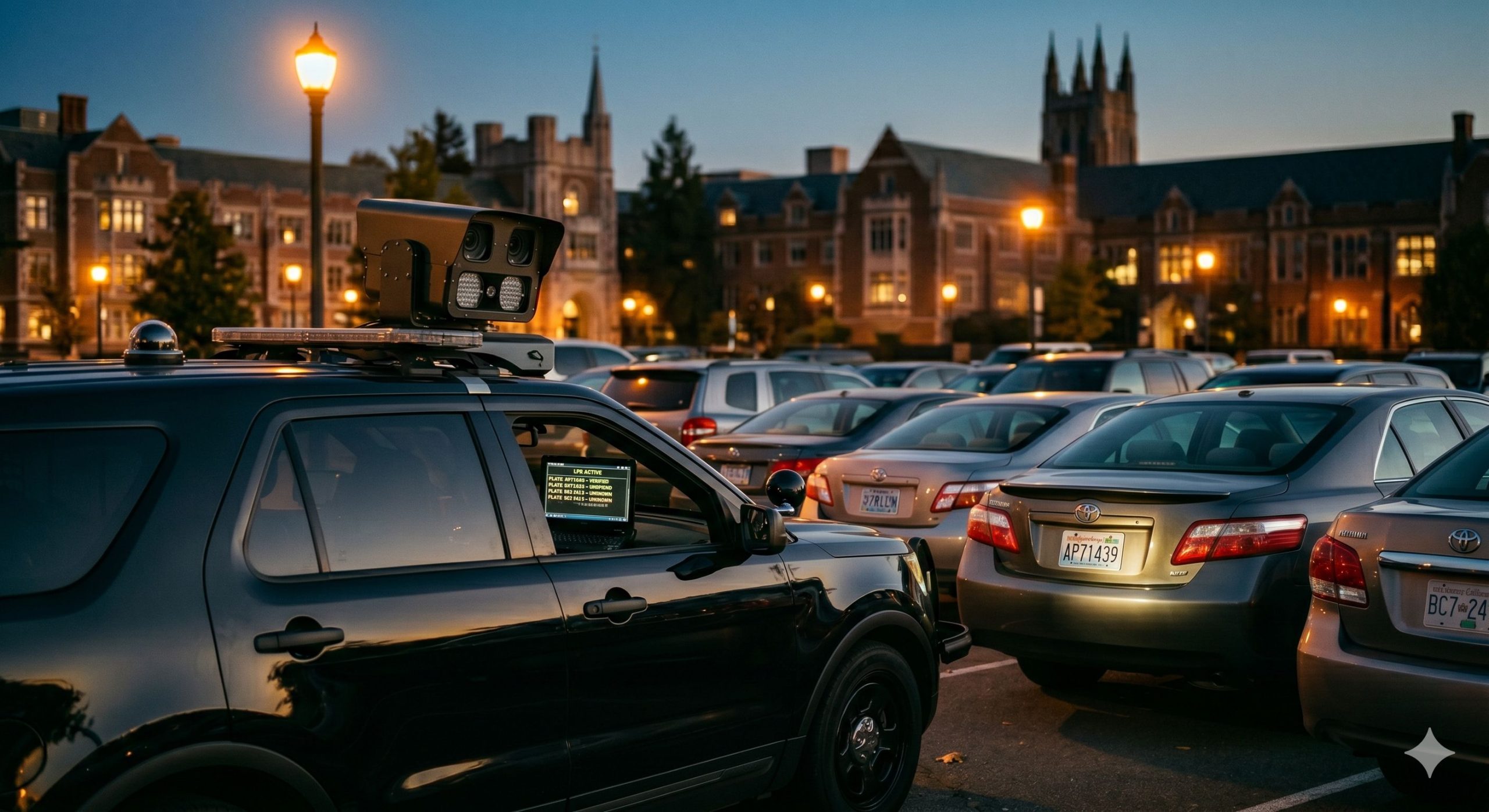
When a campus evaluates LPR, the conversation usually starts — and often ends — with enforcement efficiency. How many plates can an officer scan per hour? How does it handle virtual permits? What’s the ROI against a manual patrol baseline?
Those are legitimate questions with good answers. But they describe roughly half of what campus LPR actually does when it’s properly connected — and the other half is where things get interesting for anyone responsible for campus safety, not just parking.
What enforcement-only LPR looks like
A standalone LPR system reads plates and validates them against a permit database. Officers get a faster, more consistent workflow. Coverage improves. Citation evidence is better documented. The parking operation runs more efficiently.
That’s a legitimate outcome. But in a standalone configuration, the plate read is still essentially a permit check — a binary pass/fail against a list of registered vehicles. The security context of that vehicle doesn’t exist in the system, because the security system is somewhere else entirely.
When a vehicle with a valid parking permit is also associated with an open campus safety investigation, a standalone LPR system sees a green light. A parking officer drives past without any indication that a follow-up call to campus security might have been warranted. The systems never talked to each other, so neither did the people operating them.
On a busy campus with hundreds of enforcement scans per shift, that gap happens quietly and repeatedly — usually without anyone noticing until after the fact.
What changes when LPR connects to security
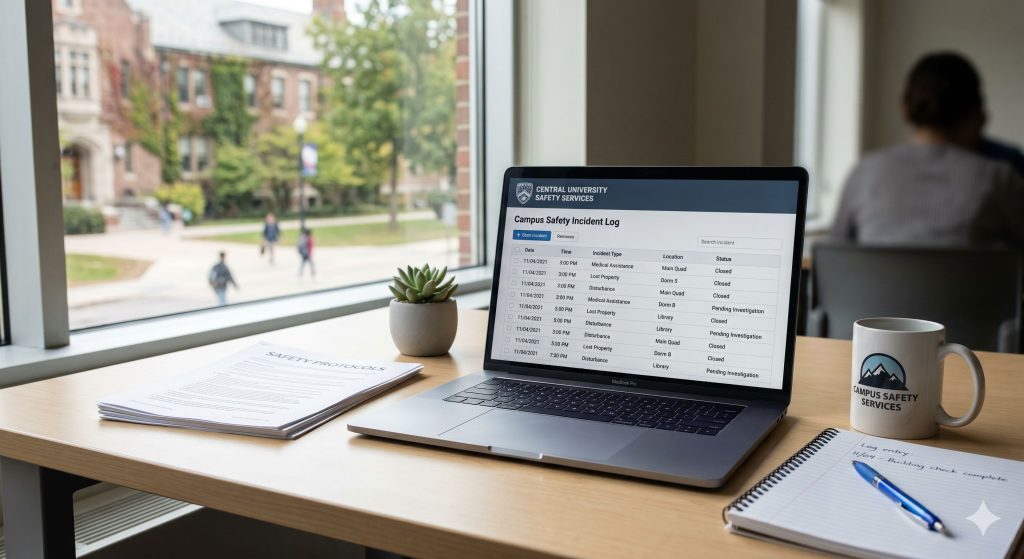
In OPSCOM, PL8RDR and IncidentAdmin share one database. Every plate read — whether from a handheld device, a vehicle-mounted camera, or a fixed installation — is validated simultaneously against permit data and security records.
The officer’s device returns a single result that reflects both. A vehicle with a valid permit and no security flags gets a green result and the patrol moves on. A vehicle flagged on a watchlist — regardless of its permit status — triggers an alert on the officer’s device, through the exact same interface used for permit violations. The officer’s workflow doesn’t change. The information is just there.
IncidentAdmin supports three watchlist alert levels:
- Red alerts — vehicles requiring immediate attention or response
- Yellow alerts — vehicles to be monitored and reported
- Blue alerts — informational notifications for awareness
A vehicle on trespass order gets a red alert. A vehicle associated with an open theft investigation gets a yellow. A vehicle flagged as of general interest to campus safety gets a blue. Officers respond proportionally — the system provides the context, the officer applies the judgment.
LPR scan history as investigative context
The enforcement use case is real-time: officer scans plate, officer receives result, officer acts or moves on. The security use case has an additional dimension that’s often underappreciated — historical scan data.
Every LPR read in OPSCOM is a timestamped, GPS-verified record: this plate, in this location, at this time. Across a busy campus with vehicle-mounted LPR running multiple patrol passes per shift, that accumulates quickly into a detailed record of campus vehicle activity.
When a security incident occurs involving a vehicle — a hit and run in a parking structure, a theft near a surface lot, a suspicious vehicle report — investigators working in IncidentAdmin have immediate access to that vehicle’s complete LPR scan history from within the incident file. Where was the vehicle seen? How often? At what times? Did it appear in proximity to previous incidents?
That context doesn’t require a data request to the parking department. It doesn’t require waiting for someone to pull records from a separate system. It’s already there, connected to the incident record, because parking and security share the same database.
For investigations that involve vehicles the security team didn’t already know about, the scan history works the other way too — a partial description, a general timeframe, a known location can be used to search scan records and identify candidate vehicles that were present and might otherwise have gone unnoticed.
Fixed LPR as a perimeter monitoring layer
Vehicle-mounted and handheld LPR provide coverage during active patrol. Fixed cameras extend that coverage to specific locations around the clock — without requiring patrol activity at those points.
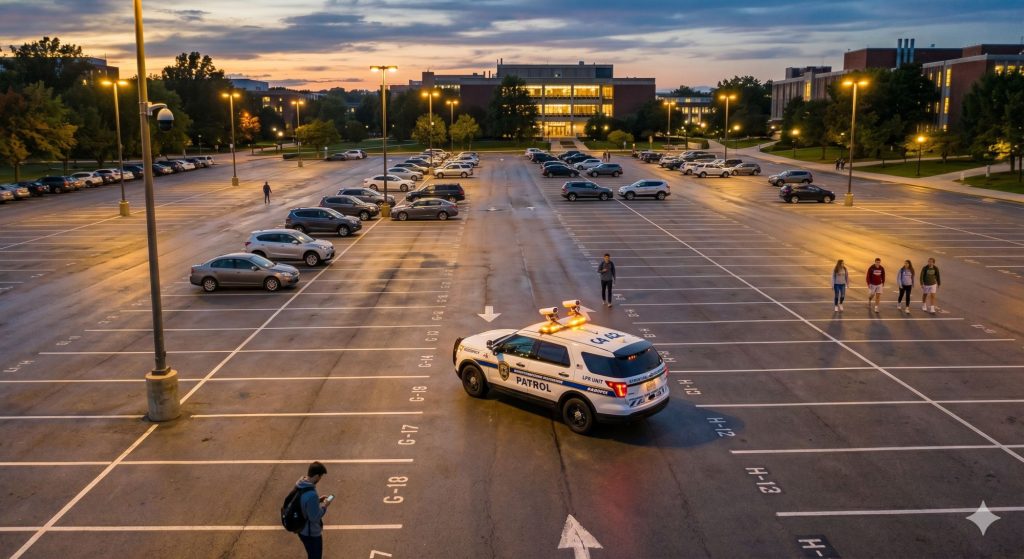
For campus environments, fixed camera placement at lot entrances, parking structure entry points, and perimeter access locations turns those positions into continuous monitoring points. Every vehicle that passes is logged. Watchlist matches trigger immediate alerts. Entry and exit counts provide real-time occupancy data as a byproduct of the security function.
This is the configuration that supports gateless parking alongside perimeter security — vehicles flow freely without queuing at a gate, while the platform tracks every entry, validates every permit, and flags every vehicle of interest without requiring human presence at the access point.
For after-hours monitoring, fixed cameras continue working when patrol staffing is reduced. A vehicle that enters a monitored lot at 2am and matches a watchlist record still generates an alert — delivered to whoever is on call, immediately, without anyone having to be physically present to spot it.
The patrol that does two jobs
The clearest operational expression of connected campus LPR is the enforcement patrol that functions simultaneously as a security check — not because the officer is doing anything different, but because the system is doing more with the same action.
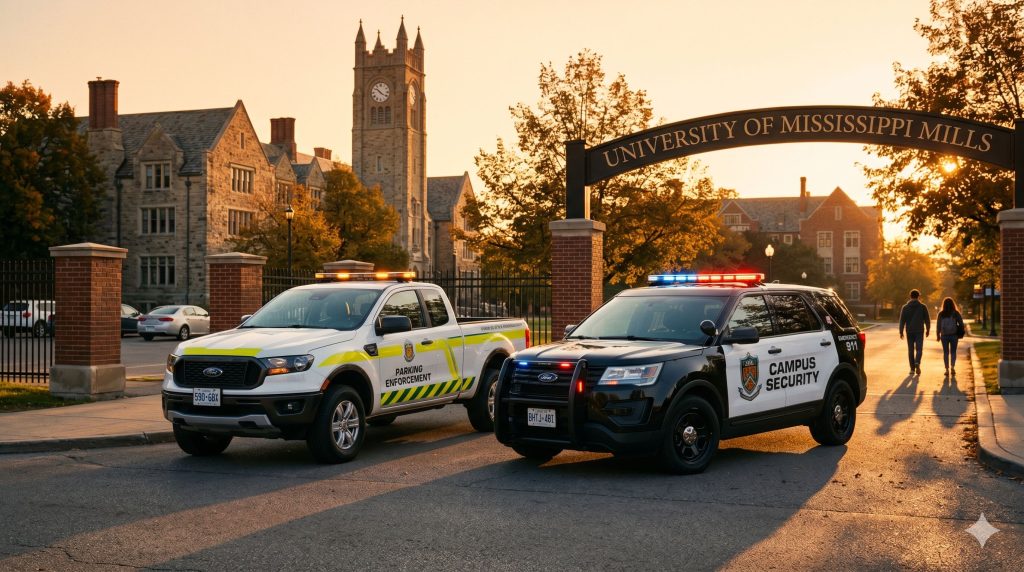
At Carleton University, the Department of University Safety runs parking enforcement and campus security on a unified OPSCOM platform. Enforcement officers patrolling lots for permit violations are simultaneously scanning plates against campus safety watchlists on every pass. BOLO vehicles and security flags surface through the same device interface as permit violations. The officer’s job doesn’t change — the operational output doubles.
That’s not a unique configuration. It’s the standard result of connecting PL8RDR to IncidentAdmin — which is how every OPSCOM campus deployment works. Read the Carleton University case study for the full operational picture.
Privacy and responsible LPR deployment
Campus LPR raises legitimate privacy questions — particularly in Canada, where PIPEDA and provincial privacy frameworks impose obligations on organizations collecting vehicle location data. Collecting plate reads that don’t result in enforcement or security action, retaining that data indefinitely, and providing broad access to scan records are all practices that deserve scrutiny.
PL8RDR is built with configurable data retention periods, role-based access controls, and audit trails that support responsible deployment. Plate reads that don’t result in enforcement actions don’t need to be retained indefinitely — and OPSCOM’s retention settings can reflect that. Security watchlist access and LPR scan history are available to personnel with a legitimate operational need, not the entire organization.
For institutions navigating privacy requirements alongside security objectives, those controls matter. The goal isn’t maximum data collection — it’s operationally useful, appropriately governed vehicle awareness that serves both the parking operation and the campus safety mandate.
LPR as part of the campus security picture
Campus security operates across multiple layers — building access, camera systems, emergency communications, officer presence, and environmental design. LPR connected to incident management adds a vehicle-awareness layer that most of those systems don’t provide: real-time identification of specific vehicles of interest, combined with a historical record of campus vehicle activity that can be searched when incidents require it.
That layer doesn’t require dedicated security hardware beyond what a parking operation would deploy anyway. It doesn’t require separate staffing. It runs on the same patrol that validates permits, connected to the same platform that manages incidents.
The enforcement ROI case for campus LPR is solid and well-documented. The security ROI case — fewer incidents going uninvestigated, faster vehicle identification when incidents occur, perimeter monitoring without additional staffing — is less often quantified but arguably more significant.
Learn more about how LPR fits into the broader campus security picture in the Campus Security Operations Knowledge Center, or explore how PL8RDR works across handheld, vehicle-mounted, and fixed camera deployments.
Related reading
- Campus Parking as a Security Layer: It Starts in the Lot
- Campus Security Operations — Knowledge Center
- License Plate Recognition — Knowledge Center
- LPR in Parking Enforcement Operations: How Patrols Actually Work
- OPSCOM for Higher Education
- Carleton University Case Study